English
 Español
 Français
 Deutsch
 Italiano
 Português
The air changes somewhere past the Karnali Bridge at Chisapani. The humidity of the Terai starts to carry a different scent—a mix of damp earth, ripening grass, and the faint, resinous perfume of the Sal forest. Entering Bardiya isn't just about crossing a provincial line; it’s about stepping into a region that, for a long time, the world forgot. This is "Naya Muluk"—the New Country—and as I gather my gear for this expedition, it feels less like a park visit and more like a return to the source of the wild.
The approach: from the hills to the horizon
The most common entry point is Thakurdwara. Arriving here, I realise immediately that this isn't the bustling tourist hub of Sauraha. It’s a quiet village where the houses are still mostly made of traditional mud and timber, and the pace of life is dictated by the sun and the seasons. As I sit in a small local eatery near the park gate, sipping tea and checking my maps, the local talk isn't about the stock market; it’s about where the "Big Male" tiger was seen crossing the road last night.
To understand what I’m looking at, I have to look at the map of the park as a living organism. Bardiya isn't just a flat patch of jungle. It’s a complex system of three distinct zones that I need to explore.
Approximately 70% of the park is dominated by Sal (Shorea robusta). Walking through these woods feels like being in a natural cathedral. The trees are tall, straight, and silver-barked. In the dry season, the ground is carpeted in crunchy, copper-coloured leaves, making a "silent" approach nearly impossible. In the monsoon, the canopy becomes an impenetrable emerald roof.
The riverine forests and the Phantas (open grasslands) are where the action happens. The Phantas are the lungs of the park. These are massive clearings where the "elephant grass" grows up to four metres high. For a traveller, this is both beautiful and terrifying—I could be five metres away from a rhino and never see it until the grass moves.
To the west, the Karnali River—Nepal’s longest—splits into two. The eastern branch is the Geruwa, and this is the lifeblood of the park’s western sector. The islands formed between these branches are prime territory for wild elephants and tigers seeking a midday soak.
I’ve gathered my field guides and checked the recent sightings board. In Bardiya, we don’t talk about "seeing animals"; we talk about "tracking" them. The goal is the Terai’s Big Five.
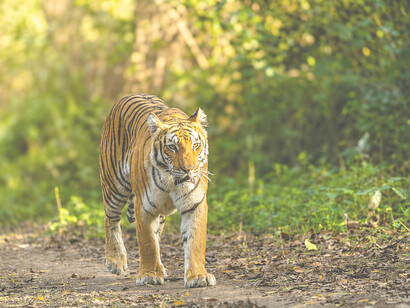
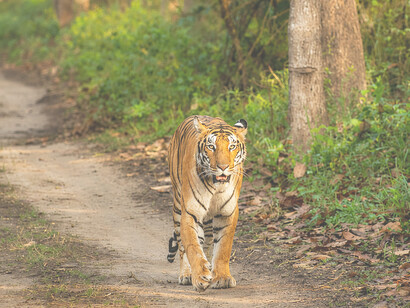
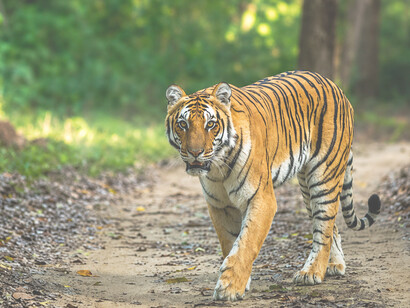
The royal Bengal tiger: the ghost of the grass
The population here has exploded. From a handful of individuals a decade ago, we are now looking at over 125 tigers. But don’t let the numbers fool you; they are masters of camouflage.
Strategy: I’m focusing on the "Kingfisher" and "Tinkuni" areas. These are spots where the forest meets the river. The tiger is a creature of habit. If he killed a deer yesterday, he will be near water today.
The soundscape: I’m listening for the "alarm calls". The barking deer has a sharp, metallic yelp; the langur monkey has a guttural cough. When the jungle goes silent, or these calls erupt, the king is moving.
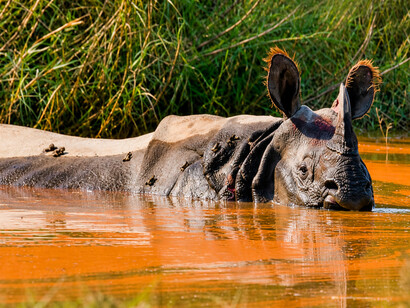
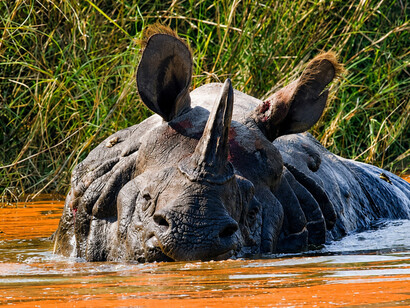
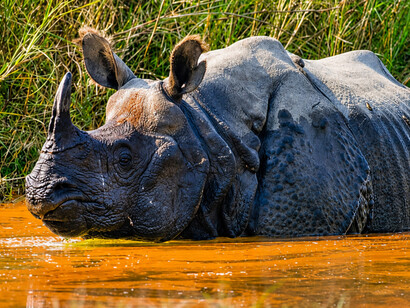
The greater one-horned rhinoceros: the prehistoric tank
Unlike Chitwan, where rhinos are everywhere, in Bardiya, they are more concentrated in the floodplain. Seeing one here feels more earned. They are solitary, grumpy, and magnificent.
- Safety note: I’ve been told that if a rhino charges, I don't run in a straight line. I climb a tree or run in a zigzag. It’s a bit of information I hope to never put to the test.
The Asiatic elephant: the nomads
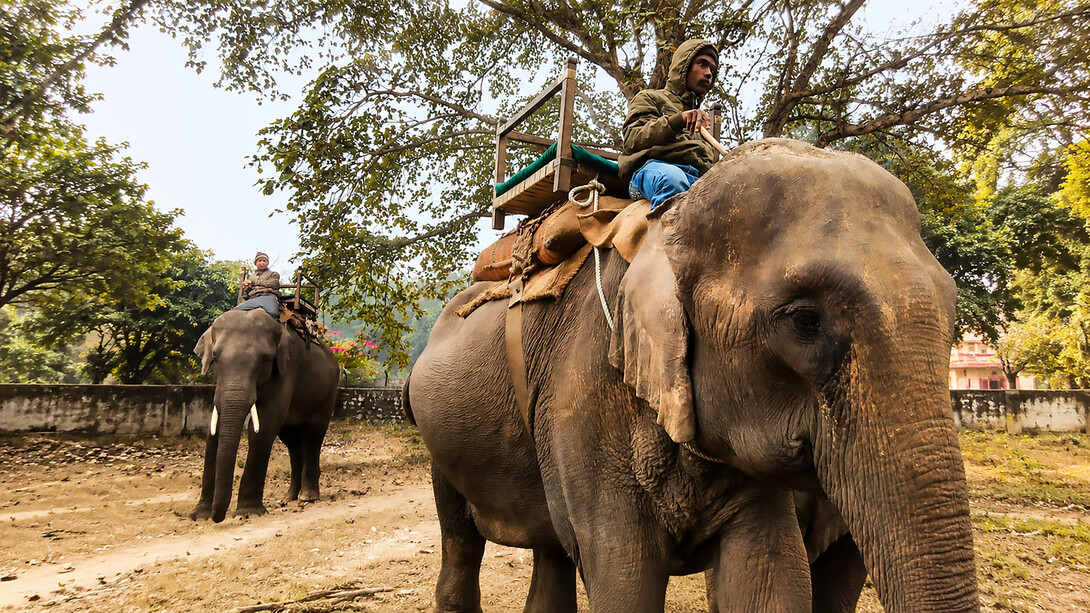
Bardiya is famous for its "Giant Bulls". These aren't resident elephants; they are travellers that move between the Dudhwa National Park in India and Bardiya. The legendary "Rajagaj" was the king here for years. Today, his descendants move through the park like silent grey clouds. Finding their fresh dung—boluses the size of footballs—is usually the first sign that a herd is nearby.
The Swamp deer (Barasingha)
If I want to see these, I have to go to the Babai Valley. They are the most elegant of the deer species, with antlers that branch into 12 points. They prefer the marshy edges of the Phantas.
The Gangetic dolphin
This is the wild card. I’ll need to head to the Chisapani Bridge or take a raft down the Geruwa. These are freshwater dolphins, nearly blind, navigating the silt-heavy waters using sonar. Seeing a dorsal fin break the surface of the Karnali is the ultimate "check" on the list.
The Babai Valley: the forbidden kingdom
As I gather information from the park rangers, one name keeps coming up: Babai.
Accessing the Babai Valley is the "Advanced Level" of a Bardiya expedition. It was closed for years due to insurgency and conservation efforts. It’s a rewilded paradise. There are no villages, no lodges, and no cell service. It’s just me, a jeep, and the most pristine wilderness in Nepal.
The valley follows the Babai River, flanked by the Churia Hills. It’s a predator’s playground. Because human interference is so low, the animals here are "bolder". Tigers can sometimes be seen lounging on the sandbanks in broad daylight. It requires a full-day permit and a dedicated jeep, but from everything I’ve gathered, it is the soul of the park.
The cultural fabric: the Tharu connection
I can’t understand the park without understanding the Tharu people. As I walk through the buffer zone villages, the architecture tells a story of adaptation. The Tharu houses are traditionally made of "wattle and daub"—mud, clay, and straw—which keeps them cool in the 40°C heat.
The Tharu are the "People of the Water and Forest". For generations, they lived in these malarial jungles where others couldn't survive. Their culture is a masterclass in sustainable gastronomy and living.
The food: I’m looking for Ghonghi (water snails) cooked with local spices and Siddhara (dried fish mashed with taro). It’s a diet pulled directly from the rivers and fields.
Social gastronomy: many of the lodges here are now moving toward a "farm-to-table" model, sourcing 100% of their produce from the local Tharu farmers in the buffer zone. This creates a circular economy—if the farmers benefit from the park, they protect the tigers.
Before I step into the jungle, I’m double-checking my kit. Bardiya is unforgiving to the unprepared.
Binoculars: I’ve opted for 10x42s. I need the light-gathering capability for the dense Sal forest.
Camera: a long lens (at least 400mm) is essential. Tigers here are often spotted across the river, not right next to the jeep.
The "Invisible" rule: no whites, no reds, no bright blues. If I want to see wildlife, I have to look like the forest. Khaki, olive drab, and dark browns are the only options.
Protection: even in the heat, long sleeves and trousers are better to protect against the "wait-a-bit" thorns and the occasional leech in the wetter months.
Jeep safari: good for covering distance and getting into the Babai Valley.
The jungle walk: this is the Bardiya speciality. Walking with two guides (one in front, one in back) is the most visceral way to experience the park. I learn to read the "newspapers of the jungle"—the tracks in the dust.
Biking/Motorcycling: While I can’t ride inside the core zone, the buffer zone roads and the ride from Nepalgunj to Thakurdwara are incredible. The road from Chisapani, with the Karnali on one side and the hills on the other, is a dream for any rider.
In my conversations with the local conservationists, a new theme emerges: the cost of success.
Bardiya is a global success story. We’ve doubled the tiger population. But the buffer zone is now a front line. As a traveller, I see the beautiful tigers; as a local, they see a predator that might take their goat or, worse, a family member.
The "Bardiya Model" of 2026 involves:
Community-managed forests: locals get a say in how the forest is used.
Predator-Proof Pens: subsidised housing for livestock to reduce conflict.
Eco-Tourism Revenue: 50% of the park entry fees go back into village development.
This social entrepreneurship is what keeps the park alive. When I pay my entry fee, I’m not just buying a ticket; I’m funding a school or a health post in the Tharu community.
I’m timing my visits based on specific goals:
The "Tiger Peak" (March to May): This is when the water holes dry up. If I sit at a "machan" (watchtower) long enough, the tiger must come to me. It’s hot (sometimes 42°C), but it’s the best time for sightings.
The Birding Window (November to February): The migratory birds from Siberia arrive. The weather is perfect for long walks, though the morning fog can be thick.
The Lush Season (October): Right after the monsoon. The air is crystal clear, and the mountains are visible in the distance, but the tall grass makes spotting tigers a game of extreme luck.
As someone who appreciates the "hub and spoke" of food logistics, seeing how these remote lodges manage their supply chains is fascinating.
In Thakurdwara, there’s no massive cold storage. Everything is fresh. The "Social Enterprise" aspect of the kitchens here is impressive. They use local varieties of rice like Anadi, and the poultry are all "local chicken"—leaner and tougher but far more flavourful than industrial broilers.
There is a movement here toward social gastronomy—training Tharus in professional hospitality standards while keeping the traditional recipes alive. It’s a perfect blend of high-end service and authentic roots.
I’ve learned the hard way that the jungle doesn't care about its schedule.
Silence is currency: the quieter I am, the more I see. This applies to the Jeep engine and its own voice.
No plastic: This is a zero-waste zone. Everything I pack in, I pack out.
Respect the space: if a tiger looks annoyed, I back off. We are the guests in their living room.
Final reflection: the soul of the West
As I sit on the banks of the Geruwa River at sunset, watching the water turn to liquid gold, I realise why Bardiya is so special. It’s not just the tigers or the rhinos. It’s the sense of scale.
In Chitwan, I feel the presence of the city just outside the gates. In Bardiya, i feel the presence of the Himalayas to the north and the vastness of India to the south. It feels like a true wilderness—one of the last places on earth where the wild isn't just a "park," but a way of life.
Whether I’m tracking a pugmark on a dusty trail, sharing a meal with a Tharu family, or simply listening to the wind in the Sal trees, Bardiya offers something rare: a chance to disappear. It’s a place that requires patience, respect, and a bit of grit. But for those willing to make the journey to the far west, the rewards are written in the shadows of the forest and the roar of the Karnali.
Bardiya isn't a place I just "visit". It’s a place I inhabit. Every track in the mud and every rustle in the grass is a story waiting to be told. I’ve gathered my information; now, the forest will provide the rest.
Logistics: Plan for at least 3-4 days. One day is never enough.
Health: High-SPF sunscreen and mosquito repellent are non-negotiable.
Mindset: Come for the tiger, but stay for the silence.
The wild is calling. It’s time to move.