English
 Español
 Français
 Deutsch
 Italiano
 Português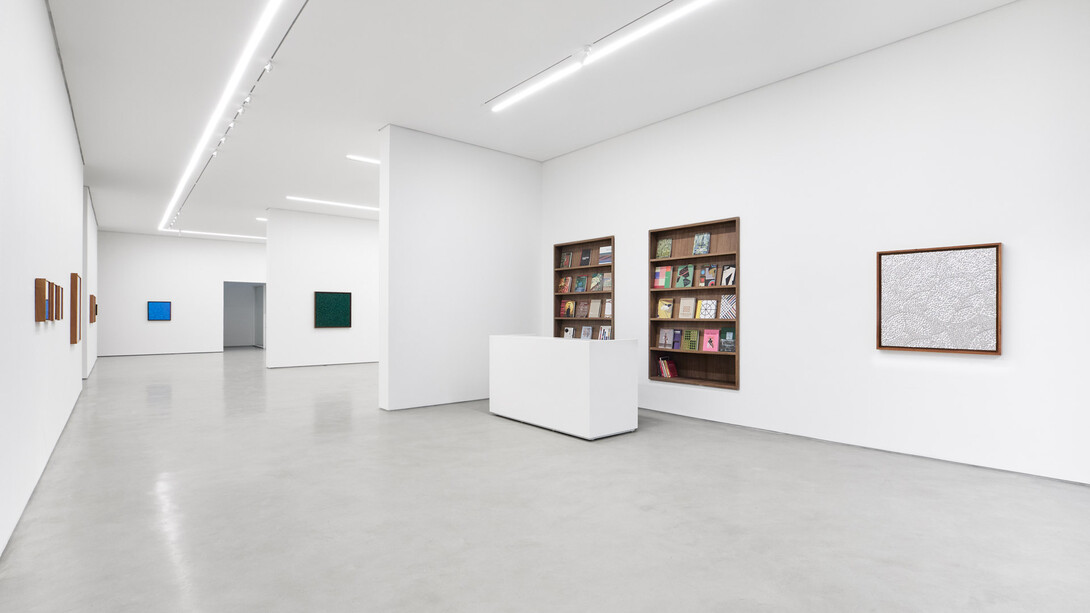
Repetition repetition – until it is different
Repetition is a gift of style(Manoel de Barros. O livro das ignorãças)
There are many similarities between the fields of art and science. Artists and scientists are researchers, curious to discover new mediums, methods, materials, and procedures. Laboratories and studios are also similar, dedicated spaces sometimes occupied in solitude, sometimes by teams in collective productions. But there is a radical difference in their processes: one of the main premises of the scientific method states that an experiment, performed multiple times under the same conditions, should always lead to the same result. However, in the field of art, this is a postulate that doesn’t hold up. It is through repetition, often under similar conditions – in the same studio, with the same materials – that artists find new visual and conceptual paths in their investigations. If, in science, repetition leads to the confirmation of a hypothesis, in art, it leads to innovation.
Gabriel de la Mora's work is perhaps one of the greatest examples of the infinite possibilities that a single artistic approach can provoke. Since the mid-1990s, the artist has employed unusual, symbolically charged materials to create works that visually operate within traditional categories such as drawing or painting, yet completely depart from the forms expected for these media. From strands of hair to bird feathers, from plaster to banknotes, from erased scribbles to the lint from the eraser used to capture the drawing on paper, from punctured shoe soles to discarded speakers, everything is subject to the artist's gesture of appropriation and transformation.
In the studio, procedures are established and systematically repeated. Each type of material is fragmented and then separated by color, size, quality, weight, and shape. These fragments are manipulated following drawings and sketches that make each composition unique. The studio assistants use manual counters during the production of the works, recording the number of fragments in each piece, usually indicated in the work’s title.
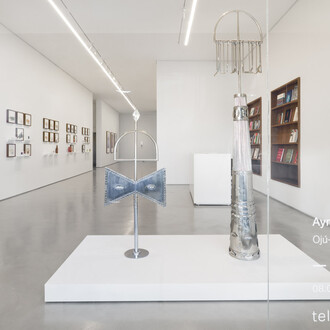
In the series Entre lo que reflejo y veo, broken Christmas ornaments gain new life as shattered surfaces, with each shard of glass reflecting the space, objects, and people facing the work. The concave and convex shapes distort the reflections, inverting or stretching them, and the almost infinitely repeated mirror image generates fluctuations in the perception of depth and movement. Initially read as monochromatic, these works are in fact chameleonic, taking on the colors of their surroundings in their own reflection; similar to each other, they are unique in their proportions, rhythms, and designs.
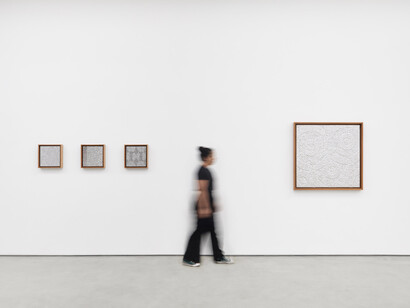
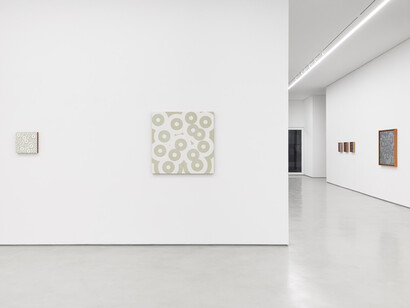
Gabriel de la Mora also frequently uses organic materials, embracing nature as a kind of collaborator in his work. Operating within the same logic as glass shards, but with completely different results, the "CaCO3" series, for example, is created using eggshells from different species. The shards are separated by color, following a pictorial logic. Their meticulous placement on the wooden base leaves no room for empty spaces or overlaps, in a puzzle game of imperfect precision. At first glance simple and monochromatic, these works are extremely intricate, revealing the infinity of shades of white that nature itself produces.
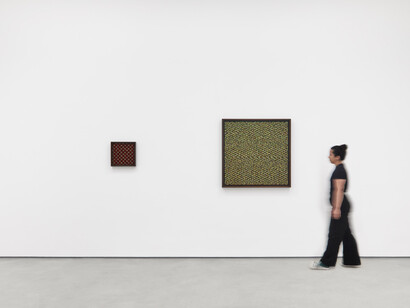
And just like eggshells, everything that comes from nature and repeats itself is the same, yet different. Bird feathers have been a recurring material in the artist's practice since 2018. By cutting small areas of the feathers and painting them solid colors, he creates mosaic-like compositions, regular in cross-section but irregular in their structure and surface. The geometric patterns of butterfly wings (purchased from various conservation projects for endangered species of the insect) vary by the millimeter, even though they are read as entirely identical. De la Mora not only appropriates the wings but also manipulates them, sometimes creating more geometric grids, sometimes patterns that follow the wing designs, on just one or both sides (evoking eyes or camouflaging leaves and trunks).
Last but not least, there are works using obsidian rock, a material that results from the rapid cooling of volcanic magma – here too, nature acts as a co-author. These works require a technical care that is dear to de la Mora's practice. Fine flakes of stone are broken and polished or ground, resulting in opaque or reflective textures, and their combinations on the surface of the works create areas of depth and volume. But there is also a mystical aspect to these works. The use of obsidian is marked by the symbolic meaning associated with the volcanic rock – some say it repels negativity, while others consider it the stone of justice, and it is widely used in meditation or alternative therapies. The mineral is quite common in Mexico, where its use (ritualistically, as a bartering material, and even as a tool and a weapon) dates back to 600 AD. All this historical and allegorical baggage is echoed in the adoption of this element, recently added to the list of materials appropriated by the artist in his tireless practice of repeating to make something different.
(Text by Julia Lima)