English
 Español
 Français
 Deutsch
 Italiano
 Português
We are managing the digital revolution challenges with century-old politics and 19th-century invisible hand economics. With the deep transformation of the technological and economic infrastructure, we must update the social, political, and cultural superstructure. Technology runs ahead, in a regulatory void, while political and institutional updating crawls along.
In material terms, our societies are already rich enough to provide the conditions for good and flourishing lives for all.
(Tom Malleson, Against Inequality, 2023)1
Can we shift how we interpret reality, or get aware that we are looking at the world through colored glasses that keep us from seeing how things have changed? For things did change, and what is more important, they are changing at an accelerated rhythm. It is not just a new situation we are facing, it is a transformation process. We do all feel amazed at the speed, we have moved so fast from giant computers to laptops, to cellphones, to the internet, to smartphones and presently to data centers and artificial intelligence in a globally connected world.
When Demis Hassabis declares the digital revolution is at least ten times deeper than the industrial revolution two centuries ago, and much faster, it is realistic. We are in the midst of a chaotic and extremely accelerated process of structural transformation. The corresponding institutions and regulatory frameworks are just being discussed. We are good at creating committees.
When I suggest it is time to change our glasses, it is because we are still stuck in the political colors they represent, the ideological shadows inherited from the 19th century, when the challenges we face—explosive inequality, environmental tragedies, and financial and political chaos—demand that we step up our worldview and concentrate on the most obvious and most threatening issues. The major shift that we need is not more growth, at any cost, more GDP, and more jobs, thus justifying the chaotic running ahead with anything that generates more money. These are stale narratives. We need governance change.
As Tom Malleson writes in the sentence I quote above, “We are already rich enough”. Sam Altman writes that the coming AI revolution would “generate enough wealth for everyone to have what they need, if we as a society manage it responsibly”, which means that “economic inclusivity matters because it’s fair, produces a stable society, and can create the largest slices of pie for the most people.”2 So even Sam Altman got it, but OpenAI follows the profit-maximizing ruthless flow, including collaboration with US surveillance agencies.
Tim Berners-Lee updates the evolution of the internet: “We let social media companies manage data for us, surveilling us and turning us into bundled products for advertising. This is what gives them the incentive to build these manipulative algorithms.”3 So here we are, with sufficient riches, enormous technological capacities, and their misuse for wealth concentration, violence, and overall manipulation. Hoping that “free markets” and the “invisible hand” will fix this is just stupid. We must get organized for the common good.
The UBS Global Wealth Report 2025 figures are sobering, and we must pay attention, particularly at the very top: “We count 2,891 USD billionaires in our sample as of the end of 2024, a small increase over the year before. The vast majority of these have a fortune between USD 1 and 49 billion. Only 31 individuals in our entire sample rank above the USD 50 billion mark.”
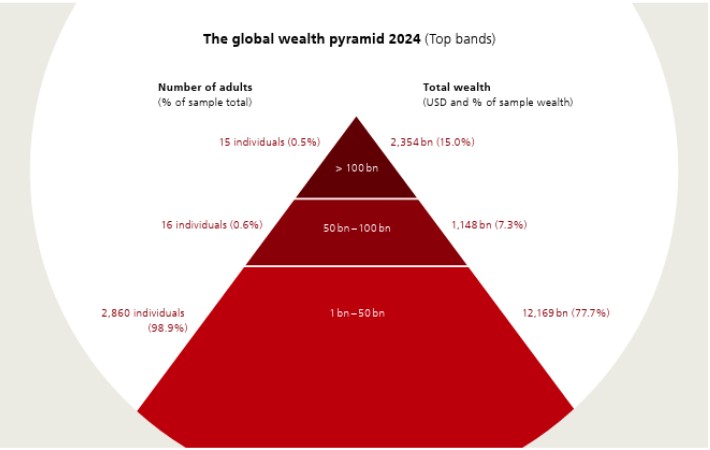
Source: UBS – Global Wealth Report 2025 – p.23.
If we take the 15 individuals at the very top, they have $2.4 trillion accumulated wealth. The UBS Report also shows that this is practically the same as the total wealth of the bottom 40.7% of the world adult population, with a comparable $2.7 trillion (p. 22). We are witnessing an explosion of wealth at the extreme top of the pyramid. This is not just about the rich and poor but about a radically more powerful appropriation of wealth in very few hands, based on control of communication, information, and finance, this last item is also basically an information item.
The digital revolution's economics are just different. This is not about “free markets”, it is about power and control, intermediation of practically any activity, and a global financial drain. Henry Ford did get rich, but he had to generate jobs, produce cars, and pay taxes. This was industrial capitalism. Kindly put the lights on or adjust your glasses. I am not quoting Marx, I am quoting Union des Banques Suisses, which by the way has “gestion de fortunes” as its core activity. Ha-Joon Chang has it right: “Our financial system has become a negative force”.4
Let me sketch the parts of this new economic and political system, characterizing the digital revolution. The basic change is in the technical infrastructure. In the feudal times, agricultural soil was the basic mean of production. With the industrial revolution, energy, machinery, and factories became the key sources of enrichment, factors of production. Agricultural activities did not cease being important, but the overall social structure was organized around industry.
The present technical infrastructure evolved to what André Gorz called “L’immatériel,” which we can call the waves, connecting instantly the whole world with information and money through the connectivity infrastructure. These “waves”, whether photons or others, belong to nature, and it is magic that I can in seconds have access to a paper or information from any part of the world. Agriculture and industry are still important, but the restructuring force of society presently belongs to the overall immaterial control. At the center of the game are not the factories any more, but the digital platforms. At the very top of the wealth pyramid seen above, we have digital systemic middlemen with profit-maximizing algorithms.
We were taught that “free markets” are the key invisible organizers of economic activity, since those who will come up on top are those who bring to the market the best and cheapest products, the best value equivalent. Pfizer marketed Paxlovid, a drug to cure Covid, at $1,390, while Harvard research showed the production costs were around $13 per course. If your kid is in danger, you will clean out your drawers or your bank account. The algorithms in the corporation will calculate the profit-maximizing price, and the extended patents—20 years, plus 20 with some “greening”—will keep the virtual monopoly situation.
The basic argument here is that even if markets do function in many sectors, particularly for small-scale local producers, overall the algorithms rule the waves, maximizing profits, whatever the social or environmental costs. Big pharma is just an example; big banking is much more powerful, not to speak of the social media oligopoly. AI is now coming on top. These are not islands, it is a system and directly connected to the traditional productive activities.
What makes these changes possible is the transformation of the corporate decision process. When a corporation goes public, the absentee owners take over. I use the Samarco environmental tragedy as an example: a major mining company in Brazil, seeing the contaminated dam was leaking, just hoped for the best. If it had belonged to a private owner, a “capitalist”, he would have invested in fixing the leak. But the global Billiton mining corporation, a major stakeholder, refused the corresponding reduction in dividends. The result was that the dam collapsed, with huge human and environmental costs. Absentee owners’ logic.
Ironically, another big ensuing business now is the lawyers’ corporation negotiating the compensations. We may also use the example of the BP disaster in the Gulf of Mexico, the Volkswagen emission frauds, the Euribor scandal involving the major global banks and so many dramas based on a simple transformation: the absentee owners, distant stockholders or their financial management companies, and profit-maximizing algorithms. We do have some financial settlements, with no guilt or imprisonments. Who paid for the 2007-2008 financial speculation crisis? Responsibility is just diluted in the “too big to fail” and “too big to jail” system.
So far, we have seen that platforms have taken control over industry, algorithms rule where we had markets, and absentee owners have taken over what were the traditional capitalists. A resulting key transformation is that social surplus is appropriated in a different way. We always had minorities living off others’ productive contribution, but the fortunes seen above radically changed the scale at the top. Henry Ford is an example of industrial capitalism, but we must also remember the Robber Barons and the Third World dramas. In the present dominant digital revolution, profits on productive activities have been taken over by unproductive rentierism.
Brett Christophers calls our system Rentier Capitalism.5 As major rent extraction mechanisms, he lists “seven core asset types”, financial intermediation, natural resource reserves, intellectual property, digital platforms, service contracts, infrastructure privatization, and landholdings. Peter Phillips details the asset management corporations, such as BlackRock, State Street, Vanguard, Fidelity, UBS, JPMorgan, and others: In 2022, the top 10 managed $50 trillion, when world GDP was $100 trillion. This is the scale. BlackRock manages $14 trillion in 2026, compared to the $7 trillion US federal budget managed by Donald Trump.6
We have seen the Billiton example for natural resource reserves. Intellectual property is particularly interesting: knowledge can be posted online and made available to everyone with practically zero cost, as Jeremy Rifkin shows in his The Zero Marginal Cost Society,7 while so many strive to make it difficult through absurdly long copyrights.
The essential fact is that global world-scale control of immaterial flows, the so-called tollbooth economy, allows for the extraction of the immense fortunes. The material economy subsists, but the value extraction mechanisms have become essentially through intermediation. If I have a coffee in a bar here in São Paulo and pay with Visa, roughly 5% of what I am paying goes to the Visa financial intermediary, which has as its major “investors”, you guessed it, Vanguard, BlackRock, etc. I find BlackRock in practically all major firms in Brazil, such as the Banco Itaú, Banco Bradesco, Eletrobrás, and so forth. Information, which is what these corporations deal with, flows instantaneously around the globe at virtually no cost, but it costs us dearly with the intermediation profits incorporated into the prices we pay.
We do feel helpless, or impotent, in the face of so many changes at such an accelerated pace, and an important factor of the overall chaos is that the information and financial flows roam the planet in seconds, generating a different instantaneous globalization, while 200 countries in the world try to manage the challenges within their borders: a dominant global set of flows, while the policies are national. The global regulation institutions, linked to the UN and other Bretton Woods structures, belong to another age, over 80 years ago, and are basically toothless. The ensuing chaos we presently face has structural roots, and if Trump and his billionaire supporters seek to maximize absurd advantages, fragmented opposition in so many countries generates little negotiating space.
How do we manage to face this scale of challenges? The way I see it, the future is not promising, to say the least. But an essential reorientation of our understanding is that building a society that is economically viable but also socially fair and environmentally sustainable, the triple bottom line, depends on interventions in the corporate decision process and rescuing the public policy-building capacity; climate change is a global drama, but the financial system that supports dirty energy is at the center of the gears.
Simple and obvious policies like the 2% tax on fortunes proposed by Gabriel Zucman have the advantage of gradually gaining political space, and they do have great potential. Launching global policies to face the most shocking dramas like the 150 million stunted children in the world could generate synergy for the necessary political reorientation of our economies: emotions are essential. Tiny changes, as compared to the structural challenges, but we must start moving. The fact is that we are presently on the threshold of systemic changes in how humanity governs itself as the “slow-motion catastrophe” deepens. And the headwinds are powerful, particularly since political and social chaos tends to bring scum to the top.
Notes
1 Tom Malleson – Against Inequality: The Practical and Ethical Case for Abolishing the Superrich – Oxford University Press, New York, 2023, p. 122.
2 Sebastian Mallaby – The Infinity Machine: Demis Hassabis, DeepMind, and the Quest for Superintelligence – Penguin Press, New York, 2026, p. 291.
3 Tim Berners-Lee – This Is for Everyone: The Unfinished Story of the World Wide Web – Farrar, Straus and Giroux, New York, 2025, p. 298.
4 Ha-Joon Chang – Economics: The User's Guide – Pelican Books, London, 2014, p. 311.
5 Brett Christophers – Rentier Capitalism: Who Owns the Economy and Who Pays for It? – Verso, London, 2020. See also L. Dowbor – The Age of Unproductive Capital – Cambridge Scholars, Cambridge, 2018.
6 Peter Phillips – Titans of Capital: How Concentrated Wealth Threatens Humanity – The Censored Press, Fair Oaks, Canada, 2024.
7 Jeremy Rifkin – The Zero Marginal Cost Society – Palgrave Macmillan, New York, 2015.