English
 Español
 Français
 Deutsch
 Italiano
 Português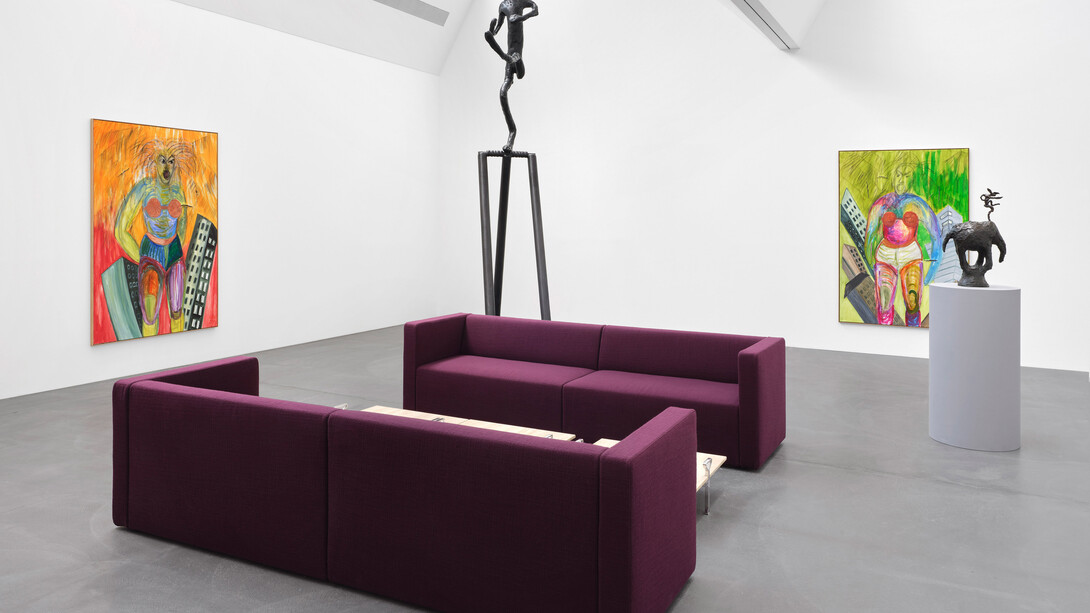
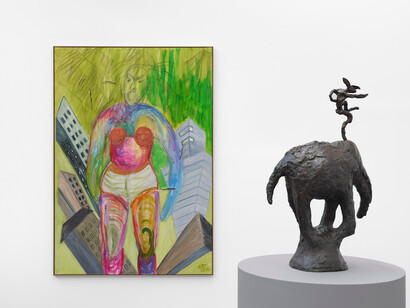
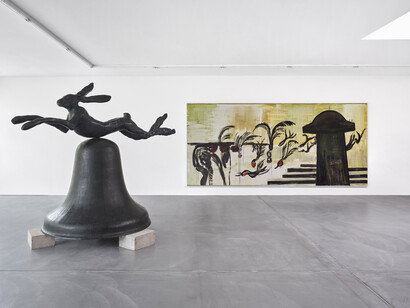
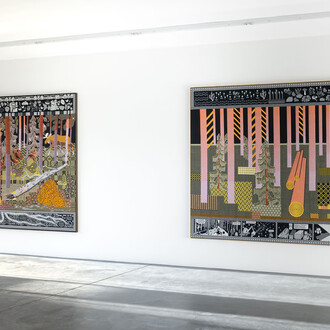
Although Barry Flanagan (1941–2009) and Ursula Reuter Christiansen (b. 1943) never crossed paths, their works come together in the exhibition, Fable and form. Here, they have much to tell one another, and to us. Throughout the exhibition, encounters emerge between works that could have originated from the same realm or story, as both artists share a fondness for narrative works populated by impressive, wild, and sometimes conflicting protagonists, whether human or animal. In the front part of the exhibition, Reuter Christiansen’s large painting The reservoir of evil conjures a scene inhabited by supernatural, bird-like figures. Circling a dark, moldering tower, their shadows (Danish: skygger) seem to drive away the hare perched on the tower bell by Barry Flanagan (Harebell on Portland stone piers). Its loyal companion, a Large Podenco hound, is leading the way.
A little further back, framed drawings that Reuter Christiansen made at the age of seventeen, reveal the imagination and ingenuity of the German-born, Danish artist. Meticulously filled to the edges with details and characters from a haunting world where mythical creatures wreak their mischief, these works on paper invite closer inspection. As though one of these beings had escaped the illustrations and entered the exhibition space, Flanagan’s Lament rears up nearby. Its twisted upper body makes the hare-like figure appear to move forward and backward, as if it wanted to both embrace and frighten us at once.
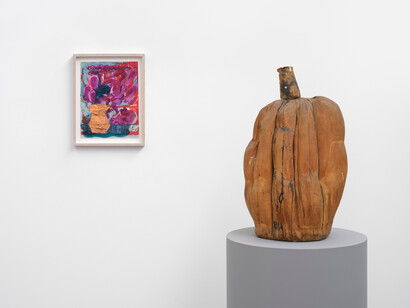
The second part of the exhibition presents further highlights from the careers of the two artists. Alongside the oversized cricket-playing hare, attention is also drawn to a work that demonstrates that Irish-Welsh Flanagan created sculptural pieces beyond his classic bronze casts. Evidence of this is pdreeoo, a withered fruit formed from plaster and cloth. Hanging in close proximity is Reuter Christiansen’s watercolor Whispering, in which a copper vessel is surrounded by animated spirits. This part of the exhibition thus brings together various works that can be seen and read in harmony with one another in many ways. All that is required is a measure of imagination and the necessary space to allow one’s own imagination to roam freely.