English
 Español
 Français
 Deutsch
 Italiano
 Português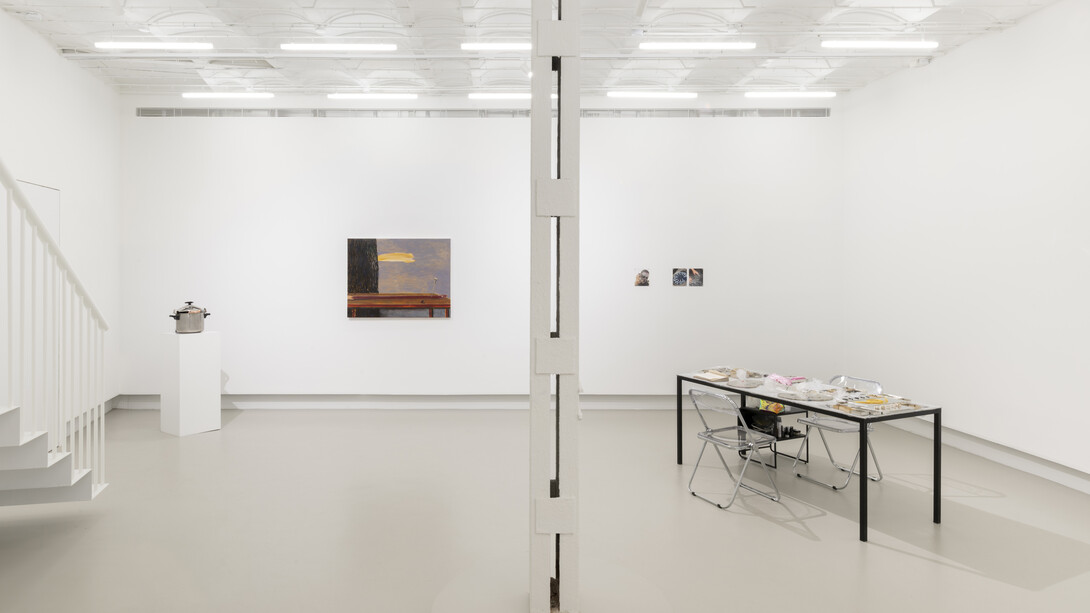
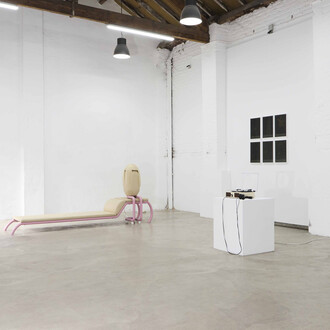
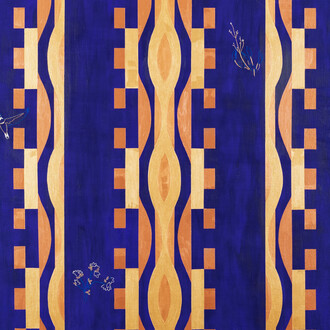
Uñas (nails) is a group show that brings together international artists united around a shared subject: the nail, selected as a motif in its bringing together of several interconnected domains of contemporary theory: gendered forms of labor, aesthetics and economy, animal-human hybridity, and the body amplifications afforded by queer(ing) technologies, whether camera, sculpture, or painted composition. The nail becomes a floating signifier through which to contextualize a diversity of practices, methodologies, and approaches to corporeal representation.
Tensions between labor, absurdity, and mechanization manifest in Mika Rottenberg’s (b. 1976, Argentina) Finger (2019), a hyperrealistic finger with a long nail turning endlessly like a machine. In this case, atop the nail functions as a pictorial surface upon which the artist depicts unfolds a stylized representation of the universe in a humorous collapse of scale. The work simultaneously indicates the absurdity of performative labor in the global economy, and the ways in which the gendered body drives industrial production. Here, capitalism is reduced to an endlessly moving, amputated, beautified object of flesh: alienated, disassociated, and with excellent nails.
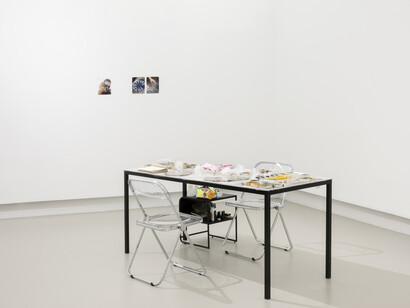
In the works by Lisa Jäger (b.1989, Germany), we are invited to try on nails in a salon constructed through specially developed silicone and display systems. These systems have been designed through the artist’s infrastructural analysis of trays used in nail parlors. The sculptures, wearable nail/claw fixtures, propose an aesthetic space between human and animal theatricality, with organic materialities that challenge conceptions of nails as solely composed of synthetic material. The works are genderless claws, fashioned through a reading of the salon as a site of logistical management and heavy-duty industrial technologies.
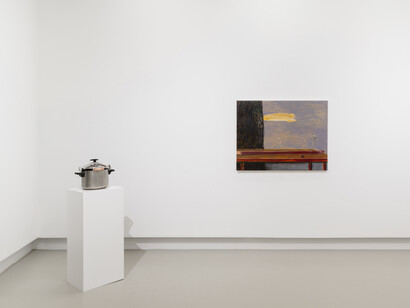
The body under pressure, and the feminized materials that signify it, emerge violently in Pilar Albarracín’s (b. 1968, Spain) Olla express / Pressure cooker (2000), an installation with sound in which a woman’s body is transformed into the materials epitomizing gendered domestic labor through the unfortunate event of being cooked alive. Here, the fingernail and hair, both specimens of dead cells, and recognizable symbols of the feminine form, are what gender this sign of humor-driven domestic horror.
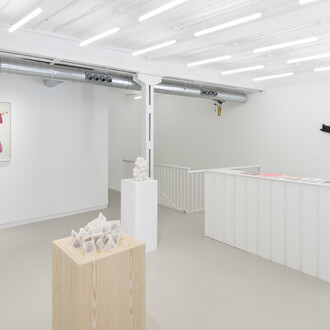
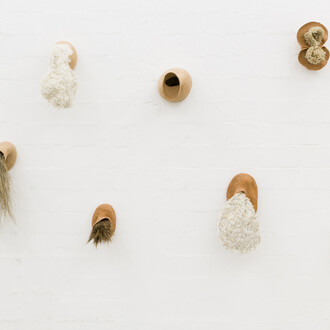
In Acaricia y golpea (2023), Ana Laura Aláez proposes a reflection on the contemporary desire to preserve a sensitivity and a youthful relationship to the world around us. The sculpture unfolds like a rain of suspended fragments, remnants of something that is being held back at the very moment it begins to disappear. Nails or fangs emerge as ambiguous prostheses: bodily extensions that function simultaneously as constructions of gender and as mechanisms of defense. Between care and aggression, the piece links vulnerability and protection, transforming signs associated with femininity into devices of resistance.
María Alcaide’s (b. 1992, Spain) pieces emerge from the artist’s long-term research into the nail salon as a space of social reproduction and chemical emission. The sculptures are made from the anthurium plant, a specimen often used in salons to absorb the chemicals expelled by acrylics and other substances used to paint, glue, or cast nails. The pots for these plants are made of towels, tools used in salons to soak up liquids dispersed throughout the nail-care process, such as rubbing alcohol and gels. These sculptural compositions are coupled with photographs that speak to the artist’s investigation into the subliminal political meanings embedded in aesthetic symbols, engaging a visual vocabulary inspired by hyper-femme meme culture. Alcaide’s The managed hand, an artist book about the global nail industry, is also placed on display, proposing beauty and care as forms of management in a world shaped by intense aesthetic expectation and pressure.
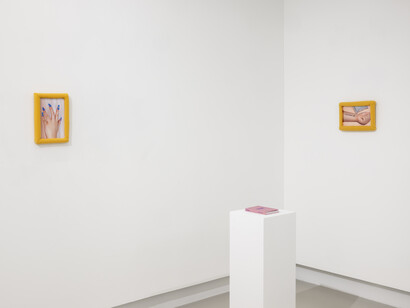
The circulation of aesthetic symbols through online worlds emerges again in the photographs of Vinh Mai Nguyen (b. 1998, USA), a media artist based in Brooklyn, New York. This series, developed over the course of 2023, is a product of the artist’s research into digitality, consumerism, and the “girl” as a transferable aesthetic. Developing invited friends to fashion such symbols as prosthetics that indicate Preciadian conceptions of the technologized corporeal continuum. In their words, relayed in the online conference mecha mecha mecha: agency, nails, and AI as wannabe girl: “Nails provide a look into the limits of our bodies. At the same time, they bring to life endless new bodily possibilities that challenge strict binaries between body and environment, beauty and ugliness, and us and others.”
While Nguyen approaches the nail as a speculative prosthetic, in Laure Prouvost’s (n. 1978, France) 2019 video piece Taking care (Love letter to fellow art work), the fingers become carriers of meaning in an object-authorial love story. Moving hands with one semi-painted fingernail are not so much the subject of explanation, but rather the carrier of narration, an alternative to Beckett’s isolated mouth in his seminal 1972 work Not I. Fingers become vehicles of communication rather than tools for caressing or holding, making them the central actors in the complex space of speaking to oneself through one’s artwork. In sync (2024), the mirror — a common feature of the beauty salon — extends this reflection on the body and its representation. As it is recurrent in Prouvost’s work, breasts appear here stripped of any logic of objectification: they are not presented as passive images for the gaze of others, but as active presences that return the viewer’s look.
Finally, the paintings of Rasmus Nilausen (b. 1980, Copenhagen), created specifically for this exhibition, propose surreal spaces where ambiguity takes hold of the scenes. Recurring elements in his visual vocabulary such as nails, fingers or fringes cooperate and coexist within compositions of improbable balance, as in Fusion (2026). This ambiguity is intensified in Still life with nails and fringe (2026) through the visual play the artist constructs around the double meaning of the English word nails, which denotes both “a thin hard layer covering the outer tip of the fingers” and “a small thin pointed piece of metal with a flat head, used for joining pieces of wood together or hanging things on a wall,” revealing, at an etymological level, its entanglement with the body, construction, and industry. In the scene, a nail pierces a fingernail that extends disproportionately across a table, bringing body and tool together within a single image. The nail thus emerges as an element positioned between the somatic and the logic of construction.
In wandering through this exhibition, we invite you to think of nails as a strange architecture of defense: dead cells compressed into hard surfaces that protect and project the sensitive endings of fingertips. Formed through the repetitive layering of organic matter, they are, in biological terms, what can be understood as a matrix, or formative substrate of cellular interaction. Through the vocabularies proposed by this selection of artists, nails are as much ornaments as they are tools: talons for scratching, grabbing, caressing, and protecting. They become occasions to think more widely about sensory apparatus, bodily devices that carry information about the world, challenging where the aesthetic meets the industrial, and where the tentacles of capitalist ontologies begin and end.