English
 Español
 Français
 Deutsch
 Italiano
 Português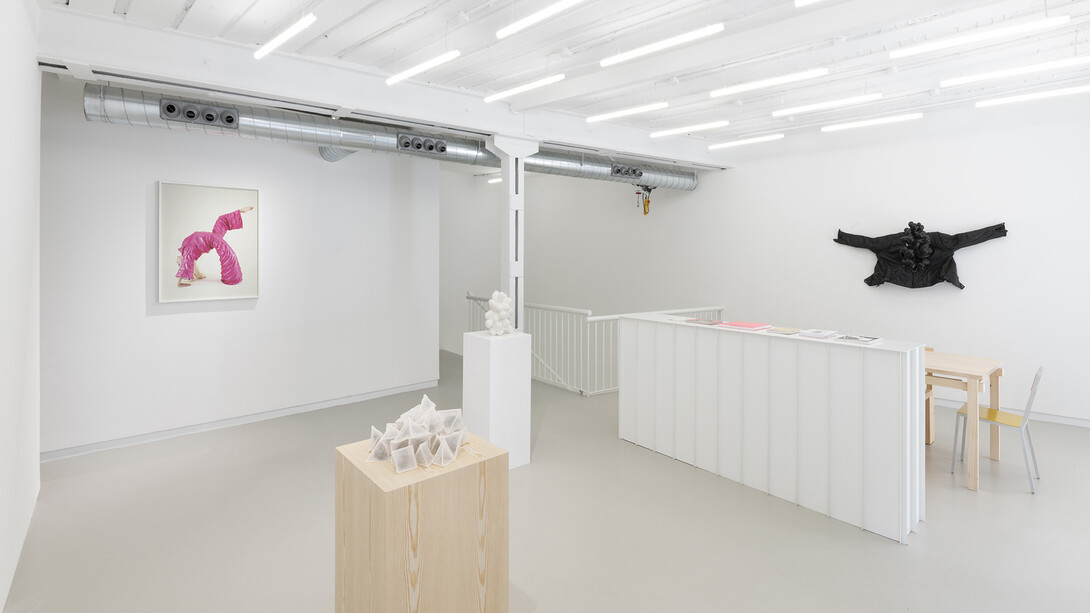
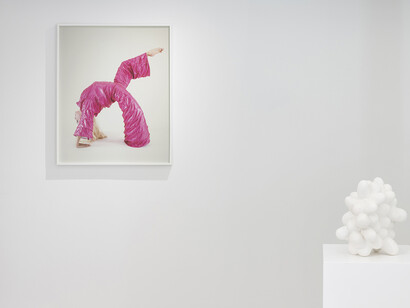
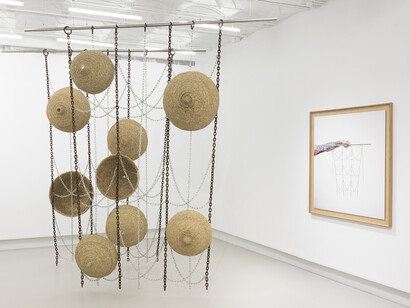
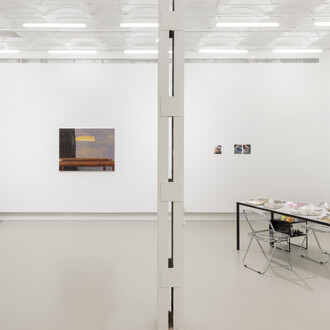
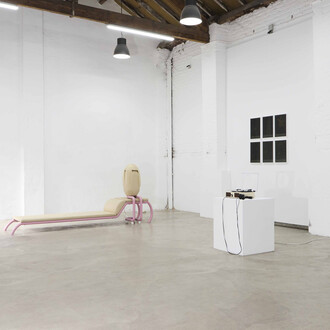
Snowfall with saliva, Ana Laura Aláez’s first solo exhibition at The Ryder Projects, marks the official announcement of her incorporation as a represented artist of the gallery. This exhibition will be the first show in Madrid dedicated to the artist since her 2019 presentation at the Centro de Arte 2 de Mayo. The selection of works on view, produced between 1992 and 2026, do not follow a teleological reading, but rather a circuit of recurrences in varied configurations, illustrating persistent concerns that run throughout Aláez’s practice.
From the outset of her career, Aláez has worked with seductive and magnetic aesthetics, conceived to attract the gaze of viewers and assert sensuality through the process of seeing. Her works are difficult to classify formally, but are linked in their capacity to surprise and unsettle. A pioneer in the field of relational art, her works span the creation of physical spaces designed to host bodies, and the production of three-dimensional objects that allude to human anatomy.
In her case, choosing to devote herself to art was, in itself, an act of rebelliousness and refusal. In the industrial Bilbao of the 1980s, her decision did not align with the expectations and limitations imposed on a working-class woman: “The creative option was not considered a respectable job for females like me […] It meant becoming, by one’s own decision, a mistake… that of representing the failed woman.”
Ana Laura Aláez both affirms and deconstructs gender through the performative power of clothing, the theatricality of femininity, and the fluidity of queer experience. Her works operate as tactile and symbolic signs—assemblages that summon corporeality, protection, and vulnerability. Among them emerges a vital attitude that destabilizes aspirational ideals of purity, both in everyday life, and in artistic practice, what Aláez views as inseparable. Always in favor of contact and contamination, her works are re-activated in the gallery as impulses of what took place in her studio (“small bursts of something that one does not understand oneself,” as Ana Laura would say), and which exceeds form and language itself.
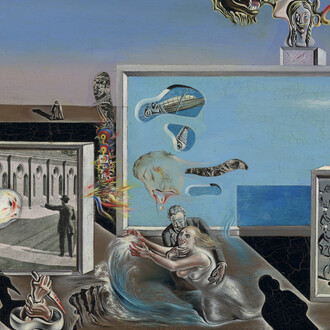
In Powers of horror (1980), philosopher Julia Kristeva argues that cultural systems based on purity and impurity, visible in Catholic culture, for instance, originate in the terror provoked by the abject: that which destabilizes the limits of the subject and threatens the coherence of the symbolic order. The abject manifests in the bodily dimension of fluids, in the difficulty of confronting the physical interior of the body, and in the darkest zones of thought—where the boundaries between self and other become blurred. For Kristeva, the symbolic representation of the abject does not eliminate it; yet, by placing it within a shared framework of signification, it does mitigate its destructive power.
In this sense, art emerges as a privileged space that allows us to recognize, name, and experience what is normally expelled, forbidden, or repressed. The realities that coexist in the title of this exhibition, Snowfall with Saliva refers to the disturbing potential of the non-objects formulated by Julia Kristeva: wounds, bodily fluids, zones of indeterminacy where the oppositions between interior/exterior and self/non-self collapse.
Anatomy, composed of aná (“through,” “from top to bottom”) and tomḗ (“cut”), derived from the verb témnein (“to cut”), the term anatomy designates, in its Greek meaning, the action of opening a body in order to access its internal structure. The word thus retains an epistemological dimension linked to scientific knowledge: knowing through separation, through dissection, through the exposure of that which remains hidden. In this context, the tension between the geometric perfection of snowflakes and the primary corporeal materiality of saliva affirms the coexistence of two types of flows that cover the entrails of a single body.
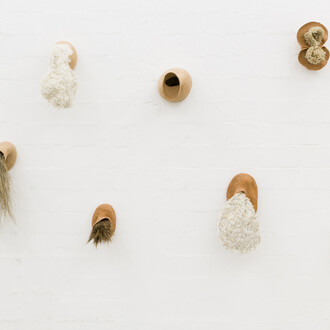
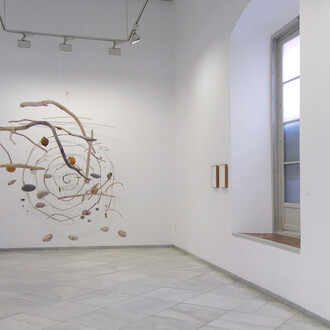
Snowy Anatomy with saliva (2026), one of the artist’s most recent works, emerges from a volume that evokes a close relationship with her own animal nature, a microscopic organism, and a large-scale explosion, the piece condenses a field of forces in which these polarities are held in tension and sustained by one another. From the prolonged process of modeling this sculpture, a creative drive surfaces—that triggers the exploration of other materials and gives rise to several works presented here for the first time.
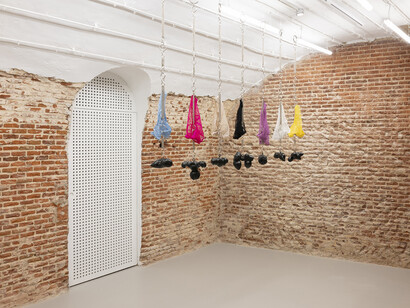
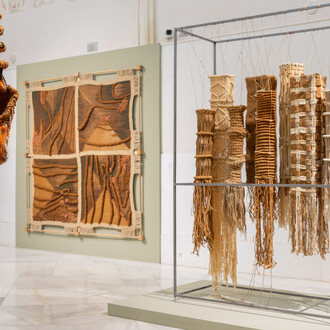
Such is the case of Riding on broomsticks (2026), produced from worn garments, in which Aláez returns to a childhood memory to construct a space of recognition toward those women who, in appearance, conformed to socially established archetypes. Over time, the artist reconnected with these figures, discovering the depth of their knowledge and their ways of being. The selected garments—historically designed to blur the female silhouette and to establish an additional distance between flesh and world—are activated through a transgenerational nexus that runs through and binds them together.
Operating on the human scale, Aláez allows the lived, the invisible, and the unnameable to interlace in her practice. Through self-representation and personal experience, the artist gives form both to subjectivities and nuances excluded from hegemonic discourses, and to that which emerges when the illusion of a fixed, closed identity is fractured. Far from offering consolation, her seduction invites us to recognize ourselves in shadow and to coexist with what we reject, reminding us that the abject arises from the inability to confront our own darkness.
In the sometimes impenetrable space between intention and gesture, between idea and matter, a fertile territory opens up where dressing and undressing may be read as two directions of the same operation: complementary strategies that construct a self in perpetual flight. This intermediate zone functions as a threshold where creative energy and the collective unconscious meet—where an apparently personal reflection silently connects us to those around us. It is within this field of tensions and shadows that Ana Laura Aláez finds the tools to materialize the fragility of the symbolic order.