English
 Español
 Français
 Deutsch
 Italiano
 Português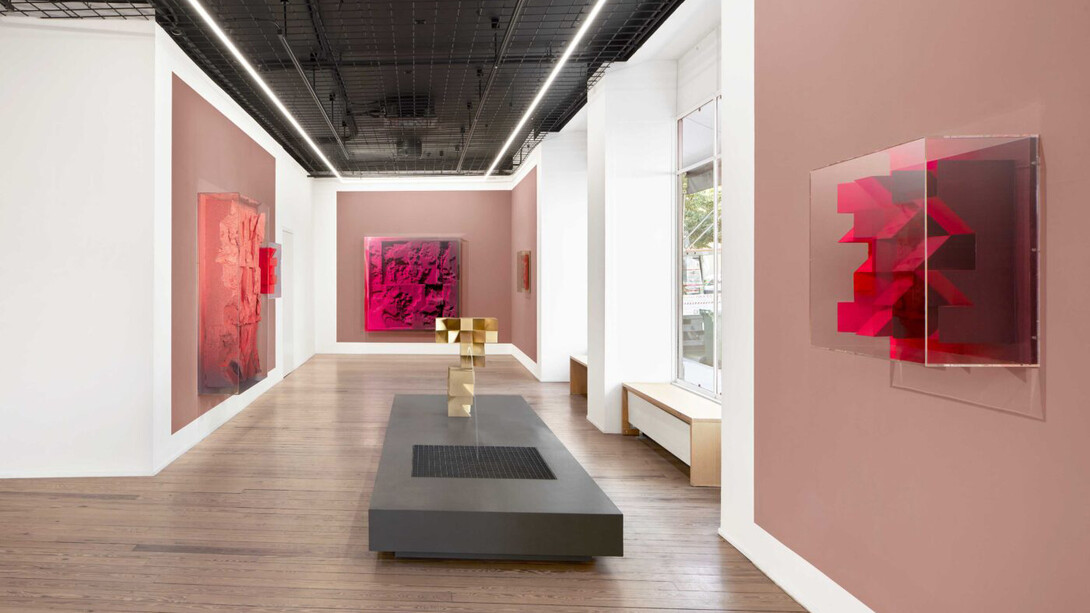
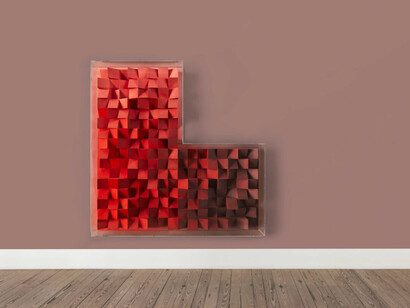
German artist born in 1971, Jan Albers develops a practice situated somewhere between painting, sculpture, and architecture. His works often take the form of reliefs built through accumulation, like compact objects where different materials meet, collide, or coexist. Unlike a sculptural tradition based on removal, Albers works through addition. He assembles, layers, compresses. Wood, metal, polystyrene, ceramic, or polymer plaster become the elements of a dense, almost geological construction, where each surface seems to conceal another stratum beneath it.
His abstract compositions can evoke fragments of architecture, unfinished models, landscapes seen from very far away or, on the contrary, observed as if under a microscope. There is always a tension between something very physical, almost raw, and a more mental form of distance. The works oscillate between saturation and erasure, balance and collapse. Nothing is ever completely stable. The reliefs require a slow gaze; their complexity emerges gradually, through details, shifts in texture, or changes in light.
In the PlAteAus series, Albers develops horizontal forms reminiscent of plateaus, strata, or artificial terrains. Polystyrene and epoxy act as compressed layers, covered with spray paint, sometimes almost powdery. One never quite knows whether one is looking at a fragment of landscape, an architectural cross-section, or a piece of matter in transformation. The surfaces remain ambiguous, both organic and industrial, as if they belonged to a territory impossible to locate.
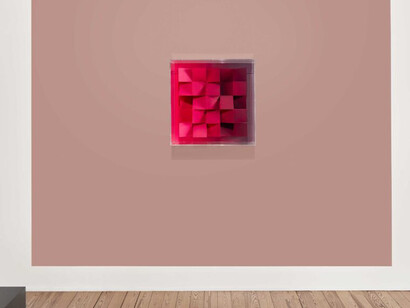
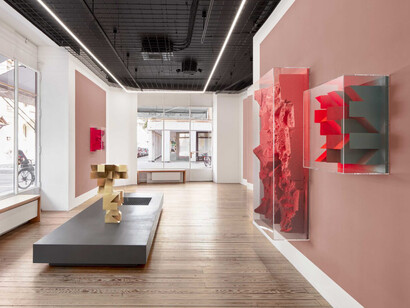
In lovELEttEr, cRacklingRed, or rOyalrOuge, the material becomes denser, more rugged. Polymer plaster thickens the reliefs, creating protrusions, overflows, zones that are at times volcanic, at others geometric. The titles introduce something else as well. For Albers, words never simply name the works. The capital letters that erupt inside the titles create visual breaks, a kind of typographic stutter that echoes the tensions present in the reliefs themselves. Reading becomes slightly disrupted, just like the surface.
The colors suggested by certain titles (cracked red, blazing reds, warmer glow) contrast with the industrial coldness of polystyrene or epoxy. Something seems to heat beneath the surface, as if the works held an internal energy without ever fully releasing it.
With riseandfaLL, Albers shifts this reflection toward another kind of presence. This bronze fountain introduces the real movement of water, its continuous cycle of rising and falling. Whereas the reliefs condense space and matter, this sculpture opens a more fluid breath. But the tension remains. The repetitive movement of the water produces both a sense of calm and a slight imbalance.
There is something paradoxically archaeological about Albers' approach, but inverted. Where archaeology excavates to reveal accumulated layers of time, Albers compresses and encapsulates them. His reliefs function like artificial stratigraphies, constructed sediments rather than discovered ones. Each work becomes a kind of synthetic fossil, a condensed record of gestures, materials, and decisions pressed into a single plane.
This inversion extends to his relationship with Land Art. Where artists like Robert Smithson or Michael Heizer worked through massive gestures in open landscapes, earthworks that expanded outward, claiming territory, Albers does the opposite. He compresses landscape into object, transforms the monumental into the handheld (or nearly so). His plateaus aren't carved into desert floors; they're built on walls, contained, domesticated. It's Land Art turned inward, miniaturized, brought into the controlled space of the gallery. But the tension remains: these objects still carry something of the outside, something geological, something that resists complete containment.
The polystyrene, that entirely synthetic, lightweight material, becomes a strange echo of basalt or sandstone. And perhaps that's where the real friction lies: not in making fake nature, but in acknowledging that our materials, our constructions, our industrial detritus will themselves become the strata future archaeologists will excavate. Albers' reliefs aren't nostalgic. They're already archaeological remains of the present.
What runs through his entire body of work is perhaps the idea of a construction that is always disrupted. Nothing is ever completely smooth, resolved, or fixed. The works seem constantly on the verge of tipping between architecture and ruin, object and landscape, control and accident. Even the titles contribute to this discreet instability.
In Jan Albers' work, surfaces do not seek to become transparent or immediately readable. They resist a little. They retain an opacity, a density. And it is probably there that the gaze truly begins to move.