English
 Español
 Français
 Deutsch
 Italiano
 Português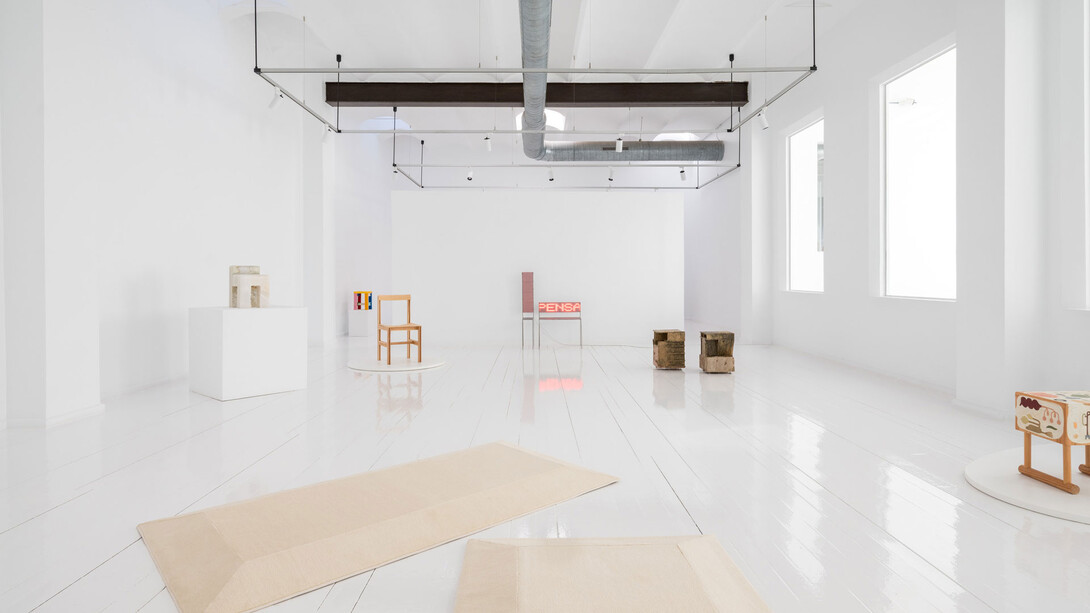
Alzueta Gallery presents Parallel route 01, a group exhibition that brings together the work of Antoni Arola, Max Enrich, Klas Ernflo, Júlia Esqué, Marc Morro, Bruno Ollé, Luna Paiva, Jaume Ramírez, Júlia Rossinyol, Octavi Serra, Inés Sistiaga, and Turbina, and will be on view from June 2 to June 30, 2026, at Alzueta Gallery Barcelona Sèneca.
This new project approaches design as a parallel route to artistic practice: a path that intersects with art, shares languages, yet pursues other ends, functional, social, material, technological, and historical. Parallel route 01 proposes a space where design and art do not compete, but rather contaminate, question, and enrich one another.
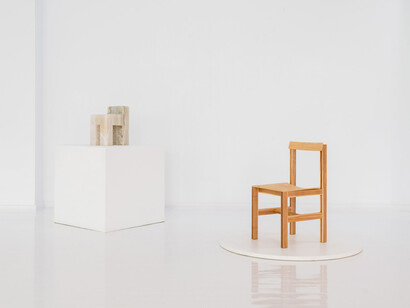
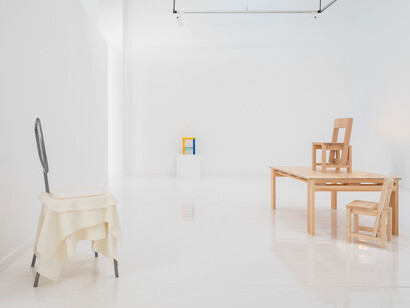
For this first edition, we posed a dual challenge: designers confronting the limits of dysfunction, and artists exploring the beauty of functionality by creating a piece to sit on. The brief was deliberately open, yet precise enough to generate a shared field of inquiry. The result is not a collection of chairs, but a constellation of responses in which the act of sitting becomes both pretext and territory, a common ground where gesture, structure, materiality, and concept converge.
At the core of the exhibition lies a question: what happens when design abandons pure function, and art embraces utility? The works gathered here inhabit that friction.
Antoni Arola presents a dual proposition: a lamp that is also a chair. Lightness—visual and physical—becomes the guiding principle, with Japanese washi paper stretched over a delicate structure becoming an object, a gesture. Inés Sistiaga’s Frame and cloth works through reduction. Fascinated by how upholstery dresses a body—structure, base, cover, cushion—she takes these elements, distills them, and translates them onto the chair frame as if it were a canvas. Materials and systems normally hidden are exposed. The invisible becomes visible.
Júlia Rossinyol takes Joseph Kosuth’s One and three chairs (1965) as a starting point. Her chairs appear as three-dimensional drawings suspended in space, their LED backrests projecting AI-generated texts that transform language into material as characters trapped in an endless dialogue about their own identity.
Bruno Ollé’s practice stems from an intimate archaeology—painting, sculpture, and found objects recontextualized into compositions that evoke both childhood play and emotional reconstruction. Here, humble materials are given new life as a sittable form. Klas Ernflo moves between painting and sculpture with a sensitivity for everyday objects and organic shapes drawn from nature. His Nordic origins and Catalan surroundings converge in a chair that carries his characteristic visual language.
Luna Paiva gilds ten stacked chairs cast in bronze, transforming them into spiritual relics. Her work plays with the sacred layers of fetish present in contemporary art, spanning from an ancient tradition where casting gold embodied a spiritual sacred anima. Marc Morro presents variations of his Kamanar collection, furniture designed for a school in southern Senegal. Here, he shows XS versions resolved without screws, alongside the K2 chair, conceived for DIY construction using materials easily found in the city.
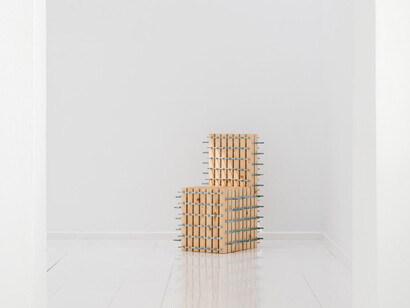
Júlia Esqué presents a raised-body rug with an inclined edge—a soft surface where diagonal transitions create a smooth passage between floor and surface, delimiting an area that invites rest. Max Enrich carved his chair from Onyx, experimenting with two contrasting stone-working techniques. A smooth, glossy machine-finished exterior hides the roughness of the hand-shaped interior—beauty and imperfection coexisting within the same material. Jaume Ramírez borrows a construction method from metal trusses and applies it to wood, combining the craft of iron with that of timber to generate joints that, while familiar, are transformed to create something new.
Octavi Serra creates from fear—the fear that a piece might not hold. His response: Buen cerca, the most robust chair possible, transforming weakness into motivation. As he notes, if his pieces have «a good from afar,» then they must also have «a good up close.» Turbina presents T.A.B. (The alien beings): ceramic, glaze, and Stone Cast. Forms that evoke landscape and object, something in-between and unknown. Matter that camouflages itself within its own logic, as if it had learned to withdraw before being seen. The pieces invite contemplation, a geometry of pause. The familiar becomes latent, existing outside our habitual systems of perception.
What emerges across these works is not unity but resonance. Each piece operates at the intersection of function and speculation, utility and contemplation. They share a territory where the act of sitting becomes secondary to the act of thinking through making. Some works celebrate craftsmanship; others question it. Some privilege structure; others privilege gesture. Together, they propose that the chair—that most familiar of objects—can still be a site of inquiry.
Parallel route 01 does not seek to dissolve the boundaries between art and design, but to inhabit the friction between them. It is a space where both practices can coexist, challenge each other, and reveal what lies beyond their conventional limits. Where design questions its own functionality, and art tests its capacity to serve. Where the routes run parallel, yet occasionally converge.