English
 Español
 Français
 Deutsch
 Italiano
 Português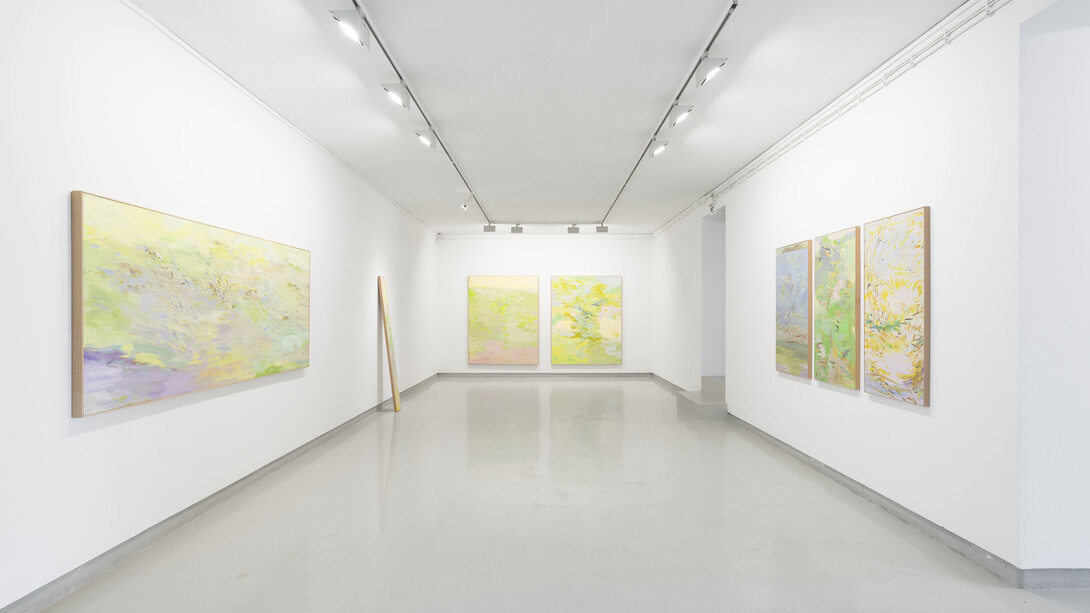
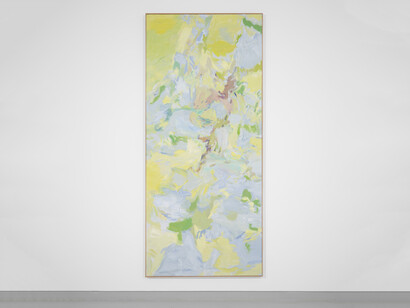
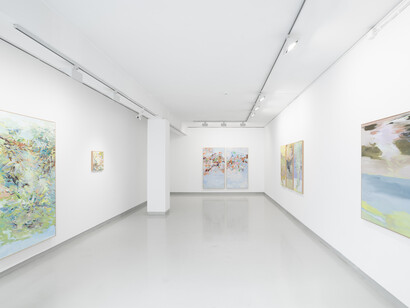
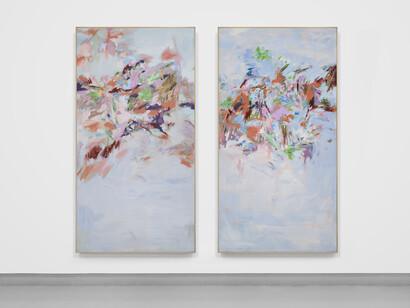
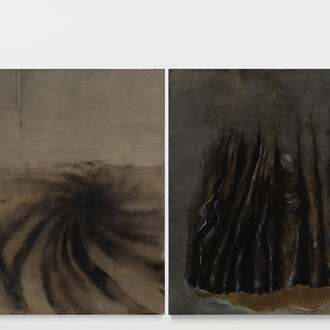
At first glance, the paintings presented by Jiŏn Kiim in Grass pillow1 seem to summon a vegetal, natural universe – though we can’t be fully certain. This principle of uncertainty, clinging to the shadow of our gaze, is one of the defining aspects of the body of work presented by Kiim.
Trailing a draft of air – or the possible echoes of the expression that gives the exhibition its title – Grass pillow embodies within itself the principle of that which is unfixed, and thus embraces paradox. We might think of something resting (the body, perchance), upon something else that takes on the shape of the one at rest (the grass). After that moment – a pause – the grass becomes something else again, assuming another form in the absence of the body. If we add to this equation the effects of the natural elements, above all the wind, we begin to perceive instability itself as the grass’s governing principle. Form, understood in this way, becomes a moment, leading us to reflect upon the relation between perception and the temporal quality inscribed in the paintings presented here.
Just as the grass that accommodates a body to subsequently change its form, these paintings preserve that same principle in their relation to the body and the gaze of the viewer who stands before them – there is no certainty about what we see; rather, there are intuitions and sensations. This leads us to one of the central forces of Jiŏn Kiim’s work: these are paintings in which the gaze we cast upon them is returned to us, spreading throughout our sensitive body. More than acts of seeing or deciphering, these paintings invite a profusion of sensations, and therein lies the mastery of Kiim’s work. I would say this is painting endowed with will: the will to install itself within us, brushing and colouring what is most intimate in our inner lives, stirring it like a gentle gust of wind that lulls our senses and feelings. It is a painting that takes its time, turning time itself into a celebration, a festival of colour and movement that lends meaning to this experience of being human.
It is also of this that Natsume Sōseki writes about in Kusamakura, a book that takes us on detours through the thoughts of a character who, in the first person, guides us through his journey and what he encounters along the way. Amidst the contemplation of natural and human elements, this character grapples with a tension that runs through the history of humanity: what if, instead of losing ourselves in human difficulties, dilemmas and suffering, we related to the world from a purely contemplative perspective? In his reflections, Sōseki draws upon works of world literature, establishing a connection between these and human feelings and dilemmas, such as suffering: “No play, however brilliant, is free from human feelings. Rare is the novel that transcends questions of right and wrong. The characteristic of these works is their inability to leave the world behind.” (Sōseki 2008: 17).
With regard to this premise that guides the writing of Kusamakura, one might find axes of contamination between the book and Kiim’s painting, insofar as this exhibition is less about conceptualising experience than about living it in accordance with the gaze, within a specific moment in time. That moment, fleeting as it is, may become something else altogether, since perception and image shift according to the temporal variable allied to bodily presence. It is around perception that the protagonist of Kusamakura seeks to establish a relation with the world, including with human beings themselves: “The southern hills and bamboo groves of those ancient poems are of a different nature, of course; nor can I treat humans quite as I do the skylark and mustard blossom; but my ideal is to approach that state as far as possible and do all I can to view humans from its vantage point.” (Sōseki 2008: 19).
Jiŏn Kiim’s paintings seem to stem from a similar standpoint – natural, contemplative; human, artifice. Kiim chooses to paint the unnameable – hence the need to use an expression, rather than a word, to “name” the body of work presented here. An expression offers greater is not a given concept; rather, it is we, as humans, who “aspire to produce the ideal of beauty within ourselves” (Kant 2017:137). Thus, nature and its formless offerings — difficult to name, though beautiful — enliven our spirit, which means, still in Kant’s terms, that the beautiful does not refer to concepts, but rather to the feelings of the subjects: “There can be no objective rule of taste that determines through concepts what is beautiful. For every judgement arising from this source is aesthetic” (Kant 2017: 136–137). Whether in the beautiful in nature, or in Kiim’s painting, the human element is part of the constellation. Although Sōseki held the ideal of observing the world and humans solely as forms within a picture, Kiim’s painting, paying homage to this stance, does not detach itself from either the perception or the feeling that these forms produce in the human spirit. I would say that this is precisely why this painting exists: it is the result of an intimate connection between the act of creating — various gestures — and the feelings they evoke, which, as we have seen, are not stable and therefore cannot be captured by a single name or concept.
I think of vibration, an authentic vibration. The fact is that some of these paintings are euphoric, and what is extraordinary about the way they affect our gaze and our bodies as we stand before them is that their dance and euphoria are contagious. Although confined to the limits of the canvas, these paintings transport us to what exists beyond them – a world that is, in large part, our private world, the world of each of us even before we speak, share and create more of the world. These paintings invite us to breathe in living moments that nourish our spirit — that sustain us through our days.
To paraphrase Manuel António Pina, sometimes we just want a place to lay our heads. Jiŏn Kiim suggests that this place should escape human artifice, that nature should bear our weight, our world and our silences, for a little while.
(Text by Rita Anuar)
Notes
1 Grass pillow (Kusamakura) is a Japanese expression that suggests the notions of “journey” and “travel”, alluding to an intimacy between the human and the natural world.