English
 Español
 Français
 Deutsch
 Italiano
 Português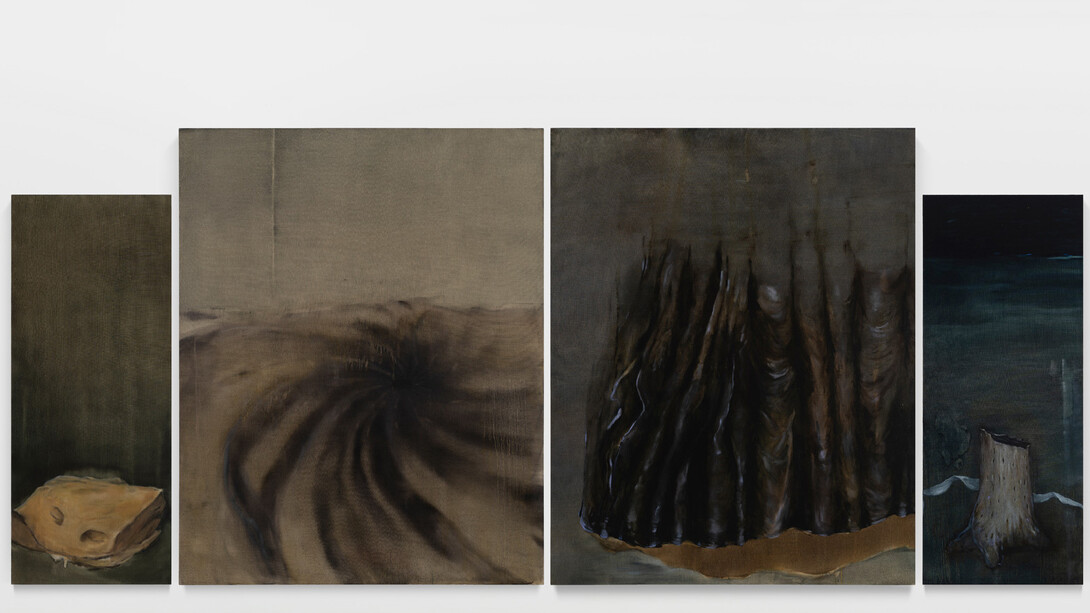
During a conversation with Laura in her studio, we spoke about the experience of creating images on images, those devoid of any meaning beyond their aesthetic quality. We quickly arrived at clichéd categorisations of what defines an artist and the ideas surrounding the desire for pure painting. She concluded: “the hands are the painter’s ultimate tool,” admitting that her own obsessions shared this universal matrix. It is as though this icon functions as a common language, serving as a painter’s truest self-portrait.
I remember when, shortly after our discussion, Laura started using gloves to paint, in an exercise of detachment from pictorial production. At the time, it struck me as rather theatrical. But looking now at the weight and presence of hands throughout her work, the gesture makes sense: it was about protection, allowing for a greater distance. By withdrawing from the scene, she opens up a liminal space between image and intention. In a moment of suspense, she grants us access to an uncertain place, where only vague, abandoned landscapes and blurred shadows emerge.
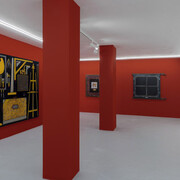
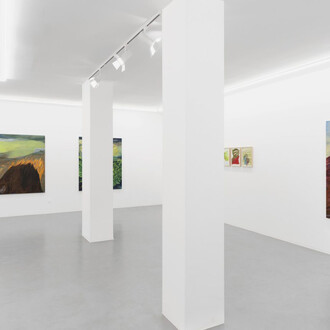
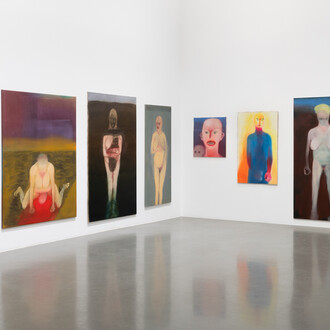
For her first solo exhibition, Laura Caetano re-evaluates her role as an archetypal artist paying homage to classical painting. In 9, these traditional interests are subtly reframed by contemporary conventions. Although the exhibition draws on the architecture of altarpieces and religious imagery, it is not anchored to any specific era of the past. Instead, it liberates itself from history, operating entirely outside of temporal or divine boundaries.
The ambiguity that shrouds these compositions is also reflected in the title. As the highest single digit in the decimal system, 9 represents the ultimate threshold before a loop completes - a spiral eternally moving toward or away from its centre, a curtain dropping into nothingness. It also evokes the Hermit of the tarot, a figure who retreats to the desert, rejects the world, and sublimates solitude.
Throughout these works, beauty emerges as something both seductive and unsettling, poised between delicacy and nihilism. Stripped of human presence, an overwhelming silence takes hold, forcing us to rely entirely on the scale of the canvases for a sense of orientation. In this way, the traditional altarpiece is redefined. Where historic altars relied on flanking saints as anachronistic witnesses to validate the sacred, here the central narrative collapses, surrendering entirely to the void.
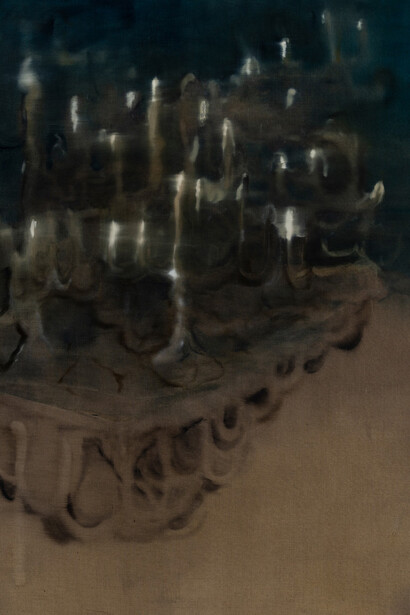
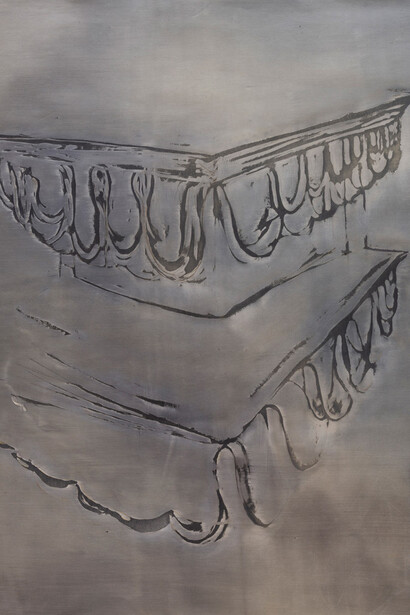
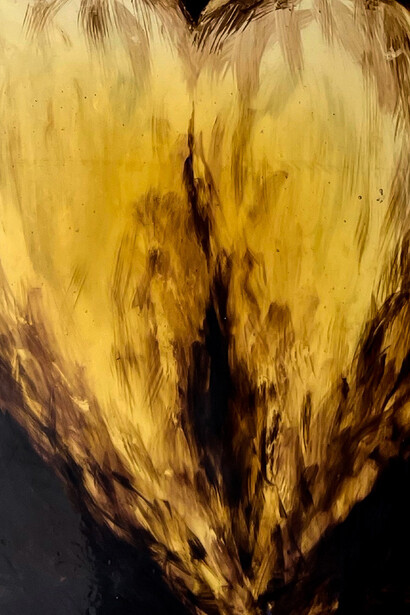
Here, technical execution takes centre stage. Delicate structures emerge within the canvas’s earliest layers, multiplying through a continuous cycle of destruction and reconstruction: oil dripping from gestural brushstrokes, building layers of varnish that gleam under the surgical precision of light. These forms feel teasingly familiar, yet impossible to contextualise. Steering clear of a dazzling crescendo, the work thrives instead on subtle notations, whispered tones, and endless stories.
(Text by Francisca Portugal)