English
 Español
 Français
 Deutsch
 Italiano
 Português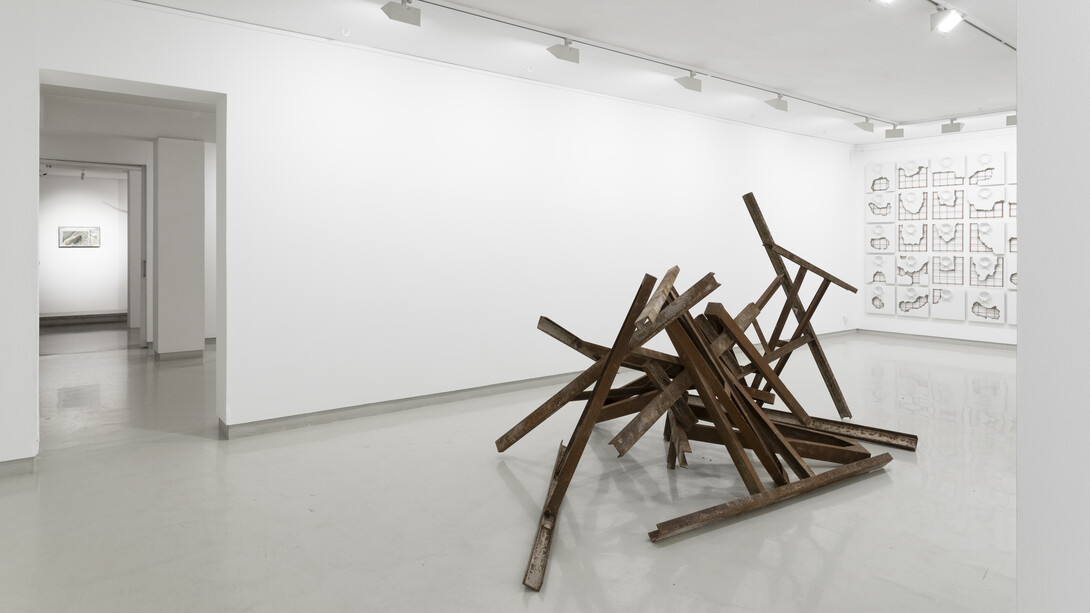
Writing about a friend's exhibition requires extra attention. It is not a trivial task, nor is it purely emotional; it is not about celebrating, nor is it about covering the discourse with sterile neutrality. It requires ethics, it requires rigor. It requires recognizing that proximity does not detract from objectivity and can, on the contrary, sharpen it.
If criticism is so often an exercise in detached authority, here it takes the form of vigilant hospitality. A porous criticism, a term proposed here as a methodology. Proximity without fusion; distance without coldness. It is in this field of tension that this text positions itself. Retroexpectativa, the name of this exhibition, emerges here as a necessity rather than a linguistic ornament. It does not designate a capricious invention, but an effort at conceptual precision in the face of something that no existing term can fully describe. Between retrospective and expectation, it shifts between both; it is not a simple fusion, but productive tension.
In a retrospective, the gaze is fixed on what has already been, as an inventory and synthesis. In expectation, the gaze is projected towards the future, still suspended in uncertainty. It designates a double and simultaneous movement that is neither a nostalgic return nor a utopian future. It is a way of inhabiting time as thickness, where the past remains active and the future breathes from the present, yet to be realized. Retroexpectativa is an attention to what remains latent. It does not remember, it rekindles. It does not idealize, it questions. It does not close, it opens.
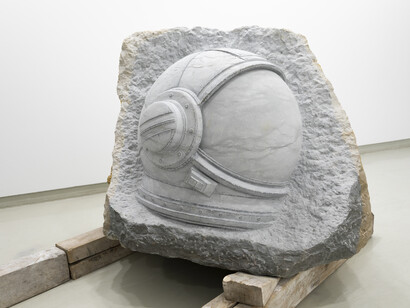
In Isaque Pinheiro's work, this gesture translates into objects that, emerging from everyday life and a recognizable imagination, reveal a trace, an unrealized potential, an echo of a possible use or a suspended memory.
“What | do are things,” he said in a conversation the other day. And suddenly, in that statement, | thought, there is an approximation to the things of Francisco Manuel Alves, better known as Abade de Bagal. An approximation that is not literal, but structural, as it has an archaeological impulse, not to fix what was, but to displace what is. The Abbot collected in order to preserve a disappearing world; Isaque «collects» in order to expose a world in permanent tension.
Where the Abade compiled inventories, Isaque composes constellations. Where the Abbot fixed the lived, Isaque exposes the living. That is why his contemporary co-creator is not museological; he is relational. He does not organize, he questions. He does not keep, he reconfigures.
As in a radical field study, the gallery in this exhibition becomes a laboratory. Irony and humor do not alleviate, they reveal. They are critical tools, conceptual scalpels. Placing us before the aesthetic unconscious that manifests itself in the disruption of the familiar. Where everyday life is returned to the viewer with a slight twist: the object is no longer just an object; it is an enigma, a divergence, a question. It is, after all, the moment when perception “stumbles” and, in that possibility of displacement, thinks.
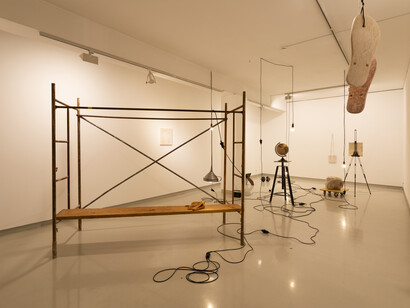
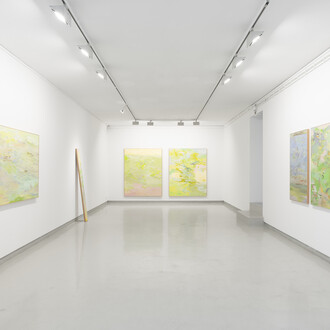
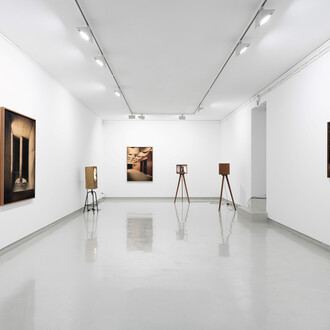
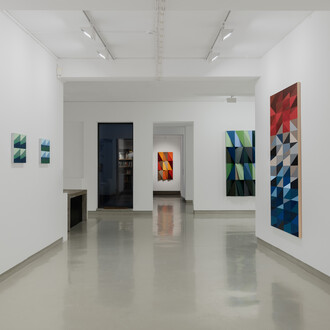
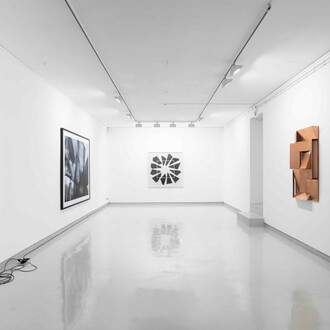
In this exhibition, Galeria Presenga is not merely a neutral container, but asserts itself as an active device for spatial enunciation. It is in this context that Isaque Pinheiro operates a true critical cartography of the place.
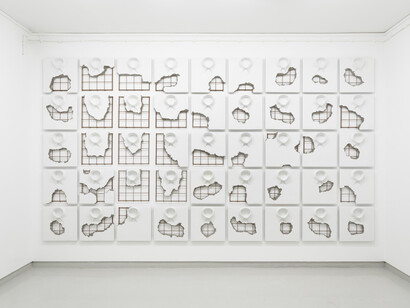
Each work occupies, measures, tensions, and reconfigures the exhibition space. The arrangement of the objects does not obey a neutral logic: on the contrary, it reveals deliberate strategies of approximation and distancing, of silence and friction, of suspension and subtle humorous inflections. In this context, the works are not limited to illustrating a pre-existing discourse; rather, they construct their own discourse in the act of their presentation.
Materiality takes on an argumentative function here. The manual gesture explicitly confronts the logic of industrial production. The relationship with everyday life, displaced from the field of functional familiarity, proves to be singularly necessary in this context as a critical and perceptive operator.
The exhibition draws on the artist's own past practice: integrating pieces previously presented in other exhibition contexts, reinscribing them in the present. This gesture is not a simple revisiting; rather, it constitutes an operative return, in which the works return to confront each other and exist in a new field of relations. Thus, the past becomes active material, subject to reconfiguration and the opening up of new meanings, a confirmation that, here, time does not return, it works. Without falling into melancholy or naive futurism.
(Text by Joño Baeta)