English
 Español
 Français
 Deutsch
 Italiano
 Português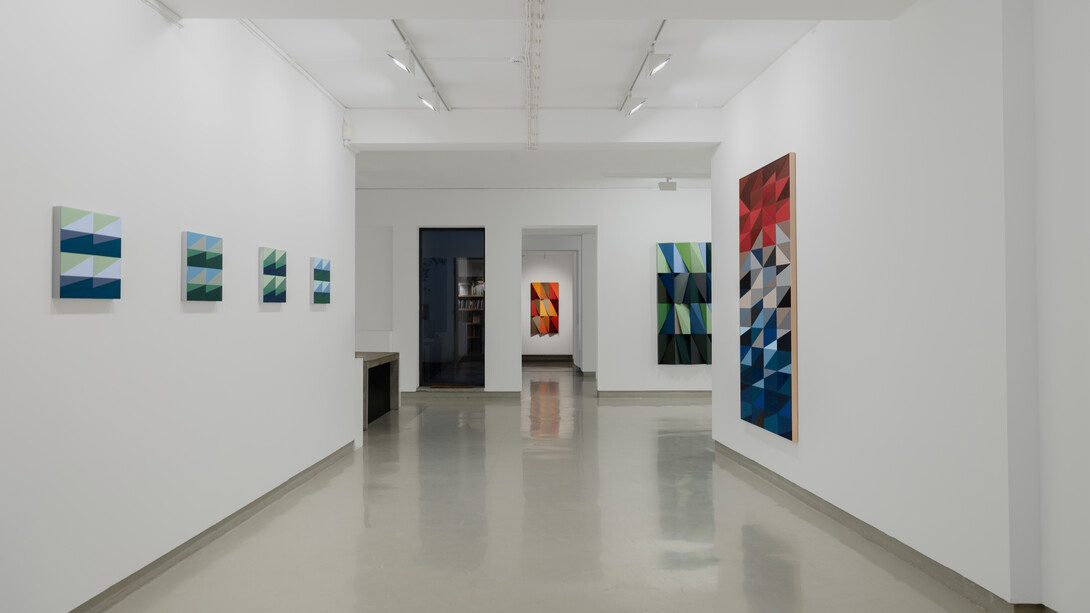
I
Among twenty snowy mountains,
The only
moving thing Was
the eye of the
blackbird.
II
I was of three minds,
Like a
tree In which there are
three blackbirds.
III
The blackbird whirled in the
autumn winds. It was a
small part of the pantomime.
(…)(Wallace Stevens)
The work of Marisa Ferreira (b.1983) operates within the field of perception and spatial experience, from the visitor’s point of view. Her work traces its lineage to modernism (Suprematism and modern Design) updating issues that produced a rift—partially solved by geometric abstraction and Minimalism—in a intense battle against figuration and landscape.
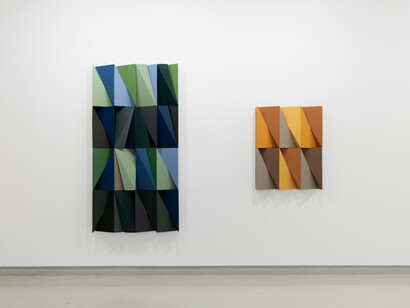
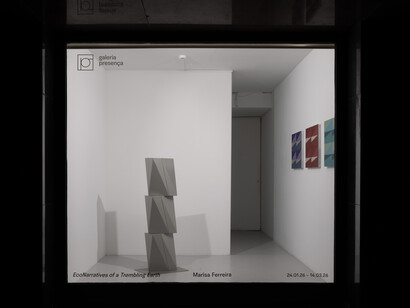
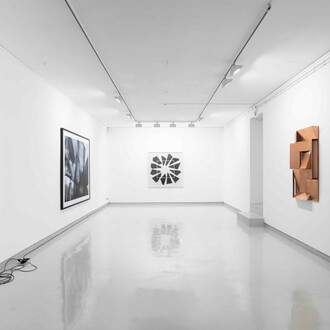
Through the use of elementary geometric shapes, the artist regularly evokes the visual atmospheres of Suprematism, displayed by the presence of the square, the rectangle, and the triangle in a three-dimensional perspective. Colour emerges as a constructive form, but mainlly as an instigator of perception combined with the simplification of forms, it seeks an approaching movement from the visitor. This seeing with the body, this seeing is believing, is one of the great virtues of her sculptures. Our curiosity would only be satisfied if we could touch it—to realize that, after all, the angular surface of her works is made of cold matter: aluminium, stainless steel, and glass.
It is through this gesture of coming close that the visitor deconstructs the illusion of a purely pictorial two-dimensional field. This zigzag, this difference between far and close, is precisely what is most stimulating about her work, as it places us in a state of permanent doubt. The ambiguity (openness) of the work (recalling Umberto Eco) admits a multiplicity of aesthetic experiences, appealing to both imagination and intelligence.
With Marisa Ferreira’s work, we move from a feeling of uncanny to a sensitive experience through a tension or fissure that repositions the terms of both painting and sculpture. The process can be linked to Alain Badiou’s assertion that the real of art is ideal impurity on the way to some form of purification, which in the artist's work is revealed through the refinement of form, colour, and the mirrored reflections of aluminium, steel, and glass.
The artist work calls for an hermeneutics of hearing (Ricoeur); it asks to be heard in order to be understood beyond everything we know about art. It demands the capacity to put ourselves in the artist’s place, speaking with the work to interpret it, and thus living through the other, through art.
The conviction that her work is committed to reality and to the other is exemplified by her piece “Shall we dance?” (2017/2019), which the artist constructed in a public place, transforming a former car park into a pedestrian zone in Oslo. In this park, music invites people to dance on a painted pavement inspired by the aesthetics of Constructivist compositions. Similarly, her public space intervention, “Lost Future” (2020), evokes a 1925 urban project by Le Corbusier that was never built in Paris. Ferreira projects the work using Le Corbusier's archival drawings, constructing it with wasted glass and mirrors on a stainless steel structure, in a critical exercise on the modern utopia.
The influence of modern design may offer a way to access the expressiveness of her works through simple forms and lines—basic geometries without ornamentation using technology from industrial flows. Marisa Ferreira inherits the modern gesture, updating a dialectics between art and industrial craftsmanship, where form serves a function—now an aesthetic one—for an active reception.
Finally, the modern heritage in the artist’s work is equally felt in the assumed presence of the grid (R. Krauss), which holds great importance in the quality of her sculptures within the field of perception. It is a structuring element that grants her pieces a kind of expansive gesture. This expansion alters spatiality by providing an illusion of depth, dynamic scales in relation to the visitor’s distance or proximity, and the modulation of volumes. In addition, the geometric structure in her pieces exceeds the physical limits of the object, interfering with the architecture of the exhibition space and setting the spectator in motion.
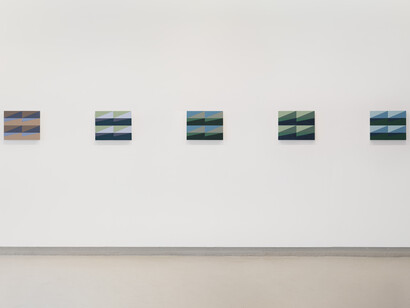
In Marisa Ferreira’s paintings and sculptures, as in Stevens’ poem, the gaze leaps in several directions, guided by a geometric, structured, serial, and cold imagery.
(Text by José Maçãs de Carvalho)