English
 Español
 Français
 Deutsch
 Italiano
 Português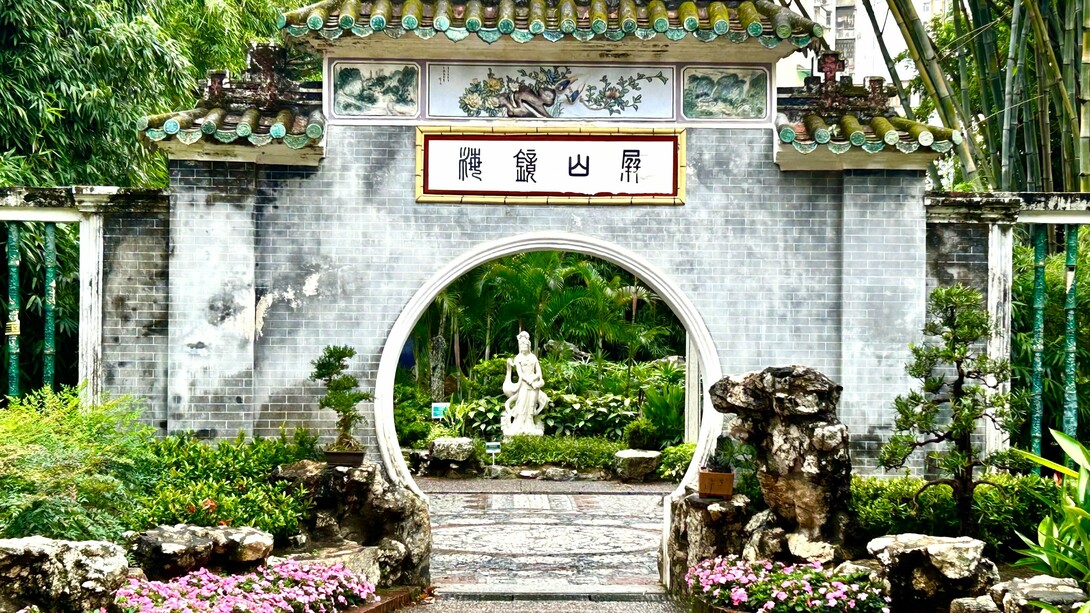
Nature does not hurry, yet everything is accomplished.
(Lao Tzu1)
A visit to the Macau Peninsula can be quite overwhelming, with massive hotels and casinos soaring above a cramped metropolis. Contrasting this with the quaint old town, which retains exceptionally preserved traces of its Portuguese heritage, defining a cohesive cultural identity that captures Macau’s true spirit proves to be a perplexing task.
For this reason, amid such a tangled web of Eastern and Western elements, visitors may overlook significant remnants of indigenous Chinese culture. No need to look further. About over a kilometer’s walk from the central Senado Square, a charming Chinese-styled garden sits in a high-walled urban oasis setting. Lou Lim Ioc Garden2 is a sprawling landscape dotted with rocks, caves, and narrow, winding paths through bamboo groves, flowering bushes, a pond, and buildings in classical Chinese and European architecture.
In 1870, wealthy Chinese merchant and philanthropist Lou Wa Sio (also Lou Kau) purchased the 1.78 hectares of land for his family retreat. The family business was engaged in the pork industry, lottery, and gambling monopolies. Lou became one of the most prominent entrepreneurs in Macau at that time. However, the gambling ban in 1904, harsh government fines, and escalating company management troubles weighed heavily on the family’s undertakings.
Lou’s bankruptcy and his subsequent suicide three years later ultimately imploded the tycoon’s enterprise. His eldest son, Lou Lim Ioc, took over the empire in 1906 and designed the estate in the Suzhou style of classical Chinese landscaping. While the son successfully revived his father’s legacy, his early death at 49 years old and the expiration of the family’s gambling franchise drove the company into financial ruin. Eventually, the family was forced to sell the property in 1973. The government of Macau reclaimed and renovated the land, which then reopened to the public in 1974.
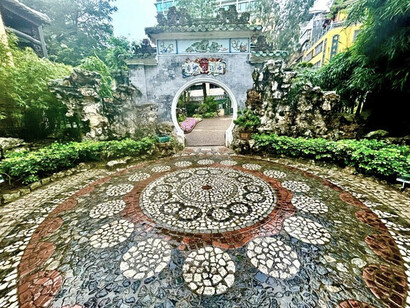
The garden entrance features a traditional Chinese-inspired arch, also called the Lunar Port for its moon shape. The pailou is characterized by an emerald green tiled roof and ancient Chinese paintings. Through the graceful arch, one can catch a glimpse of an immaculate statue of the Goddess of Mercy, one of the highly venerated deities of Chinese Buddhism. Dainty pink blossoms and bamboo trees line the entryway to the meandering lanes. Adorning the cobblestone pavement are intricate Chinese pebble mosaics designed with repeated geometric shapes, auspicious cloud motifs, and petite flowers.
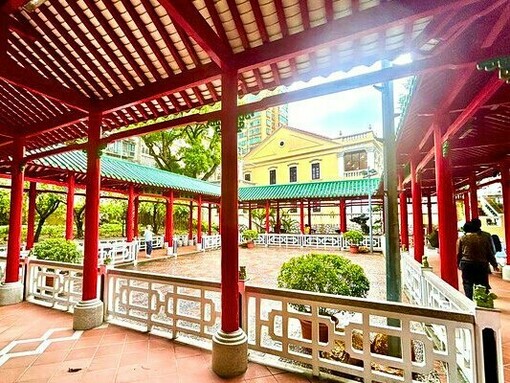
Lou Kau, a botany enthusiast, wished the estate to embody Taoist principles, which integrate the balance of water, rocks, plants, and architecture with poetry and harmony. A walled-in courtyard, being one of the fundamental aspects of the Suzhou style, is manifested in the large cloister, the Green Grass Hall. Fire-red pillars and roof rafters support the brightly lit corridors. The floor emulates zigzag patterns that coincide with the Chinese theme of layered views. Many people come to take walks, read a book, spend quiet moments on the benches, or do Tai Chi exercises. Devoid of furnishings, the open and expansive central garth invites you to breathe in a sense of unhindered freedom.
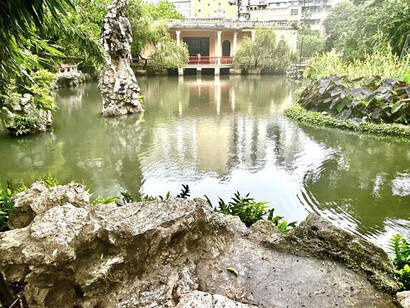
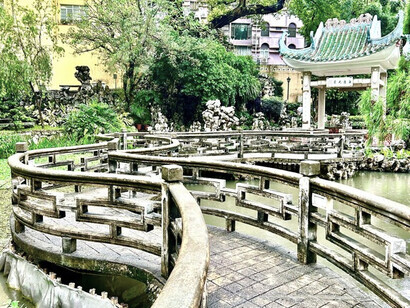
Traversing the grounds along a labyrinth of asymmetrical pathways and stone steps, one finally arrives at the enchanting lotus or koi pond. The Nine-turn Zigzag Bridge that crosses over the water is believed to dispel evil spirits that commonly move in straight lines. Thriving trees and abundant flora and fauna, such as blooming lotus flowers, float peacefully on the water, while golden carp and turtles frolic playfully in the pond, creating an almost quintessential picture of paradise.
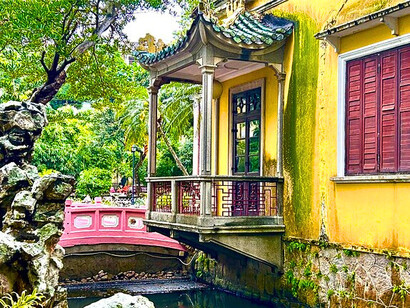
At the far center of the pond sits the Spring Hall, with a striking mustard-yellow façade and shining crimson railings—an emblematic fusion of Portuguese and Chinese hues. Gothic pillars surrounding the passages reveal engraved European flower motifs. Looking out over the majestic pond, the wide veranda protrudes with dazzling, scarlet-red balustrades. Pale pink railings wrap the building, with matching pastel bridges connecting to the green space. The individual balconies also feature streamlined Art Deco-like lattice windows. Their Chinese-framed roofs with upturned eaves and vermilion-grilled guardrails cast silhouettes of timeless, rustic beauty.
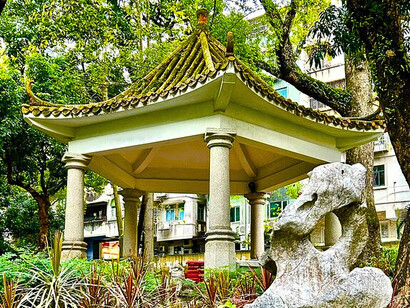
Other pavilions, with similar Chinese flying eaves in turquoise blue, olive green, and rust, are sprinkled around the property. Perched on the hills, they embrace the full breadth of the pond below.
Exploring more deeply along the footpaths leads to grottos and man-made caverns. Bizarre rock sculptures seem to echo fantastical mountains. The bamboo thickets flank the walkways in dense clusters, secluding visitors in private alcoves for solemn contemplation.
Steeped in the sensory delights of downtown Macau's Portuguese and Macanese spices and bustling crowds, you will find a quiet refuge at the turn-of-the-century Lou Lim Ioc Garden, whose elegance and serenity offer the perfect afternoon escape.
Notes
1 Lao Tzu.
2 Lou Lim Ioc Garden.