English
 Español
 Français
 Deutsch
 Italiano
 Português
The more we journey back through time, the more it becomes clear that art was never merely decorative.
It was communicative, sacred, and deeply entwined with how early humans understood their place in the cosmos. In this ninth chapter of our Journey of Art, we meet a figure who may very well have stood as a sentinel of the spirit world: the Urfa Man.
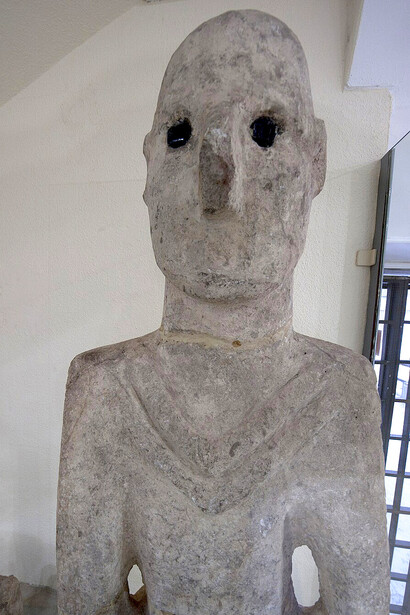
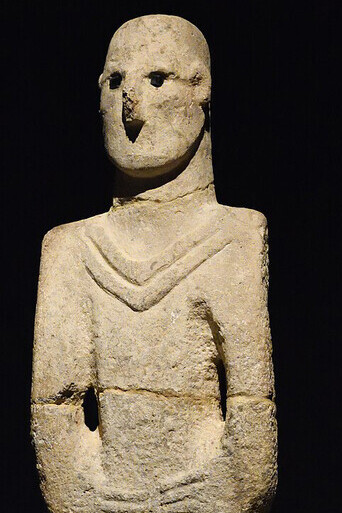
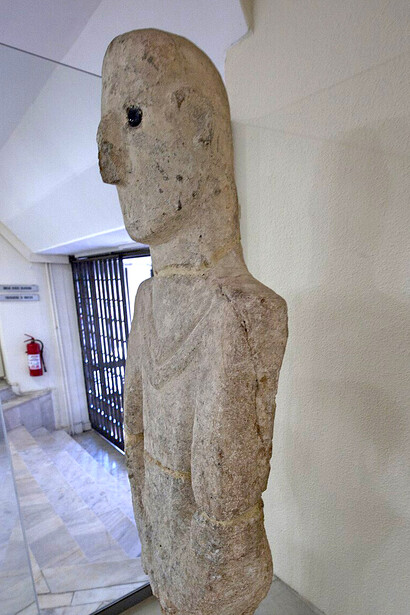
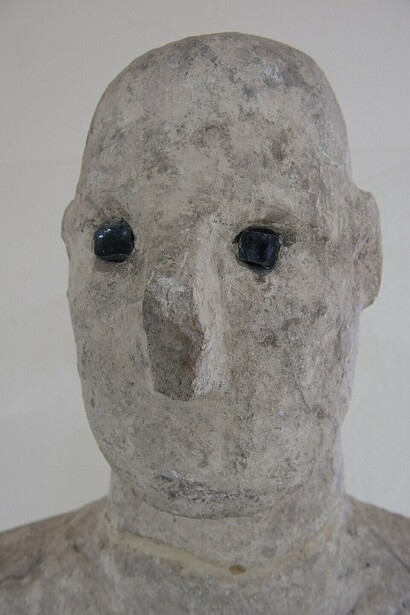
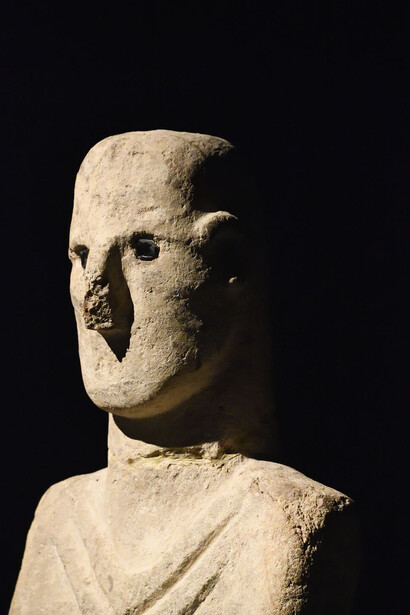
Discovered in the 1990s near the city of Urfa in southeastern Turkey, this statue is believed to be the oldest life-sized naturalistic human sculpture ever found. Standing at approximately 1.90 meters tall and carved from limestone, Urfa Man predates even the temples of Göbekli Tepe. He is ancient, yet his gaze is eerily present.
As a soulscape artist, I’m always looking for that silent exchange between the physical and the metaphysical.
And Urfa Man, to me, embodies this liminal energy. He is not merely a representation of a man; he is a vessel of memory, a keeper of something far older than words. His simplicity is disarming, but his purpose seems anything but casual.
The gaze beyond time
What first grips me, and many who’ve stood before him, are the eyes.
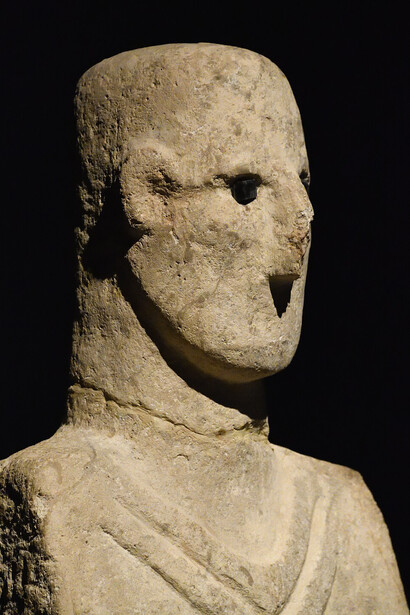
The sockets are deep and dark, yet originally inlaid with black obsidian, giving them a glassy, penetrative presence. These are not decorative choices. Obsidian is volcanic glass, often associated with healing, protection, and spiritual clarity in ancient belief systems.
By embedding obsidian into the eye sockets, the makers of Urfa Man may have been infusing him with the ability to see, not just the world of the living, but perhaps the one that lies beyond.
In this way, Urfa Man isn’t just looking; he’s watching. Witnessing.
Maybe even judging.
When I paint eyes in my own art, I often find myself asking, What are they holding? Pain? Wisdom? Secrets?
The eyes of the Urfa Man feel like they contain something ancient and unspoken. A memory of ritual. A reflection of cosmic order.
The ritual collar
Around his neck is a distinctive V-shaped carving, almost like a collar or necklace. Some scholars have interpreted it as clothing, while others suggest it might symbolize a ritual garment or even a spiritual rank. Either way, the presence of this carved feature marks the figure as significant.
He was not just a person. He was a symbol.
When I look at this collar, I think of early priest-kings, of those who walked the line between human and divine. Those who led ceremonies, who invoked the gods, who mediated between the earthly and the celestial.
Could Urfa Man have been an ancestral effigy? A stand-in for the spiritual leader of a long-lost tribe? Or maybe he was a placeholder for a god himself, not to be worshipped as stone, but to be honored as a channel for something higher.
Pre-Göbekli and post-creation
Urfa Man is believed to have been created around 9000 BCE, which places him in the Pre-Pottery Neolithic era. That alone is staggering; he predates writing, metal, and even the wheel.
Yet somehow, amidst the chaos and survivalism of early human life, someone had the time, the skill, and the spiritual urgency to carve a life-sized human from stone.
Why?
This is where ritual comes in. Art, especially at this scale, was not made for pleasure or prestige. It was made with purpose.
In this case, it might have been part of a burial or offering ritual. Or perhaps he stood guard over a sacred site, not unlike the stele and animal carvings of nearby Göbekli Tepe.
The region around Urfa was a cradle of spiritual transformation. It is here that humanity first began to ask questions not just of how to survive, but why we exist.
Art, in that moment, became a sacred act. A form of prayer. A ritual unto itself.
The stillness of devotion
There is something about the posture of the Urfa Man that evokes reverence. His hands are clasped together at the front of his body, resting just above his belt or navel. It’s not a defensive stance; it’s one of submission, humility, or offering.
This quiet gesture speaks volumes. It reminds me of the stillness we often associate with meditation or prayer. And as I reflect on the essence of ritual in early human life, I’m reminded that rituals are not always loud. Sometimes they are silent, repetitive, and deeply personal.
To me, this figure may have been created for the ritual, and then became the ritual. A visual echo of an ancient practice now lost to time.
A universal thread
What makes Urfa Man so compelling is that he is not alone. Not literally, perhaps; he is a single figure, but symbolically, he shares a lineage with other ancient sculptures from around the world.
From the Venus figurines of Europe to the anthropomorphic statues of Ain Ghazal in Jordan, we see humanity repeating a sacred pattern: to recreate the human form not for vanity, but for veneration.
It’s astonishing that these traditions arose independently, separated by time and geography, yet all pointed toward a similar instinct.
To sculpt.
To create.
To bow before the power of the human image, not as ego, but as mirror.
This is the real journey of art. Not a linear path of progress, but a spiraling evolution of consciousness. Each sculpture, each symbol, becomes a breadcrumb guiding us back to our spiritual ancestry.
In the presence of the watcher
Standing before Urfa Man today, one is struck by how much has changed, and how much has not.
We may live in cities, speak in digital tongues, and orbit satellites, but the questions remain the same. Who are we? Why are we here?
What lies beyond?
Urfa Man doesn’t answer these questions. He simply stands. And watches. And in that silence, we are invited to remember that once, long ago, someone stood where we stand now, carving stone, honoring spirit, and daring to believe that art could outlast time.
Final reflections
As I write this, I can’t help but wonder if Urfa Man was ever meant to be found. Perhaps he was buried on purpose. Perhaps he was always meant to be uncovered in a different age, one like ours, where we’ve drifted so far from ritual, from stillness, from the sacred, that we need to be reminded.
And maybe that’s why I paint.
Because, like Urfa Man, I believe in the power of stillness. Of reverence. Of soul made visible.
In honoring him, we are not just looking back; we are reconnecting. To a time when art was not content. It was a ceremony. A presence. A truth.
And in that gaze, deep, obsidian, and eternal, we might just find our way home.