English
 Español
 Français
 Deutsch
 Italiano
 Português
The last few years have seen a spate of youth movements – led especially by the generation called Gen Z – that have brought down entire regimes or in other dramatic ways, changed the political scenario. Sustained protests and demonstrations in Nepal, Bangladesh, Madagascar, the Philippines, Indonesia, Morocco, and elsewhere have forced governments to act on issues like corruption or even brought them down. But have they resulted in any fundamental shifts towards justice for all?
One of the latest avatars is the Cockroach Janta Party (CJP) in India, whose sudden emergence has been about as surprising as a cockroach climbing out of your drainpipe and about as scary for the ruling party. The immediate trigger for the formation of CJP was a controversial remark made by the Chief Justice of India’s Supreme Court in mid-May, in which he called youngsters and activists ‘cockroaches’1. In the immediate backlash that followed, he clarified that he was only talking about people who had entered professions like law, using fake degrees. But the uproar continued. A communications strategist, Abhijit Dipke, initiated the CJP on social media in mid-May as a sarcastic parody. With 10 million followers on Instagram (surpassing the number that the BJP, currently ruling India, has!) within five days and 350,000 people ‘registering’ for the party, this quickly morphed into a movement of political dimensions.
In a typically knee-jerk reaction, the Indian government blocked CJP’s X account. The ban did not have much impact, as CJP’s creative posts (liberally using AI) based on the legendary resilience of cockroaches (“You forgot what we do best: survive”) kept appearing on all sorts of forums. Perhaps inadvertently, these were also providing to the cockroach, otherwise reviled by most people, a semblance of respect for being one of the planet’s oldest species (over 150 million years old!).
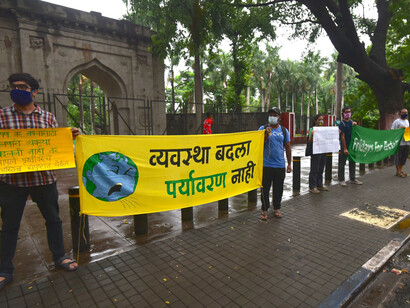
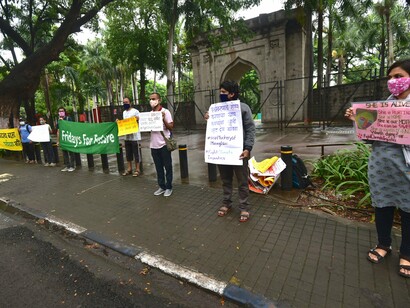
And then CJP called for a physical protest, showing that it is not only a digital movement. This took place in Delhi on 6th June with the participation of youth, parents and representatives of social movements. On-ground actions by ‘cockroaches’ have taken place in many parts of India, highlighting diverse issues like the state of roads, corruption, and unemployment. Thus far, the CJP’s primary demands have related to the resignation of the Union Education Minister for his responsibility in a shocking case of leak of an examination paper involving over 2 million young applicants to medical colleges, cleaning up of the education system, and action to create jobs to deal with India’s high youth unemployment rate. It has become rapidly clear that the Chief Justice’s remarks were only a trigger and that the CJP's momentum is based on long-simmering anger and frustration amongst India’s youth and other citizens.
The demands of some other Gen Z-led movements have been wider, such as a total change of political regime in Nepal and Bangladesh. Others have ranged from action on climate justice to stopping Israel’s genocide in Gaza. But in all, the underlying feeling of dissatisfaction with the current political and economic system is evident.
Learning from history
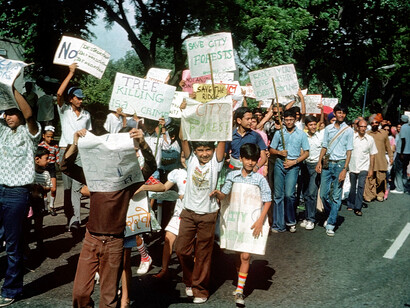
Youth movements are not, of course, an invention of Gen Z. Recent parallels include the Arab intifada rebellions region in 2010-11 (the so-called ‘Arab Spring’), which resulted in several regime changes. Much earlier, in 1968, a series of protests erupted across the world, many led by youth, on issues like war, civil and democratic rights, worker rights, anti-dictatorships, and more. Young people were at the forefront of the anti-Vietnam War movement in the USA in the 1960s-70s (one cannot forget the iconic image of a young woman putting a rose flower into the bayonet of a soldier). From then to now, youth have led with creative and vibrant movements on a range of issues. My own journey started in a movement led by school and college students in the early 1980s to protect Delhi’s urban forests and against ‘development’ that we characterised as ‘destruction’ in its ruthless desecration of nature and displacement of nature-dependent communities.
Many of these have succeeded to varying degrees in meeting their immediate objectives, such as protecting a forest or bringing down a regime. But they have not, for the most part, resulted in fundamental transformations of the system. Just as in the case of revolutionary leftist parties defeating right-wing regimes and taking over political power at national levels (notably many in Latin America), the change in regime may lead to some progressive steps relating to welfare, cleaner governance, and laws that expand rights and inclusion of marginalised peoples. But political power remains concentrated in the hands of a few, ideals and values are compromised to stay in power, and economic models remain focused on industrialism and unending economic growth that destroy as many livelihoods as they create, apart from taking us further towards global ecological collapse.
The widespread revolts of the 1960s and 70s resulted in many gains, such as for worker rights, but did not transform the basic conditions of capitalist labour exploitation and hostile competition (if not wars) between nations. The result is that the goals of solving the biggest problems humanity faces – obscene inequalities, ecological collapse, wars and genocide, authoritarianism and erosion of democratic rights – remain distant dreams. Not that any one movement can achieve this in a heavily globalised world, but are there serious attempts at moving towards these even at local and national levels?
We will have to wait to see if the new political leadership in Nepal will bring such fundamental changes. The government led by a 36 year-old engineer-rapper Balendra Shah (currently the youngest serving head of state in the world), has issued an ambitious 100-point Reform Agenda2. This has many promising actions on welfare and accountable and efficient governance, but I could not see anything on empowering village and urban communities for decentralised democracy and very little on moving Nepal towards ecological sustainability (other than protecting wetlands and watersheds).
Some points in the agenda may even go against this, such as a plan to "maximise energy export revenue and accelerate hydropower development”, if these entail mega-projects in mountainous areas with serious environmental and social consequences. Reportedly, constituents of the Gen Z movement that led to the dramatic political changes in Nepal are in dialogue with the government (some are even in it), and I know some of them are keen on more grounded democracy and ecological sustainability. But it is unclear how much they can influence its course, and more importantly, how much the vision of Gen Z as a whole goes beyond only reforms.
Visionary thinking needed
One of the crucial missing elements in many of these revolutionary movements is some kind of ‘prefiguration’. Once the primary goal of bringing down a regime or throwing out a corrupt minister has been met, what next? Is there a vision of the kind of politics and economy that would bring benefits to everyone, that would not also result in concentrations of power and wealth? Is there some kind of thinking on a path of ‘development’ that would not result in obscene inequalities and ecological collapse? Are those who take over power, whether designated or decided on by the youth, the kind of people who will genuinely value democracy and do everything they can to strengthen it?
Beyond some dramatic actions such as arresting visibly corrupt politicians and bureaucrats of the previous regime, do they have the vision to decentralise power amongst citizens so that a public check can be kept on corruption at large? If unemployment and inflation have been a major driver of protests, do the new leaders have a handle on how to generate dignified livelihoods and contain prices in ways that are equitable as well as ecologically sustainable … or will they try just more of the failed models of industrialisation and promoting consumerism, or other such elements of neoliberal economics that do not regard ecological limits as a serious issue?
None of these alternative pathways are easy to conceive of, let alone implement. But nor are they impossible, as thousands of successful initiatives across the world are showing3. Communities have demonstrated how real democracy (not the superficial Western kind where our rights are mostly confined to voting) can work, where everyone has a voice, decision-making starts in rural and urban communities, and nature is part of such decision-making4. Collectives of workers have shown how responsible production can take place in which everyone benefits. Farmers’ groups have displayed a diversity of food production systems that do not destroy or poison the soil and water and all life in them. Millions of dignified livelihoods are being created in sectors of the economy that are ecologically responsible (what the International Labour Organisation calls ‘green jobs’), such as decentralised renewable energy and public transportation.
The issue is not that such solutions don’t exist. Rather, very often, movements of protest know much better what they are against than what they are for. Their visions and recipes for change are often restricted to reforms within the same system. For instance, they may demand the independence of election oversight institutions to reduce political party influences in the polls but not go beyond that to ask, 'How can power itself be so decentralised that the public can keep a check on all institutions?' Or, to take an environmental issue, they may demand shifts away from fossil fuels to renewable energy but not ask the questions of what kind of RE is truly equitable and sustainable and how to keep a check on luxury and wasteful consumption – questions that lead to challenging models of development itself.
Financial corruption is an issue that creates considerable anger and frustration, and rightly so. Many youth and citizens’ movements have been triggered by this scourge. However, as I’ve earlier argued in the context of an anti-corruption movement that gained significant political mileage in India in the early 2010s, corruption is much larger than financial malpractice5. There is the corruption of mindsets, which leads to unbridled profit-making driven by greed, and unscrupulous politics driven by the desire to hold on to power. A system that has no financial corruption can still be one that results in huge inequalities and ecological unsustainability. Unless protest movements have all these kinds of corruption and distortions on their radar and a vision on how to create governance and economic processes that reduce avenues for such greed and power hunger, they will have limited success. Some of the CJP’s manifesto demands (like freeing the media of corporate control) do point in this direction6, which is encouraging; and perhaps with the involvement of people like climate activist Sonam Wangchuk of Ladakh, the scope will increase to other aspects of democracy and environment.
Similarly, unemployment is another major driver of movements, rightly so. But they usually do not challenge the current model of ‘development’ based on unending economic growth and a technological free-for-all that enables displacement of human labour and agency by machines (something that AI is going to significantly enhance). They need to work towards replacing this model with approaches that maximise dignified livelihoods based on regenerative approaches to nature and technology. In a country like India, for instance, this means prioritising handmade, decentralised production and small-scale manufacturing, regenerating the millions of hectares of degraded lands to make them productive, decentralised services, localised trade and so on.
The same for education. Movements have demanded universal access to educational institutions, reforms in the system of exams and so on. These are understandable demands. But movements also need to ask: if the current education system is orientated towards extreme individualism and selfishness, generates insanely high aspirations relating to money, fame and power, and trains the youth to fit into the same corporate and government systems that have caused so much havoc, what really changes? We need a vision of education where young people can learn creatively and with fun; become responsible for each other and for nature; optimise the talents and skills they want to; learn from their own communities as well as from others; take pride in their family’s cultures and languages while learning those of others; explore livelihood options that provide them dignity and freedom; challenge traditional and new inequalities; and learn how to be resilient in the face of climate and other crises. Hopefully as it evolves, CJP can incorporate such systemic shifts in its demands for India, and other youth movements for other countries and regions.
For all the above changes I’ve mentioned, there are living examples that are working. Many solutions do not need to be invented afresh; they exist somewhere or other on the planet. Elsewhere I have written about how the ‘flower of transformation’, in which positive solutions are being found for economic, political, social, cultural, and ecological problems, is a way of envisioning and practising holistic change7. Of course, it would be very difficult, if not impossible, for any one nation (especially a small one with limited internal resources like Nepal) to do such radical shifts on its own. This is where transnational cooperation by peoples and communities, where possible, supported by change-seekers in the new governments, becomes important.
For today’s youth to appreciate and learn from these, there also needs to be intergenerational dialogue and learning. Not the kind where exploitative classes within older generations attempt to brainwash the youth into fitting into the same exploitative system (aided by a powerful corporate advertising sector). Rather, those of us who have tried changing systems towards more radically progressive worldviews and those from Indigenous peoples and local communities who continue to ‘tread lightly on the earth' have a responsibility to make our knowledge and experience available, not as impositions but as a history that has important lessons. In general, we have failed in our endeavours (a ‘big L’, to use a Gen Z term I recently learnt), but there are many specific successes also (where we ‘slayed it’). Both can be learnt from.
Gen Z (and now, Gen A and whatever other alphabets follow!) have the energy, the innovative spirit, and the creativity to lead revolutions towards a better world. But for this, protest has to be combined with prefiguration of the fundamental transformations that humanity needs to make. Hopefully the many revolutions that the youth are involved in, across the world, are already considering or will consider such an approach, with citizens’ movements of all ages standing up in support and solidarity.
References
1 CJI’s ‘Cockroach’ Remark Sparks Debate on Dignity of Youth and Public Discourse.
2 Balen. (n.d.). 100-point reform agenda.
3 Radical Ecological Democracy: Searching for alternatives to the current unsustainable and inequitable model of development.
4 Global Tapestry of Alternatives. 2025. Radical Democracy: recovering the roots of self-governance & autonomy.
5 Kothari, Ashish. 2011. ‘Corruption and the right to participate’, Economic and Political Weekly XLVI(35).
6 Cockroach Janta Party Manifesto.
7 Kothari, Ashish. 2022. ‘The flower of transformation’, meer.com.