English
 Español
 Français
 Deutsch
 Italiano
 Português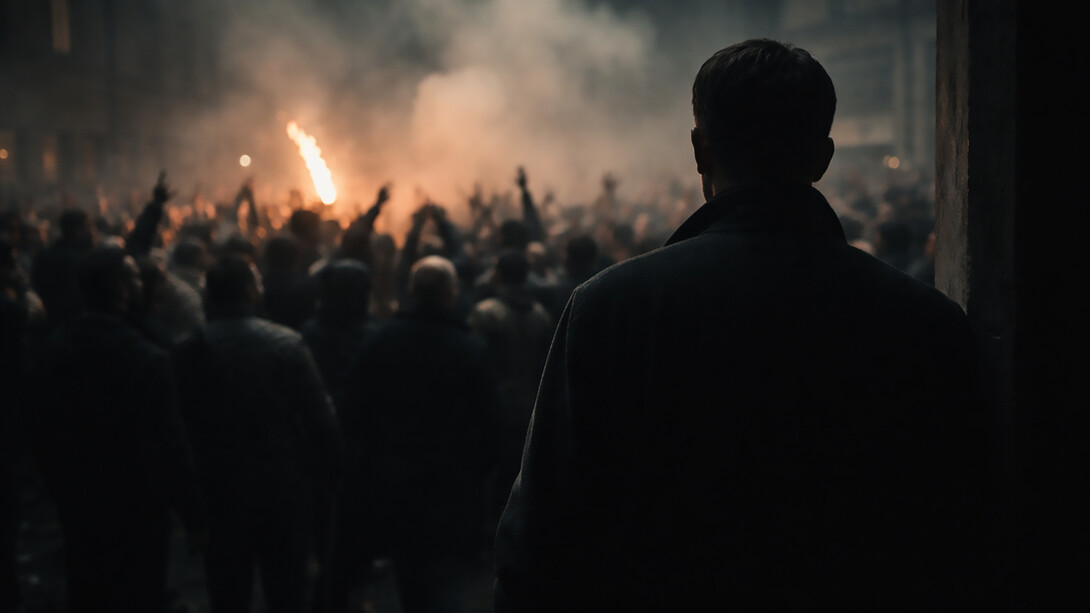
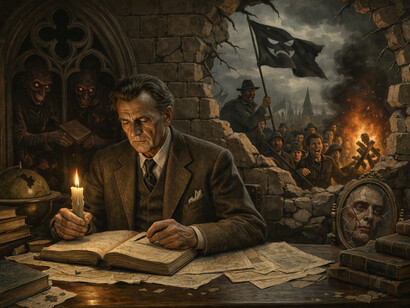
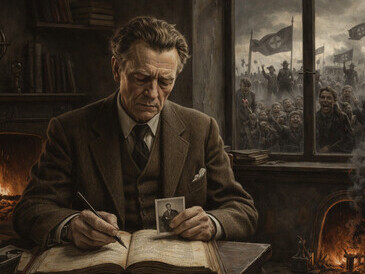
In the summer of 1936, a Bavarian aristocrat named Friedrich Reck-Malleczewen began keeping a secret diary. He was a conservative, a monarchist, a man who had watched the world he understood dissolve into something monstrous. He would continue writing for eight years, until the Gestapo arrested him in late 1944. He died in Dachau in February 1945, weeks before liberation.
The diary, published posthumously as Diary of a Man in Despair, is not a political analysis of National Socialism. Rather, it is an unsettling psychological autopsy of a society that had chosen its own destruction, performed by a man who understood that the choosing was, for many, the point.
I have been rereading Reck in the early months of 2026, as the political landscape of the West shifts in ways that feel both unprecedented and grimly familiar. Not because I think we are reliving the 1930s (historical analogies are usually more flattering than they are accurate) but because Reck diagnosed something about the appetite for catastrophe that most political commentary still fails to grasp. He understood that fascism was not primarily an ideology but a libidinal formation. A way of wanting. A structuring of our innermost desires.
And desire, unlike policy, does not yield to rational refutation.
The conventional account of fascism's appeal emphasises grievance: economic dislocation, national humiliation, and the failure of liberal institutions to deliver on their promises. All of this is true, and all of it is insufficient. Reck watched the same conditions produce wildly different responses in different people. Some turned to socialism, others to religious renewal, and others to quiet despair. What distinguished those who embraced National Socialism was not the severity of their suffering but the quality of their response to it.
"I am convinced," he wrote, "that at least nine-tenths of the population, including a considerable portion of those who have been deprived of their jobs, would refuse point-blank to go along with the Nazis—if they could be brought face to face with the realities."
But they could not be brought face to face. What they wanted was something else entirely in permission. Permission to hate, to resent, to indulge impulses that peacetime morality had suppressed. The Nazi movement offered this permission wrapped in the language of national renewal, but Reck saw through the packaging to the thing itself. What his neighbours craved was not Germany's restoration but the pleasure of destruction—the "psychic catacombs", as he called them, finally opened, the buried appetites finally fed.
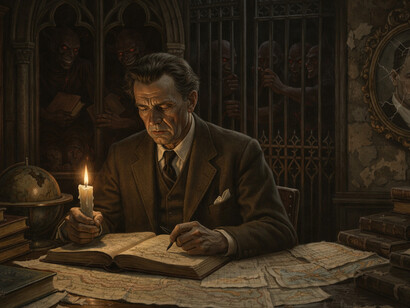
"How much do we really know about the vaults and caverns which lie somewhere under the structure," he asked, "about these psychic catacombs in which all our concealed desires, our fearful dreams and evil spirits, our vices and our forgotten and unexpiated sins, have been buried for generations?"
The answer, he discovered, was very little.
Reck's sharpest observations concern the pleasure his contemporaries took in the regime's excesses. Not merely tolerance or complicity, but active enjoyment. He describes dinner parties where guests competed to share the most lurid rumours about Jewish neighbours. He records the gleeful anticipation with which ordinary Germans awaited each new escalation, each new transgression of civilised norms.
This is what most analyses of far-right politics still miss. The focus on economic anxiety, on cultural displacement, on legitimate grievances exploited by demagogues – all of this treats the voter as a rational actor making a mistake that better information might correct. Reck knew otherwise. He watched educated, prosperous, comfortable people embrace barbarism not despite but because of what it offered them in the transgressive thrill of casting off restraint, the satisfaction of finally saying what one had always thought, and the libidinal charge of collective cruelty.
"They are not being misled," he wrote of his neighbours. "They are getting exactly what they want."
I think of this when I try to understand the political realignments of our present moment. The return of figures and movements that polite commentary had declared finished. History had ended, or so we were told. The ideological schisms and fights of yesterday, of that ugly, old world, were no more. So rejoice. You do not need a drink; you are ideology. Turn away from the ruin of failed political projects, for you have joined the winning side. This was the promise of the end of the Cold War.
We know now, far too late, that this was an illusion – a kind of Fata Morgana in the body politic of our times. Our collective appetite for provocation seems to intensify rather than diminish with each scandal. The voters who tell pollsters they know their chosen leaders are liars, are cruel, and are corrupt—and support them anyway, perhaps because of these qualities rather than despite them.
The liberal assumption is that politics operates through interest. People vote for what benefits them, and a sufficiently persuasive account of their true interests will shift their allegiance. Reck, however, understood that interest is not the only engine of political behaviour. There is also spite. The desire to wound, to burn, to drag others down into one's own misery. The pleasure of destruction for its own sake.
This is what declining material circumstances produce in some—not all, but some. Not the revolutionary who believes a better world is possible, but the arsonist who has concluded that if he cannot have what he wants, no one else should either. The politics of "at least it will make the right people angry." The voter who understands perfectly well that the policies they support will harm them and votes for them anyway because the harm will be shared, and shared suffering feels like justice to those who believe they have been suffering alone. It is a system of duelling sadisms.
Reck saw this dynamic with terrible clarity. "They would rather perish in filth," he wrote of certain of his countrymen, "than give up a single one of their vices."
What Reck could not have anticipated was the technological infrastructure that would eventually be built to service these appetites. The psychic catacombs he described were, in his time, largely private; shameful desires were nursed in isolation and expressed only in trusted company or not at all. Stigma and taboo and shame still existed. The genius of digital platforms is to have made the catacombs social. To have transformed private vice into public community. To have built recommendation algorithms that identify your buried appetites and connect you with others who share them, validating and amplifying what might otherwise have remained suppressed.
The result is visible everywhere, if one cares to look. The forums where violent footage circulates as entertainment, where death is edited into compilations and set to music, and where hundreds of thousands gather to watch and comment and compete for engagement. The social media ecosystems where cruelty generates clicks, clicks generate revenue, and revenue generates more cruelty. The political movements that have learnt to harness transgression as a mobilising force, understanding that the outrage of their opponents is itself a reward for their supporters. How else are we to make sense of the mainstreaming of every conceivable type of extreme content online?
This is not a return to the 1930s. The mechanisms are different, the contexts distinct, and the outcomes uncertain. But the appetite Reck diagnosed, that libidinal hunger for destruction, for transgression, for spite – this has not changed.
One of the most disturbing passages in the diary describes Reck's encounter with Hitler himself, years before the seizure of power, in a Munich restaurant. Hitler was then a marginal figure, a failed artist ranting to a small circle of followers. Reck watched him eat—"slices of cake, which he consumed with a spoon, as though they were porridge"—and saw nothing impressive. A "raw-vegetable Genghis Khan", he called him. A nullity.
And yet this nullity conquered Germany. Not through force alone, not through cunning alone, but because he offered something millions of people wanted: permission to be their worst selves. Hitler was, in Reck's account, less a leader than a permission structure. A living licence to indulge in what had previously been forbidden. His vulgarity was not a defect but a feature; it signalled that the old restraints no longer applied.
I think of this when I watch contemporary political figures whose appeal seems inexplicable by conventional measures. The gaffes that should destroy them but don't. The cruelties that should repel but attract. The lies are so obvious that believing them becomes an act of tribal allegiance rather than cognitive error.
The supporters understand this perfectly. They are not being fooled. They are being liberated – liberated from the scolding nature of bourgeois society. Liberated from the obligation to be polite to people they despise. Liberated from the demand that they perform concern for strangers, and above all, liberated from the exhausting fiction that the rules were ever applied fairly and therefore deserved their respect.
Reck offers no solutions. He was not that kind of writer. But we at least get a diagnosis, a precise account of how a civilised society can choose barbarism. How the desire for destruction can become its own justification. How spite can feel, to those who wield it, like justice.
He also offers a warning, though not the one usually drawn from his diary. The conventional lesson is vigilance: watch for the signs, resist the demagogues, and defend the institutions. All of this is true, and all of it is insufficient. Reck's deeper warning is about the self. About the psychic catacombs that exist not only in nations but also in individuals. About the buried appetites that crisis and permission can surface in anyone. Though a monarchist and arguably a reactionary himself, he recognises that fascism starts firstly as a blight of the soul and of one's world-facing, moral self.
"I have spent the last several years in the position of a man who has stumbled into a den of murderers," he wrote. "Now I sit in a corner, trying not to be noticed, hoping against hope that I will be able to slip out before anyone catches sight of me."
He was arrested, transported, and killed. But even had he survived, he would not have escaped uncontaminated. No one does. To live through such times is to be shaped by them, to discover in oneself responses one would rather not acknowledge, and to feel the pull of the catacombs even as one resists it.
We are not in Weimar. We are not facing the specific concatenation of forces that produced National Socialism. Historical analogies seduce us into believing we know how the story ends, and we do not. What we face is something new, something still taking shape, something whose ultimate form remains undetermined. If only we had our own Reck for this moment.
Source
Reck-Malleczewen, Friedrich. Diary of a Man in Despair. Translated by Paul Rubens. New York: New York Review Books, 2013.