English
 Español
 Français
 Deutsch
 Italiano
 Português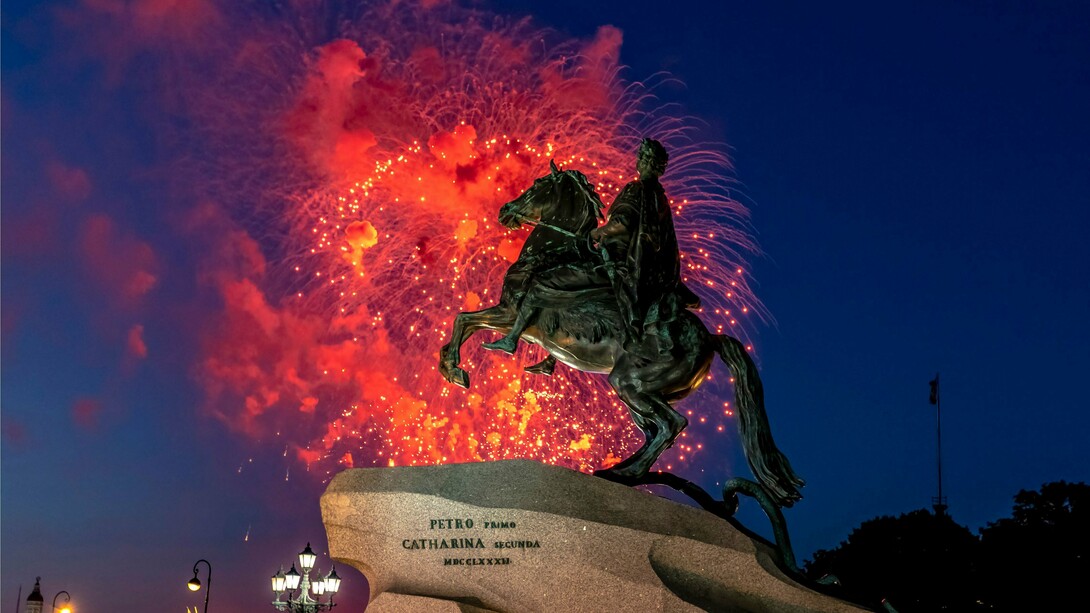
Peter the Great was named tsar at the age of 10 and began to rule in 1689 at the age of 17 until he declared himself 'Emperor of All Russia' in 1721. At the age of 25, he traveled through Europe, where he was amazed by its culture, refinement, and scientific, naval, and military advancements. He spent months in the Netherlands. He decided that Russia needed to become more European and be brought closer to the great capitals. Confronting the Swedish Empire, he gained access to the Baltic Sea and began construction of what is now St. Petersburg in 1703. With a long-term geopolitical vision, he then began building a major port that still connects Russia directly to Western Europe today.
As a rising power, Peter the Great challenged the Swedes, who controlled Northern Europe. He defeated them at the Battle of Poltava in 1709. This marked the beginning of an expansion that had already incorporated Siberia and reached the Pacific Ocean, where Vladivostok was founded in 1860. The monarchical dynasty, which spanned more than 300 years, established itself as a military force and one of Europe’s great powers. It formed temporary or long-term alliances with major nations to maintain the balance of power, halt Napoleon, or support the great empires. At the same time, the dynasty produced writers, musicians, and scientists who left a lasting mark on art and literature.
Peter the Great was succeeded by his wife, Catherine I, with whom he had no children, although he had a son from a previous marriage, Peter II, who died aged 14. Next came his grandson, Peter III, who was married to a Prussian princess. Six months after assuming the throne, she orchestrated one of the most famous coups in Russian history. She took the name Catherine the Great and continued the imperial strategic vision. Her armies continued the expansion by conquering Crimea from the Ottoman Empire in 1783, thereby gaining access to the Black Sea.
Her intention was to reach Istanbul to gain access to the Dardanelles, and from there to the Mediterranean. However, they were stopped by England, which had allied with the Turks when it saw its control of the seas being threatened. The Russian Empire reached its greatest extent by incorporating parts of Poland, Ukraine, Finland, Estonia, Latvia, Lithuania, Belarus, and the Caucasus, among other territories. However, it began to weaken in the late 19th century under the Romanov dynasty, finally ending with the Russian Revolution of 1917.
It expanded from 13 million km² at the beginning of Peter the Great’s reign to 22.8 million km². Shortly before the end of the First World War and the signing of the Treaty of Brest-Litovsk in March 1918, on Lenin’s orders to consolidate the revolution, it was forced to cede many of those countries, which then declared their independence. In November of that same year, at the end of the Great War, the Bolsheviks declared the treaty invalid, entering into a civil war that lasted until 1922, when the Soviet Union was officially established.
Following the 1939 agreement between the USSR and Germany, the Soviet Union’s foreign policy and military power once again embarked on territorial expansion, incorporating eastern Poland, the three Baltic states, Moldova, Ukraine, and Belarus. In February 1945, at the Yalta Conference, Stalin, Roosevelt, and Churchill sealed the fate of Eastern Europe, and following Germany’s surrender and the Red Army’s entry into Berlin in May, this was confirmed.
The territories liberated by the Soviets remained under their control, and Berlin was divided into four zones, with the United States and Britain ceding one section to France. Only Tito’s Yugoslavia, which had almost entirely liberated itself from the German and Italian invaders, remained outside Moscow’s sphere of influence.
A total of eight leaders took turns in power during the 74-year Soviet dictatorship, from Lenin to Gorbachev. None of them ceded territory or granted independence to any of the countries under their control. The policy of balancing power with the United States relied on nuclear deterrence—the threat of mutual destruction—which resulted in an extended period of stability in Europe.
During this time, the West enjoyed freedom and economic growth, while the East had to deal with growing discontent among its population and the hardships of limited economic development. By the time of the Soviet Union’s dissolution in 1991, the territory governed from the Kremlin covered nearly the same area as the Russian Empire founded by Peter the Great—22.4 million square kilometers, not counting its influence over the countries of the so-called European socialist bloc.
Peter the Great's influence has always been significant in the context of empire, territorial expansion, and Russia’s role in Europe. This was true during the communist era and remains so in today's Russian Federation. In 2005, President Vladimir Putin made this clear when he stated: 'The collapse of the Soviet Union was the greatest geopolitical catastrophe of the 20th century.' This surely included the loss of 5.3 million square kilometers, reducing the country’s area to its current size of 17.1 million square kilometers—a decrease of 24%. The population also declined from almost 300 million in 1991 to 150 million today.
Around 25 million ethnic Russians and almost 90 million Russian speakers now live outside Russia’s current borders. Nevertheless, Russia remains the world’s largest country and the most populous in Europe. Geopolitically, the Russian Federation lost the security of its western border, as well as its territorial and maritime connectivity, when it ceded Ukraine, including the Crimean Peninsula.
The collapse of the Soviet Union, the reunification of Germany and the resulting political and economic upheaval led to the weakening of the Russian state and the loss of its status as the world’s second-largest power. This was accompanied by a social crisis, corruption, and widespread discouragement among the population. The United States took advantage of the decade during which Boris Yeltsin was in power to expand its military bases eastwards, despite having committed not to do so. Henry Kissinger and George Kennan, among others, have pointed out that this disregards Russian national interests and increases the risk of new wars.
Current leader Vladimir Putin, who has been in power—whether as prime minister or president—since 1999, understands the importance of history, traditions, culture, and national pride in societies. His vision for Russia's greatness and its rightful place in Europe builds on a foreign policy vision that began in the 18th century and focused on border security and Russia's role. This was confirmed by the invasion of Crimea and the subsequent war of conquest against Ukraine.
From the perspective of international law, this constitutes a clear violation of the United Nations Charter—a fact that other powers have also failed to respect, as evidenced by the daily occurrence of treaties being disregarded and countries in the Middle East being attacked outside the legal framework established by the Security Council.
However, politically, the issue is more complex. The United States came close to entering a third world war in 1962 when the Soviet Union attempted to deploy nuclear missiles in Cuba, which constituted a direct threat to US security. The Ukrainian government’s intention to join NATO and establish military bases on Russia’s borders is also a cause of the current situation, resulting in thousands of deaths, destruction, increased military spending, and greater insecurity for all European countries. There is no end in sight that would satisfy everyone.
Russia will undoubtedly be weakened by sanctions and the ongoing war, but it will continue to be a major power in Europe. Together with the United States, it remains a leading nuclear country. Just as tsars and emperors did before them, Moscow seeks alliances based on common interests, as it is doing today with China and other allies. However, politically, the issue is more complex.
Alexander III joined forces with France to counter Prussia, the Austro-Hungarian Empire, and Italy in 1894 to seal the Franco-Russian alliance—and to remind everyone that there are no permanent enemies or friends. He financed the bridge that bears his name, which crosses the Seine and connects Les Invalides, where Napoleon is buried, with the Champs-Élysées, home to the Grand and Petit Palais, considered one of the most beautiful bridges in the French capital.