English
 Español
 Français
 Deutsch
 Italiano
 Português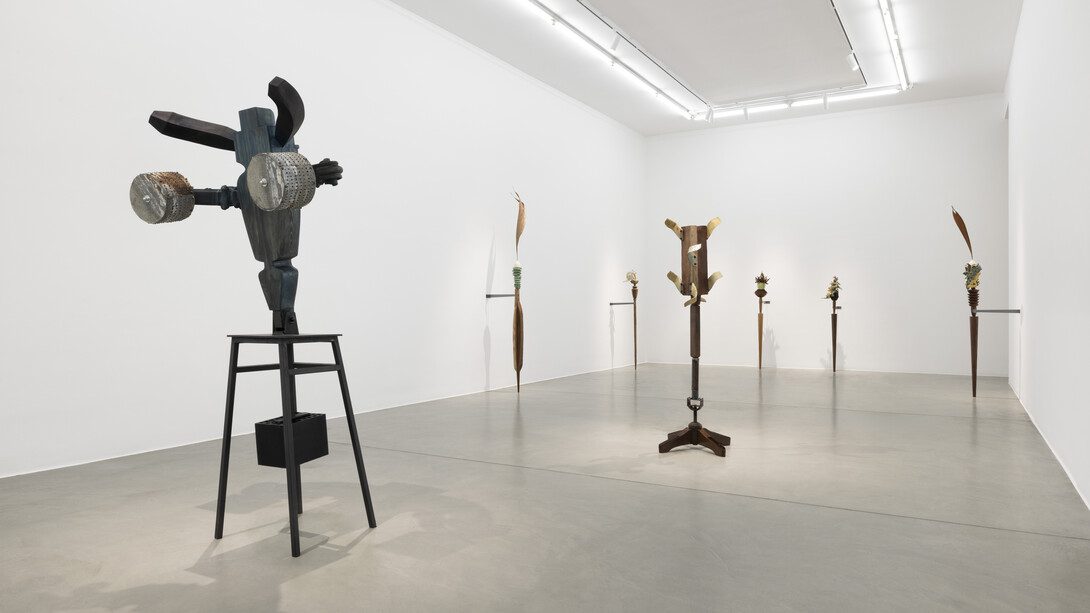
In this exhibition, a distinctly autobiographical dimension of Francesco Simeti’s practice emerges with particular clarity, intertwining personal memory, popular culture, childhood imagery, and reflections on the relationship between humans and the landscape.
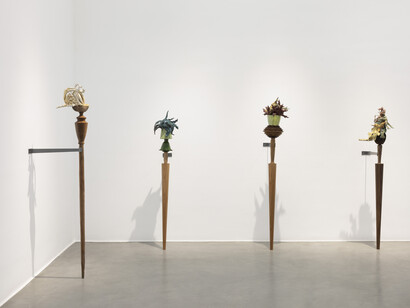
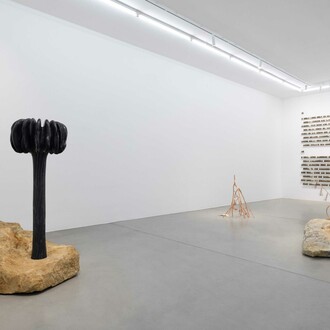
The presented works seem to emerge from a process of reactivating memories connected to the artist’s childhood and visual education in the countryside of Alcamo, Sicily. The first sculptures in the exhibition recall works that Simeti created as a very young artist at his family’s farm: assemblages built from carved stones, metal fragments, and found materials, often positioned near the machinery used for agricultural labor. Objects without a precise purpose, yet somehow preserving the memory of one, as if they simultaneously belonged to the worlds of tools, sculpture, and living creatures.
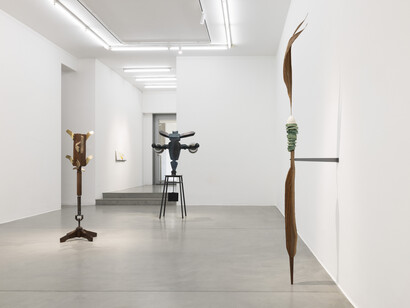
This same ambiguity runs throughout all the exhibition. The sculptures seem to constantly oscillate between mechanical presence and anthropomorphic figure, between industrial wreck and fairy-tale character. The large wooden and metal figure in the first room inevitably evokes the frontal, theatrical structure of Sicilian puppets, while at the same time keeping something fragile and improvised, almost domestic. In many of the works emerge an imaginary world that belongs equally to the history of twentieth-century sculpture and to popular culture, handmade toys, cartoons, and children’s narratives. Even the reference to the Barbapapà characters and the stories in which they try to protect trees and gardens from the advance of bulldozers does not appear here as a simple nostalgic quote, but rather as the resurfacing of a form of primitive ecological imagination—only seemingly naïve—in which nature is perceived as something alive, vulnerable, and deeply bound to the emotional sphere.
The media themselves also tell a story of personal transformation. All of the wood used in the sculptures comes from a wood shop in New York where the artist shared a studio until a few years ago. The closure of said shop and moving to a new studio marked an important turning point in Francesco Simeti’s practice, radically altering his relationship to workspace and production. While many earlier works developed in relation to immersive installations and large-scale environments, these pieces instead seem to arise from a more intimate and closer condition. This is not a reduction, but rather a shift toward a more physical and everyday dimension, in which the relationship between body, materials, and space becomes direct and continuous once again. For this reason, the works retain something visibly constructed, assembled, almost provisional, as though they intentionally leave exposed the process of their making.
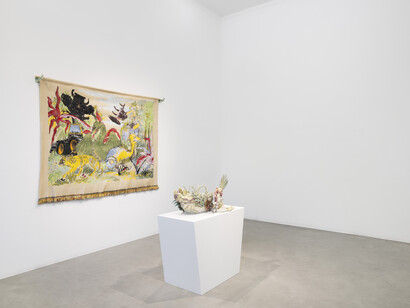
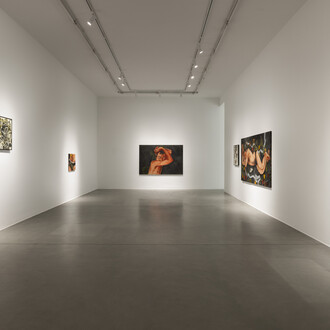
In the plaster paintings, nature seems to slowly emerge from the surface, like an image surfacing through processes of layering and sedimentation. The drawings and watercolors, which for a long time inhabited Simeti’s working process in an implicit and preparatory way, are shown here for the first time as autonomous pictorial elements, appearing in the exhibition as an integral part of the construction of the works. For Simeti, drawing often represents a preliminary space of observation and transformation: landscapes, forms, and figures that take shape on paper before becoming sculptures and installations. The tapestry also originates from this same process, developed from a watercolor created in one of the notebooks the artist constantly carries with him, like a mobile archive of images, intuitions, and visual memories.
Together with the sculptures in the first room there is a sound component built from recordings of circular saws, logging machines, and the thuds of falling trees intertwines with the buzzing of bees, wasps, and other pollinating insects. Gradually, the two sound ranges begin to merge. The organic noise of the insects takes on an aggressive, mechanical presence, while the sounds of the machines seem to lose part of their industrial rigidity. The listening produces a continuous perceptual uncertainty, in which nature and artifice cease to appear as opposites and instead begin to contaminate one another reciprocally.
The exhibition develops from research initiated by Simeti on the occasion of the Cheongju Craft Biennale in Korea, where the artist began reflecting on contemporary technologies tied to the intensive extraction of natural resources. Forestry machines used to fell, uproot, and strip trees become the central iconographic core of the project. Tools designed to take control and dominance through extremely precise movements here assume an almost emotional and bodily presence in Simeti’s works. In both the tapestry and the large sculpture in the first room, these machines seem to transform into hybrid creatures that grasp, embrace, and wound at the same time, making visible the thin line separating care, control, and devastation.
Through the layering of images, materials, and personal memories, Simeti constructs an exhibition in which ecological reflection does not emerge through a direct representation of catastrophe, but rather through ambiguous, seductive, and deeply human forms. An emotional landscape in which the machine takes on the features of a body, sculpture those of a character, and where even violence continues to coexist with the stubborn desire to imagine a possibility of relationship between humans and nature.