English
 Español
 Français
 Deutsch
 Italiano
 Português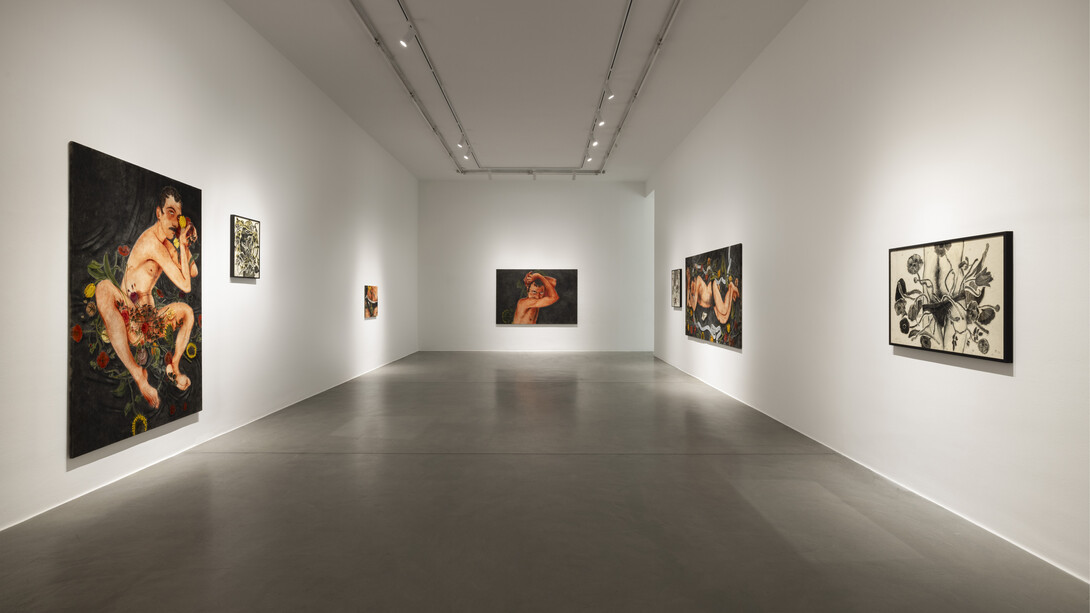
Act I: Ostinato
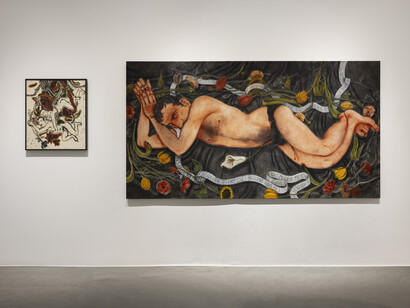
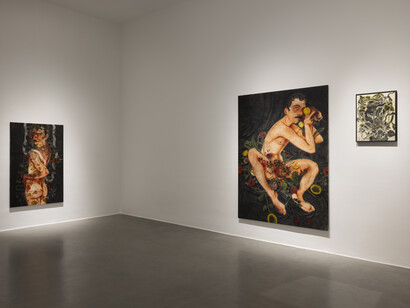
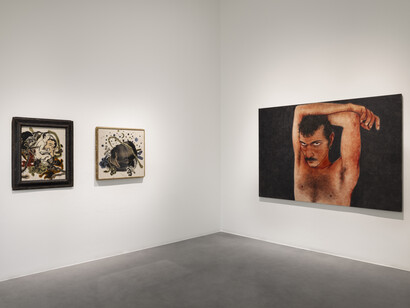
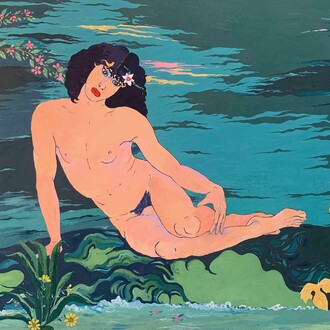
Obstinate does not only mean headstrong, perseverant, stubborn, tenacious, resolute, firm, tireless, persistent, and other such adjectives. In music, an ostinato is a recurring, constant motif, insistently repeated, upon which a series of variations are then grafted. Intriguingly, in some cases it is defined as a “musical pattern” intended to create an effect of static continuity and, at the same time, a separation from the other parts, especially the melody. This image fits perfectly with the work of Roberto de Pinto: from the very beginning of his career everything has revolved around the representation of what we might call the artist’s alter ego: a recurring and constant figure that, from time to time, is depicted in new and often surprising ways. These are not self-portraits, for the bodies and faces we see are actual characters, profoundly influenced by the artist’s physiognomy but then made independent, almost as if they were figures from a novel or play by Pirandello. But that’s not all. In some ways, in de Pinto’s hands painting becomes a tool for exploring identity and experimentation, inevitably evolving by intertwining with his life. This exhibition is clear evidence of this: compared to the paintings of his early years, which were more graphic and rooted in the fundamental component of the line and drawing, today more painterly and complex surfaces emerge, characterized by numerous nuances achieved through the more frequent use of oil paint in addition to encaustic, his signature style, which still dominates and allows him to achieve interesting epidermal effects. In the paintings presented here, we see a dark background from which the figures forcefully stand out, very theatrically, as if emerging from a dark scene, acquiring a sculptural, volumetric solidity, even more realistic, given by the new pictorial treatment of the body’s surface.
Act II: Capriccio
The exhibition holds a surprise, a series of works that open up a new path in de Pinto’s career. They stem from a performance – his first – held in Turin last autumn, in which the artist, after stripping almost completely, began handling a series of cut-out drawings following the outlines of the images, which completely covered the performance space. He then placed them on his own body, on his own skin, as if he were performing a dance of love with paper models of possible identities. All this while singing the song Amandoti by the group CCCP. Using these cut-out drawings, the artist began to create collages and compositions, as though the individual elements had become letters of an alphabet or words from a dictionary from which to draw on in order to compose love phrases. The drawings suggest (even through their title, Capricci) the way in which throughout the exhibition there is much of the atmosphere and feeling of moments in painting such as the Rococo and of artists such as François Boucher, Jean-Honoré Fragonard and Jean-Antoine Watteau, where frivolity became a diversion – and at the same time a hidden instrument of pictorial evolution – within which the anxieties of history often nest.
Act III: Pas de deux
The performance, and especially the theatricality of that moment, was a turning point that has clearly shaped this exhibition. The figures in the paintings have lost the irony of the past (which instead remains in the collage drawings): they are less sly, they pose nude in a deeply sensual manner and wink with great seriousness at the viewer, or perhaps only at the painter –we’ll never know. But we can’t shake the feeling of being superfluous in this pas de deux between the artist and his subject. The painter responds to his figure’s gaze by covering the body with flowers of many different species, painted with a vitality and love that we could only find in the botanical approach of Pisanello or David Hockney. The only elements that seem intended for us observers (voyeurs) are the fragments of poems, mostly love poems, inserted into the paintings and drawings – sometimes like comic book balloons, sometimes similar to the way the words reach Mary from the mouth of the Angel in Simone Martini’s Annunciation -in which we find some form of commentary on this exclusive and faithful relationship, albeit one keen to be spied on. The poems are by writers such as T. S. Eliot, Pablo Neruda, Constantine Cavafy, some of de Pinto’s most beloved authors, as well as works by Ravel. And there are so many roses in these poems: an eternal symbol capable of uniting body and spirit, of holding together the Mother of God and Jean Genet, an allegory and anagram of Eros, the only force capable of guiding our lives and our dance in the world.
(A critical text in three acts, by Antonio Grulli)