English
 Español
 Français
 Deutsch
 Italiano
 Português
"Grey has infinite shades," sings Jorge Drexler, the Uruguayan musician, together with the murga Falta y Resto, in his song Las Palabras from his last album Taracá. The song says, "Let's use words to create nuance. Let's seek subtlety in speech. Let's honor every letter of what is said."
For some time now, that song has been resonating in me with the feeling that it is pointing to something that is breaking. Not only words, but the very possibility of nuance. The possibility of complexity.
There are things that are wrong and are simply wrong. Genocide. Torture. Injustices. Crimes against humanity. Everything that threatens our lives. Defending nuance can never become an excuse to suspend judgment in the face of horror; that would be its most comfortable perversion, but it is not what I am referring to. What is at stake is something prior: the capacity to hold complexity without being paralyzed by contradiction or pushed toward a side.
Ch'ixi
Silvia Rivera Cusicanqui, from the Aymara cosmovision—a people who inhabit the heights of the Andes, in South America—offers a concept for this: she calls it "ch'ixi," a word that also names a color: a grey made of small black and white dots that appears when both coexist side by side without ever fully blending. From afar it looks like one; up close it is two.
Ch'ixi, she writes, escapes the idea that everything must merge into one. It works as a "third included": something that is and is not at the same time. She asks: "Why must every contradiction become a paralyzing either/or?"
That question speaks directly to our time. The obligation to choose a single color. The fear of internal contradiction. The suspicion toward those who can hold two apparently incompatible ideas without needing to resolve them. Why can't two positions coexist? Why, for example, does conflict arise when we say we are against a military invasion of a sovereign country and at the same time against the very authoritarian regime that governs it?
Gloria Anzaldúa, a Chicana writer—a term used to name her Mexican-American identity shaped by the border—called this capacity tolerance for ambiguity. For her, the "new mestiza consciousness" learns to live within contradictions, to move between worlds, to hold multiple perspectives without rejecting any. Or rejecting several at once. It is living in that complexity.
Thinking from the border, says Anzaldúa, is training yourself in this: going beyond rigid categories, resisting the need for a single answer, and remaining open to tension instead of resolving it too quickly.
By this point, this may sound abstract, even poetic. But it has a direct political translation.
Between antagonism and agonism
The Belgian political theorist Chantal Mouffe distinguishes between two ways in which societies deal with conflict. Antagonism: the other is an enemy that must be destroyed. Agonism: the other is a legitimate adversary with whom I disagree but whom I do not seek to eliminate.
Her thesis is uncomfortable and necessary: conflict in politics cannot be erased; what changes is how it is expressed. When democracy loses its agonistic space—when it stops offering ways for differences to appear as debate instead of war—what remains is pure antagonism. The language of the enemy.
Mouffe has also argued that the rise of the far right in Europe coincided with moments when traditional parties became indistinguishable from each other. Polarization, in that sense, is the symptom of a politics that has lost its capacity for nuance.
But wouldn't it be more convenient to talk more? To connect through words, to connect through the encounter with the other? The question is not whether conflict exists, but how we engage with it. When the other becomes an enemy, conflict becomes destructive.
But conflict can also become a space of transformation. For Mouffe, conflict is the engine of democracy itself. We fight. We must fight. But we fight so that the other can exist, not so that the other disappears.
In her essay For a Culture of Conflict, cultural policy specialist Dr. Friederike Landau-Donnelly argues for a "culture of conflict": a practice in which conflict mediation is trained like a muscle.
She names some of its components: agonistic listening, a desire for complexity, and an affective and empathetic attitude toward disagreement.
Conflicts, from her perspective, can be spaces of movement of ideas, positions, and communities. This requires practice. The capacity to listen without reacting immediately.
The grey is not the absence of tension. It is the space where tension can exist without collapsing into hostility. Conflict, sustained this way, becomes generative. It opens a space where ideas can be tested, where positions can move, and where transformation becomes possible.
Building bridges through gray areas
How often do we choose A or B because it is easier and, many times, safer? Staying in the grey can make us feel exposed; there is no clear side to belong to and no group ready to defend you. You risk being misunderstood or, simply, being left alone.
But perhaps the problem is not only the fear of being "canceled." Perhaps it is also a kind of mental laziness. Choosing a side too quickly saves us from the harder work of thinking.
Living in the grey is carrying that weight. Resisting easy answers. Staying with questions a little longer than we are used to.
But if we go to the etymology, "dialogue" comes from the Greek "dia-logos," meaning "through the word." It does not imply reaching agreement. Rather, truth, or meaning, flows between two people; it does not belong to either of them. The "grey" is that in-between space: a shared ground where two people meet without merging.
By this point, Drexler's song keeps playing in my mind. Because when nuance disappears, the first thing that breaks is language. Insults replace arguments. Labels replace people, and we reduce the person in front of us to a single word that is often loaded with rejection.
The grey is not a soft mix of colors; it is a field of forces. It is harder than the white or the black because it asks us to remain where tension lives. And I am not referring to inhabiting the grey as a retreat into silence or an invitation to passivity.
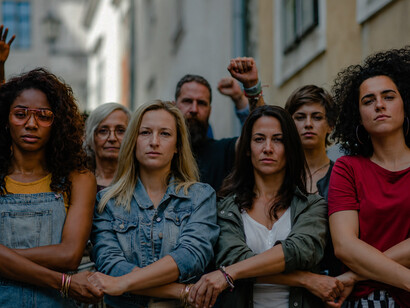
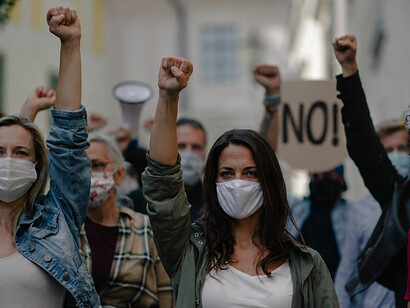
It is not about lowering the voice but about turning up the volume of complexity. It is the radical refusal to let ourselves be simplified. In times when our identities and struggles are being reduced to empty slogans, raising our voice from the place of nuance is an act of cultural rebellion.
It is the courage to hold our banners high without closing our eyes to the contradictions of the world.
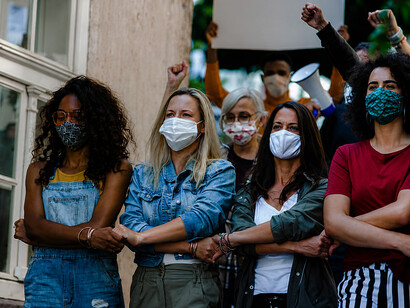
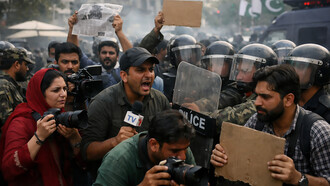
Organizing, taking to the streets, and shouting for what is ours requires, precisely, the capacity to meet the other in that in-between space. Black and white are walls. Only the gray is a bridge strong enough to carry the weight of a collective construction.
Inhabiting the grey is polyphony. Being loud in the grey is daring to say truths that make both sides uncomfortable. It is the sound of many different voices organizing without erasing each other.
Reclaiming complexity is, in that sense, a radical stance against the simplifying logic of the algorithm. Let's take feminism as an example: I heard women in a university classroom say they have stopped using the word because it "makes some people uncomfortable," and I think, why abandon words that carry so much weight?
We need a feminism wide enough to hold the indigenous woman, the trans woman, the working woman and the one who is not, the rural woman, the migrant woman, and the Afro-descendant woman, all and each one with her own gray, without demanding that we all think alike to march together. That is not a weakness of the movement. It is its only way of being real.
Change in the everyday
The Peruvian thinker Aníbal Quijano (1930-2018) became one of the central voices of decolonial thought in Latin America. He introduced the concept of the "Coloniality of Power," where he argues that colonialism did not end with independence but changed form. Race, labor, gender, and knowledge continue to be organized according to a colonial hierarchy that places Europe at the center.
For Quijano, this structure determines who is considered a legitimate knower, whose knowledge counts, and whose does not. His distinction between social movements and the movement of society points to something deeper than organized politics: the transformation of how people relate, think, and live together. And for that movement to happen in all its complexity, we must break the bubbles that isolate us from one another—the social, ideological, and cultural enclosures that keep different sectors apart and make real encounters not possible.
Argentine philosopher María Lugones took this idea further with the concept of the coloniality of gender: the male/female binary is not a natural category but a colonial imposition. Before European conquest, many Indigenous and African communities held more fluid understandings of gender, body, and sexuality. Coloniality did not only extract resources: it reorganized the most intimate categories of human existence. And solidarity, Lugones said, cannot be built from abstract unity but from the willingness to enter the other's world without erasing it.
And there lies the change, in the transformation of society itself: the cultural and relational shifts in how people live together. Diversity cannot exist only as the coexistence of separate identities. It requires the work of building relationships across differences, of sustaining bonds that are not predetermined, calculated, or confined within safe limits.
"Pedagogy of sensibility": tenderness as rebellion
Argentine anthropologist Rita Segato also takes this concept from Quijano and proposes the pedagogy of sensibility. Rather than invoking empathy or compassion, words she considers too large to have reached their destination, she calls for something more concrete: the pleasure of tenderness, of care, of recognizing that the other feels and desires.
She argues that the pursuit of power does not lead to happiness but to a narcissistic gratification rooted in the domination of bodies and territories. Studying gender and masculinity, she contends, is ultimately studying power. To imagine different futures, we must recover our capacity for imagination and ask from which position in the world we are thinking.
Segato says we live in a "pedagogy of cruelty": a training that teaches us to see the world in black and white so that it becomes easier to hate, to discard, and to turn the other into a thing. Cruelty needs simplification. If the other is only a label, an enemy, or an object, the violence becomes painless to the eye that watches it.
Against that, inhabiting the grey is embracing its opposite: a tenderness that is political and even subversive. Not tenderness as weakness, but as the force of defending the bond, life, and the irreducibility of the other against the simplification that kills.
The bond, unlike the thing, is alive; it changes; it is full of nuance. It is grey. Raising our voice is not only shouting slogans. It is shouting that we are human and complex and that our right to contradiction is what keeps us alive and organized. Tenderness, in this sense, is the glue of organization.
The right to opacity
The poet and philosopher Édouard Glissant, from Martinique—the Caribbean island—wrote against this logic through a beautiful idea: the right to opacity. In a time that demands total transparency, immediate clarity, and completely readable identities, Glissant defends the right not to be completely understood. To remain complex. To not fit entirely within someone else's gaze.
Opacity, he says, is the very condition of a real encounter. I can only relate to you if I give up the need to understand you completely. If I accept that there are parts of you I will not understand—and that this is not a failure, but a form of respect.
Perhaps this is the most silent cultural struggle of our time: whether we are still capable of sustaining a conversation with someone without reducing them to a side, without demanding that they become transparent, or without needing them to agree with us in order to consider them legitimate.
Inhabiting the grey, in that sense, is a political act. Aymara, mestizo, Caribbean, Uruguayan, Mexican. Latina, African, European, and Asian. From everywhere and from nowhere. Human, deeply human, and deeply complex.
"People pass, but words remain," sings Drexler at the end of the song. Perhaps words also pass when we let them harden into slogans. And perhaps the only thing that truly remains is what we do with nuance: the insistence on seeking it, the patience to hold it, the trust that between one extreme and the other there is a world.
Raising our voice for life is fighting for the right to be complex beings. Simplification turns us into things. Reclaiming the grey is defending our humanity.
I would like to close with this phrase by Gina Valdés, Chicana poet and writer: "There are so many borders that divide people, but for every border, there is also a bridge."
Perhaps, in the end, the grey is not an opaque mix of colors but the place where all colors are possible.
References
Drexler, Jorge. "Las Palabras." Taracá. Sony Music, 2026.
Rivera Cusicanqui, Silvia. Un mundo ch'ixi es posible. Ensayos desde un presente en crisis. Buenos Aires: Tinta Limón, 2018.
Anzaldúa, Gloria. Borderlands / La Frontera: La Nueva Mestiza. Trad. Carmen Valle. Madrid: Capitán Swing, 2016.
Mouffe, Chantal. Agonistics: Thinking the World Politically. London: Verso, 2013.
Landau-Donnelly, Friederike. For a Culture of Conflict: A Plea for a Cultural Policy of Conflict, Diversity, and Difference. Bonn: Friedrich-Ebert-Stiftung, 2025.
Quijano, Aníbal. "Coloniality of Power, Eurocentrism, and Latin America." Nepantla: Views from South, 1(3), 2000.
Lugones, María. "The Coloniality of Gender." Worlds & Knowledges Otherwise, 2(2), 2008.
Segato, Rita. Contra-pedagogías de la crueldad. Buenos Aires: Prometeo Libros, 2018.
Valdés, Gina. Puentes y fronteras / Bridges and Borders. Tempe: Bilingual Press, 1996.