English
 Español
 Français
 Deutsch
 Italiano
 Português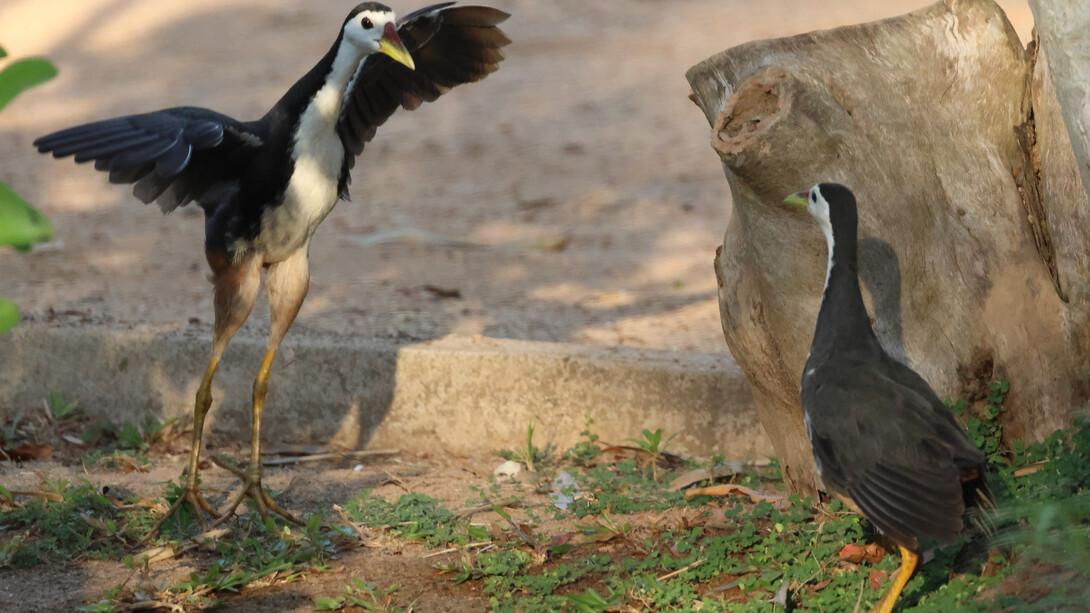
Ask an experienced birder, and they will often explain that ears are possibly more important than eyes when it comes to recording the presence or absence of a species of bird from a site. This is partly because some birds may be at a distance and not in the line of sight. Partly because birds, even those very close to the observer, may be concealed by vegetation. Partly because birds flying overhead may escape detection were it not for their flight calls. As a result, birders pay attention to learning the calls and songs of birds. Sometimes, it is purely for the aesthetic pleasure of listening to a dawn chorus.
On an April morning, I had arrived at Diyasaru Park, on the outskirts of metropolitan Colombo and just across from the parliament building. This morning, I decided to use my short visit to listen to the birds and enjoy them in an aesthetic manner and not be overly preoccupied with photography. The account below is based on notes I made in the course of two hours.
One of the first birds I saw when I entered the wetland park was a Purple Swamphen. It made a dash running for about two meters across lily pads and pulled something out of the water. It was a fish. This was the first time I had seen a Purple Swamphen actively hunt and catch a fish. It did not swallow it like a heron or egret but instead held it in one foot and pecked away at it. A female or possibly a first-year Asian Paradise Flycatcher chased away a White-throated Kingfisher. A Purple Heron was a few feet away from me and was not alarmed by my presence. It had a steely reptilian glare and we exchanged stares. In the background, Common Ioras and White-bellied Drongos were singing. The Ioras were uttering their screechy call. A pair often maintains contact with a constant medley of calls and songs. The Purple Heron flew away, uttering its guttural call. There was no sign of a person or animal disturbing it.
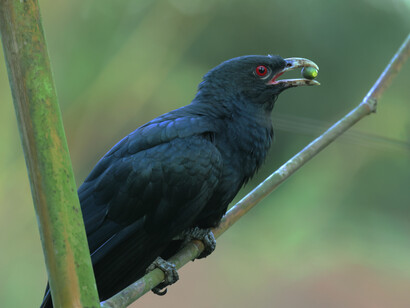
A male Asian Koel was calling, probably the same individual I have heard over the last week. The males call around April to find suitable mates. The female will then lay its eggs in a crow’s nest, as the koels are brood parasites. Although the male looks very similar to a crow, it’s a cuckoo.
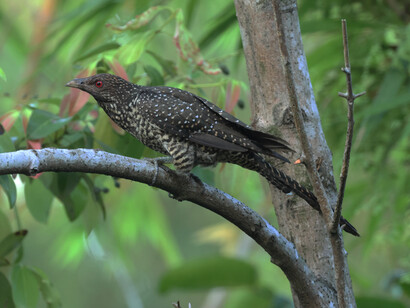
Two Purple Swamphens squabbled and then were joined by another two. They were leaping into the air. To my surprise, a House Crow also joined them and leapt into the air. The fighting lasted less than a minute. I noticed two female Asian Koels were close to the calling male. The females fought with each other, and one flew away.
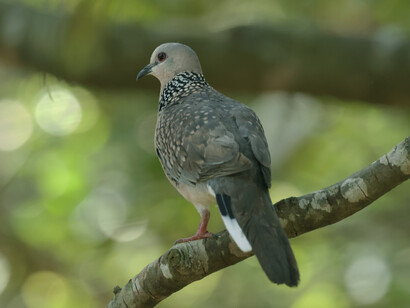
A Stork-billed Kingfisher flew in with its whinnying call and settled on a wire, and uttered a range of vocalisations. Two White-breasted Waterhen were pointing down at each other with half-raised wings to signify readiness to fight. After a bout of threat posturing, one bird gave in and scuttled away. A nearby house was playing some Buddhist prayers. The chants drifted, mixing with bird calls, including the cooing of Spotted Doves. A Little Green Heron took flight, and a Lesser Whistling-duck in flight overhead drew attention to their presence. The calls of an agitated Red-wattled Lapwing cut through the Stork-billed Kingfisher’s whinnying.
An Oriental Magpie-Robin was adding its own screechy notes to those coming from the Ioras. Equipped with a double larynx, the magpie-robin is one of the finest songsters in Asia when it chooses to sing. A Common Tailorbird was chattering in the low foliage, and in the canopy Brown-headed Barbets were thrumming and Pale-billed Flowerpeckers ‘tlip tlip-ing. Purple-rumped Sunbirds were joining in with their short, high-pitched notes. A Blyth’s Reed Warbler called harshly, sounding indignant at my presence.
A pair of the endemic Sri Lankan Lesser Flamebacks gave a whinnying call. Red-vented Bulbuls were calling cheerfully over a Palm Squirrel's insistent chip chip. I thought it would be an interesting study to see how many Palm Squirrels were present within the confines of the Diyasaru Park. They are such a common sight. A Spotted Dove was singing sonorously, with a Greater Coucal breaking in with an ‘oop oop’. The coucal is another species of cuckoo, with a crow-like appearance, with a black head and neck. It has a beady red eye.
A troop of Purple-faced Leaf Monkeys barked furiously, followed by whooping calls. A Forest Wagtail flew over, and Ring-necked Parakeets were screeching overhead. I looked up, and a Spot-billed Pelican loomed in like a giant, but did not touch down. A White-breasted Waterhen clucked quietly to itself whilst another broke into the rolling ‘korawak korawak’ call which gives rise to its local name, the ‘korawakka’.
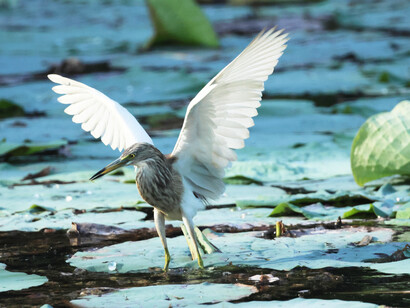
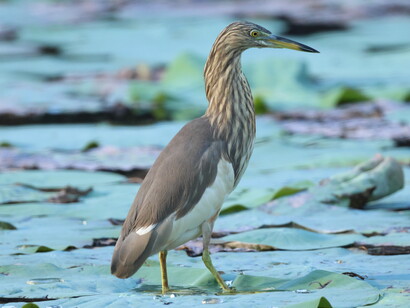
Two Little Green Herons flew across a channel of water. Two Purple Swamphens squabbled briefly, and one flew away grunting. A Pond Heron looked brown until it opened its wings and burst into white. Two White-breasted Waterhens squared up and battled; it was brief.
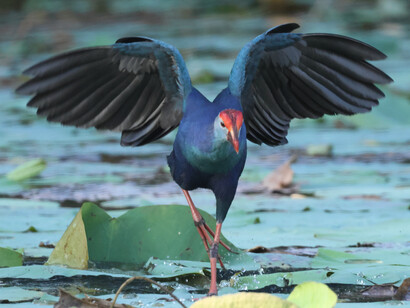
The Asian Koel kept calling, and the Oriental Magpie-Robin had now burst into song. The Stork-billed Kingfisher kept whinnying. A White-breasted Swamphen pranced on the floating leaves of water lilies, and I photographed it with wings outstretched. A Loten’s Sunbird called, the call with a metallic tone and not in concordance with the beauty of the bird.
The sun was still struggling to break through a veil of cloud. The muted light is nevertheless bright, such is the luminescence of the tropical sun. A White-breasted Waterhen stalked a Purple Swamphen and raised its wings to fight. Surprisingly, the swamphen retreated, but another swamphen fended off the waterhen, which beat a hasty retreat. An Asian Koel perched over me and started to make its repetitious ‘koo woo koo woo’ call. Perhaps it was the same male koel I had seen earlier. A bread van trundled past in the distance, playing a catchy tune. An Indian Pond Heron pranced on the water lilies as it sought to seize prey.
The Common Ioras continued to maintain contact with a medley of calls. The Asian Koel raised its call to a hysterical pitch and paused. After a lull, it uttered the ‘koo woo koo woo’ in a rapid sequence of notes and then fell back to repeating it at slow, measured intervals. A Common Kingfisher whistled past. A Yellow Bittern chattered from within a dense thicket. A White-throated Kingfisher whinnied, and White-bellied Drongos broke out into liquid bubbling notes. A flock of Yellow-billed Babblers started to laugh. A Greater Coucal made a scratchy call, very different from its deep guttural calls.
I sat down on a bench behind a thicket of bamboo and looked across a stretch of water. This place has been good in the past for close views of hunting Oriental Darters. A Palm Squirrel brought a bundle of fluff in its mouth to a nest it was constructing on a Golden Leather Fern just ten feet away from me. I would not have noticed it were it not for the rustle of its approach. The fresh leaves of the plant were a golden brown.
A Green Imperial Pigeon betrayed its presence from a fruiting tree near me with a deep-throated call. A White-bellied Drongo started to sing again and was joined by the fluty calls of a Black-headed Oriole. A Pale-billed Flowerpecker trilled whilst another uttered the familiar ‘tlip tlip’ call. Common Mynas make contact calls.
A pair of House Crows perched near me and started cawing. They lost interest in me and flew off. It was nearly 8 am, and surprisingly for a Saturday, I had been all alone. Perhaps it was not an auspicious day, as there had been no crowds of people on multiple wedding shoots. The enlightened managers of this park make it easy for people to turn up and buy tickets for professional shoots. As a result, Diyasaru Park is popular for wedding shoots (pre-wedding and post-wedding), birthday shoots (for babies and young children), as well as commercial advertising shoots. This makes fantastic business sense as the park generates a strong stream of revenues for its upkeep and makes it possible for birdwatchers and bird photographers to have a well-maintained biodiversity jewel on the city’s doorstep.
A young couple arrived with two small children, the mother carrying one in her arms. I thought how wonderful it is for children to grow up in a busy city and yet have an urban oasis such as this. During my childhood, I had no such luxury and had to wander around Colombo, bird watching on neglected plots of land which have now vanished under sports complexes and high-rise apartment blocks. As a thirteen-year-old, I used to wander about the city with my neighbour, away from home for hours at a time, with our parents having no idea where we were. This was in the days before mobile phones. This was a childhood that no child in Colombo will be allowed anymore.
A Green Imperial Pigeon started to ‘vroom’ from a tree. Birds were still vocal with a Koel, Greater Coucal, White-throated Kingfisher, Oriental Magpie-Robin, Common Myna, Purple-rumped Sunbird, Yellow-billed Babbler, and White-bellied Drongo still calling or singing. Above me, two male Asian Koels had perched. There was no sign of animosity. One called softly. A House Crow perched near them and kept a wary eye. They often chase koels who cuckold them. Iridescence glinted off one of the koel’s wings. They both flew away together amicably. An upturned water lily leaf caught my eye. The low light had brought out the strong veins that give it strength. Plain Prinias called in the distance. A security guard rode past on his motorbike on patrol.
I met another couple with their baby daughter. They recognised me and told me that they have many of my books, which they use to identify birds and other animals. They live nearby in Talangama, which also has a fine wetland complex. He tells me that he posts his bird photographs on Instagram. A pair of the endemic Sri Lankan swallow wheeled overhead. I visited the concrete pond to look at dragonflies. A few species were present, including Common Bluetail, Elusive Adjutant, Variegated Flutterer, Paddyfield Parasol, and Spine-legged Redbolt. A wheezing call alerted me to a Brahminy Kite wheeling overhead on a clear blue sky.
A crash in the branches alerted me to a troop of endemic Purple-faced Leaf Monkeys racing through the canopy. I passed a small party from the same troop. I make eye contact with one who is just a few feet away. They are so close, I know if I stop to take pictures, they will take fright and rush away. As they are feeding, I don’t want to disturb them for the sake of a picture, and I continued without pausing or interrupting their feeding. I had taken pictures earlier when they were at a what was a comfortable distance for them. It was now time to leave after a magical two hours, and I headed for the exit, passing a juvenile Land Monitor.