English
 Español
 Français
 Deutsch
 Italiano
 Português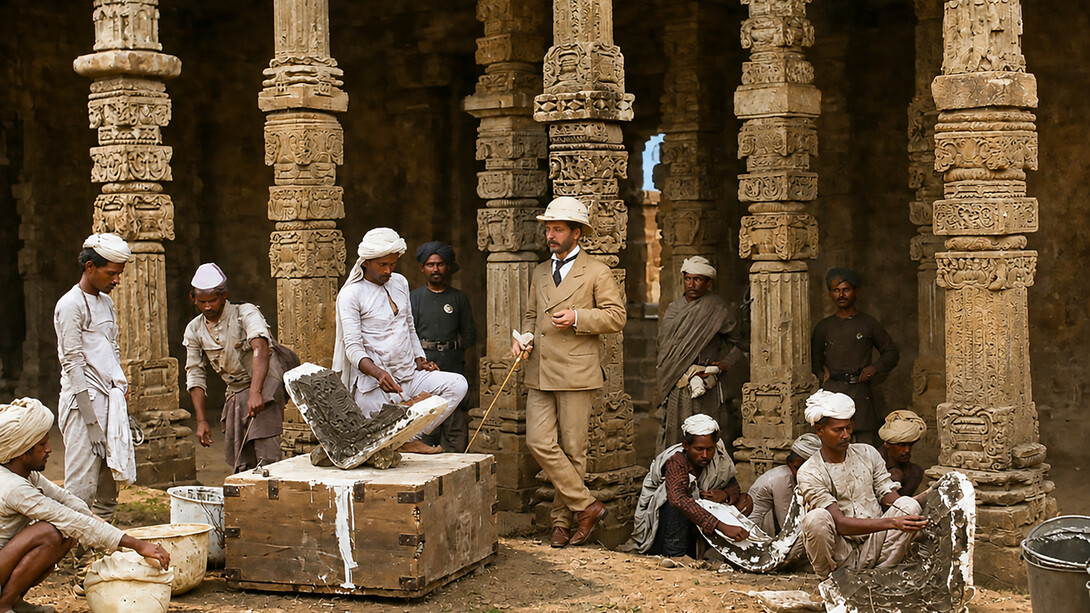
The study of the past saw a radical change in the 1830s. From an antiquarian approach that was essentially literary and bookish, the figure of the archaeologist emerged, giving way to a period of intense campaign of excavation that produced spectacular results. In fact, the nineteenth century is known for the discovery of monuments like the remains of the legendary city of Troy by Heinrich Schliemann, the reconstruction of the palace of Knossos and of the historical remains of the ‘Minoan’ culture in Crete, near Heraklion, or the discovery of the civilisations and monuments of ancient Sumer and Akkad in Mesopotamia, i.e., nowadays Iraq.
That these great discoveries went along with the imperial expansions of Europe in the East is a certain fact that is now beyond debate. It is in this context that it is possible to relocate the narrative on the discovery of the said ‘Indo-Greek’ civilisation, dating back to the aftermath of the extensive conquest of Alexander the Great and his passage in India.
Considering these facts, I will argue that British 'orientalists' – or, for precision's sake, indologists – elaborated a narrative that implied that Britain’s role in India was to complete the Greeks’ civilising mission in India.
A British Champollion: James Prinseps
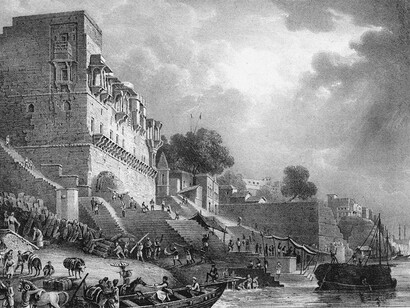
In Great Britain, James Prinsep is remembered as the pioneer of Indian archaeology. In the spirit of scientific patriotism, tainted with a dash of long-standing Anglo-French rivalry, British academics also remembered him as the counterpart of Champollion. It is true, however, that each man’s story has similarities. In effect, Prinsep unlocked the mysterious Brahmi scripts, whereas Champollion did so with Egyptian hieroglyphs. Moreover, both Prinsep and Champollion died young; the two deaths were most probably due to tropical fevers. In Kolkata (then, Calcutta), a monument, the Prinsep Ghats, was built to pay homage to him. After having spent months as “a wreck of mind and body", Prinsep passed away in quite a similar way to that of Champollion. Champollion’s legend may have been more successful with the French public than that of Prinsep, who is, however, academically recognised for his important discoveries.
The unlocking of ancient Egypt has much to do with the mythology surrounding Napoleon's expedition to this country, as said in a previous article (see H. Ikhlef, European colonialism and the 'Oriental Renaissance', Meer, August 2025). Still, the two contributed to writing the legend of the adventurous savants in distant countries, resurrecting long-dead civilisations and their mysterious scriptures. The French expedition ended in a debacle for Bonaparte and the French military. Yet, propaganda had transformed it into a formidable scientific success. Especially when Champollion claimed to have deciphered the Stone of Rosetta before British scholar Sir Arthur Young. Arguably, British academicians needed an alter ego or counterfigure that could challenge the narrative on Champollion; J. Prinsep became the ideal figure to counterbalance this myth.
Prinsep is remembered mostly as the great scholar he undoubtedly was. What must, however, be highlighted is that he came from one of the important families of the colonial elite in those times. His father’s success in the Indian trade secured comfortable wealth and opened the path for his sons to make ambitious careers within the East India Company. Indeed, the Prinseps were involved in Indian affairs since the time of Sir William Jones, in the 1770s. Three of John’s sons, Henry Toby, William, and George, became merchants and joined the famous commercial house Palmer & Co. William pursued a successful career at Palmer & Co. from 1817 until the agency’s bankruptcy, which led to a financial crisis in 1829-30. However, William Prinsep went back to India about two years later and joined Mackintosh & Co. (to which the Asiatic Society entrusted its funds after the Palmer & Co. bankruptcy).
This agency also failed in 1835, but this second failure did not dissuade W. Prinsep from making plans to establish another trading house. However, he was officially prohibited from carrying out any business activity under his own name. Therefore, he has native partners. In fact, William Prinsep met a ‘Babu’ with whom he launched another venture, also doomed to fail. That Indian partner was Dwarkannath Tagore, grandfather of the Indian national poet Rabindranath. Their partnership became known as Carr, Tagore & Co. William was also a member of the Asiatic Society of Bengal, together with his brothers Henry, Thoby, and, of course, James. H. T. Prinsep eventually became secretary to the government in 1836 and was elected president of the Asiatic Society in 1841. William Prinsep's younger brothers, Thomas and James, landed in Calcutta in 1819. James was yet to become the well-known orientalist that he would eventually be.
Initially, James Prinsep was to be an architect, but he finally entered, upon recommendation, the Calcutta Mint under the orders of Horace Hayman Wilson. Between 1820 and 1835, the Asiatic Society began to blossom as an institution chiefly devoted to oriental studies. This institution was then in the hands of James Prinsep and Horace Wilson, who had taken the lead of the so-called ‘orientalist’ party in their controversies against the ‘anglicists’ on policies of colonial education.
The notoriety of Gleanings in Science soon reached Europe, one of its most famous readers being Charles Darwin. In 1827, Prinsep founded a new journal, the Journal of the Asiatic Society of Bengal, which superseded Gleanings in Science. and the then-current publication of the Asiatic Society, the Asiatic Researches. It was then able to compete with its European offspring and counterparts, the Journal Asiatique (the organ of the Paris Asiatic Society) and the Journal of the Royal Asiatic Society of Great Britain and Ireland. Prinsep, in association with H. H. Wilson, had a tribune that they could also use for political purposes. During the Orientalist-Anglicist affair, for instance, they used their network to get support, both moral and material, from Oriental scholars in France and Great Britain. At an academic level, they had a powerful means to reach a wide public beyond India and devise a kind of scientific diplomacy that may exert some influence on colonial policies.
The deciphering of the Brahmi and Kharoshti scripts made Prinsep a famous scholar. As said, his accomplishments have been overshadowed by the celebrity achieved by Champollion. Nevertheless, it is worth setting chauvinisms aside and acknowledging Prinsep’s scholarship. It can be argued that the methods that allowed Prinsep to decipher both scripts were similar and perhaps influenced by the methods used by Champollion and his associates to unlock hieroglyphs. Just like this one, compared the scripts with Greek ones on the Rosetta Stone, so did Prinsep, ancient coins he happened to work on at the Mint.
Many items were sent to him due to military turmoils in Punjab and the Afghan frontier (there was no Pakistan yet before the latter was founded with the partition of India). The troubles in the region of the peninsula saw the involvement of former officers of the Napoleonic army, such as Rubino Ventura, a Jewish Italian born near Bologna, and Paolo Avitabile, from Agerola, near Naples. These men made their Indian careers at the service of the Rajah Ranjit Singh. Systematic exploration of the northern areas led to substantial discoveries; that was also due to these officers’ interest in archaeology and numismatics. Given their background as soldiers in the Grand Armée, it is possible to suppose that there is a connection with the expedition to Egypt led by Bonaparte. At least, it is possible to wonder whether military expansion and ‘antiquarian’ research have been coupled together and for what reasons. We could suppose that this was one way to devise cosmographies of worlds that Europeans experienced since Europe had become a set of imperial powers in the Americas first, and in the Orient then.
The invention of the Indo-Greek civilisation
The fact is that the context of the 1830s in Northern India afforded an impressive expansion of knowledge regarding this region. The most important result was the discovery of the traces of the kingdoms born subsequently after the Macedonian expedition led by Alexander the Great. Another of the generals of Ranjit Singh, and an acolyte of Ventura and Avitabile, was probably one of the first scholars who had taken an interest in tracing the routes followed by the Macedonian armies. Court also sold his 45-page account, ‘The Itinerary from Yezd to Caboul’, to the Calcutta government in 1832, in which he expressed his interest in tracing Alexander's passage in Afghanistan.
The itinerary was followed by some conjectures on Alexander's march in Bactria, which was published in the JASB in 1836517. Court's account was the result of his exploration and the synthesis of an incredible amount of information obtained from the locals of the regions he travelled through in 1827 and from one Haji Allah Khan, who was a secret agent of Singh who accompanied him. In 1830, Ventura opened the cupola of Manikyala, nearly thirty kilometres away from Rawalpindi in what is nowadays Pakistani Punjab. Direct communication with France being then not possible, they addressed the results of their research to Prinsep in Calcutta, and Ventura sent him “the complete collection of objects, including the relics, discovered in the great stupa of Manikyala".
Among other items, there was a long inscription on a small stupa. It is on this inscription that Prinsep deciphered the Kharosthi, and he announced his success at two meetings of the Asiatic Society of Bengal, in March and April 1838: he had successfully deciphered the names of two ‘Greek’ (indeed Macedonian) kings, Antiochus and Ptolemy, in the pillars of Asoka, the Buddhist king who ordered their construction.
Nevertheless, French generals of Ranjit Singh were not the only sources upon which Prinsep could rely. He had at his side a young officer whose role was to be central in the creation of the Archaeological Survey of India, of which he eventually became the first president: Alexander Cunningham. A letter from Cunningham to Prinsep, among James Prinsep’s private papers at the former India Office library, provides further details about the decipherment of the Kharosthi. The method used to decipher the Kharosthi has striking similarities to the one employed to unlock the Egyptian hieroglyphs and, to a lesser extent, the cuneiforms.
In fact, both methods were the result of an 'epistemological' encounter between Greek and local languages. For instance, Aρδοχρo is a Greek name for the Indian goddess of fertility, Lakshmi (लक्ष्मी lakṣmī), the consort of Vishnu, but also that of the Persian/Iranian divinity (Avestic, Ashi Vanguhi) of fecundity who shares common attributes with the Greek Demeter. On most coins of this period found in northwestern India, the names of kings were carved. In particular, Greek names. The presence of Greek names was extremely helpful. Just as in the case of the hieroglyphs, royal names provided keys to associate sounds with graphemes.
Prinsep asserted that no pandit knew the Karoshti and Brahmi scripts. Neither the pillars nor the coins had Sanskrit inscriptions and legends, and most were in Magadhi, the language in which the Buddha preached, though some were in Pali, one of the languages in which the teachings of the Buddha had been written down. At the same time, Magadhi is the ancestor of Bengali, the local language of the Presidency of Calcutta. Were there not native scholars knowledgeable in the different Prakrits and able to provide helpful assistance?
It was one thing to decipher the scripts with the help of Greek inscriptions. It was another thing to understand the languages in which the scripts were written down. Therefore, the assistance of pandits was indispensable, given that the languages of the Asoka edicts could be translated into modern Prakrit by applying the methods elaborated by ancient Indian grammarians that pandits had been using for a very long time. The process of understanding the language followed three steps. First, scholars rendered the Brahmi and Karoshti into Nagari that pandits could read. Pandits then applied transformational rules in order to render the Magadhi text either into Sanskrit or Bengali, Magadhi being the progenitor of the Bangla language (that of both West and East Bengal, meaning Bangladesh). Once this was done, it was easier for Prinsep and his colleagues to provide an English translation and to publish the result of their research.
The fact is that a new civilisation has emerged. It had to be named and, thus, characterised. The question now is: what did these people call themselves? What were the main features of their social organisation, religious beliefs, and economic development?
The British and European Orientalists soon defined the Indo-Bactrian kingdoms and the Mauryas as Indo-Greek. Indeed, the Greek influence is undeniable: numismatic sources testify to multilingualism just as the art (like sculpture, for instance) is characterised by strong Hellenistic influences. Generalist narratives placed the ‘Indo-Greeks’ amongst the many invaders who occupied India during antiquity. It became a mainstream view that the British were there to achieve the role of the Greeks: enlightening Indians with the lights of European civilisation, of which Britain was, obviously, the beacon.
By selection, colonial elites and British ideologues like James Mill attempted to construct a social identity that legitimised Britain’s presence in India. This kind of idea informed archaeologists and militaries. It was the case of figures like Sir Mortimer Wheeler during the 20th century. This was a trend of colonial justifications that was also used by the French in Algeria. Whereas the British Empire continued Alexander (except he was in favour of hybridisation and cultural fusions), the French constructed an image of themselves as successors to the Romans, who built monumental cities in Timgad and paved the way for Augustine to emerge in Hippo Regius (Annaba).
The invention of the concept of Indo-Greek cultures has a ‘scientific’ and historical base, just like many Orientalist discourses. Yet, it is epistemologically doubtful: it is an effort at applying filters to the interpretations of the past. The sources rather portray local cultures that had integrated elements of Hellenistic influences to some extent. These cultures and the political entities that partly represented them were, however, local. Buddhism was the main religion of their societies, and we have seen that coins also made reference to the Avestic divinity Aρδοχρo, assimilated to Lakshmi, not Demeter. The concept of 'Indo-Greek' is thus an overstatement in many regards; a construction which remains used because it has become a tradition and because no substantial effort has been made to reconsider the concept and its ideological implications. It is inserted in a providentialist framework stating that the Greeks pioneered (Western) civilisation, a mission, indeed, that the British had come to accomplish.
Politics of scientific power
The discovery, or invention, of the Indo-Greeks marked a turning point in Indian archaeology. One of the main consequences was the creation of the Archaeological Survey of India. In some ways, it was a continuation of a strategy of research already tried since the beginnings of colonial rule: unite competent scholars to carry out research more efficiently. Yet, there was a shift in practice as this one benefited from the technologies of the second half of the nineteenth century. For example, photography was imported into this field. It replaced hand-made illustrations and lengthy descriptions, thus saving time.
It was – as already explained at the beginning of this article – the time of great excavation campaigns, globally speaking. And the surveying modality can be interpreted as a new mode of measuring and organising territories. In this view, the archaeological survey completed predecessors like the trigonometric and geological surveys of India. The Archaeological Survey participated in an almost mathematical way of management of the place, which aimed at installing colonial power on more rational bases after the 1858 Sepoy Mutiny. Archaeological research was often directed by the military, and this implied a more capillary presence of armed forces on territories.
Scholarly research thus went hand in hand with systematic surveillance, information gathering, and rapid deployment of troops in the turbulent territories of Northern India. More generally speaking, there is a consensual view among colonial and postcolonial theorists and historians that the colonies were some kind of laboratories of social experimentation. There, modern techniques of governance were tested and perfected before being reimported in the metropoles. Surveys and censuses were central parts of this experimentation. Arguably, archaeological research fitted into an attempt by the rulers to “create a secure and usable past in India for themselves". This led to the formation of a discourse that reflected India’s history as a linear narrative of decline and occupations ideally achieved with the British Raj and the reign of its empress, Queen Victoria.
Conclusion
The narrative of the emergence of Indian archaeology shares with Egyptology a background of colonial expansion and violence. It was born amid subjection by the British power of the East India Company, followed by the British Raj. Therefore, it is, at first glance a narrative of oppression, and it does not consider the native's response,.
How did the Indians react to the resurrection of their past while their history was being denied because they could not speak for themselves, had to wait for their turn, and were being placed in what D. Chakrabarty dubbed the ‘waiting room’ of history? The restoration of colonised voices has made impressive progress since Edward W. Said’s Culture & Imperialism, M. Bernal’s Black Athena, and D. Chakrabarty's Provincialising Europe. Native’s counterpoint is thus to be the main interest of a subsequent article.