English
 Español
 Français
 Deutsch
 Italiano
 Português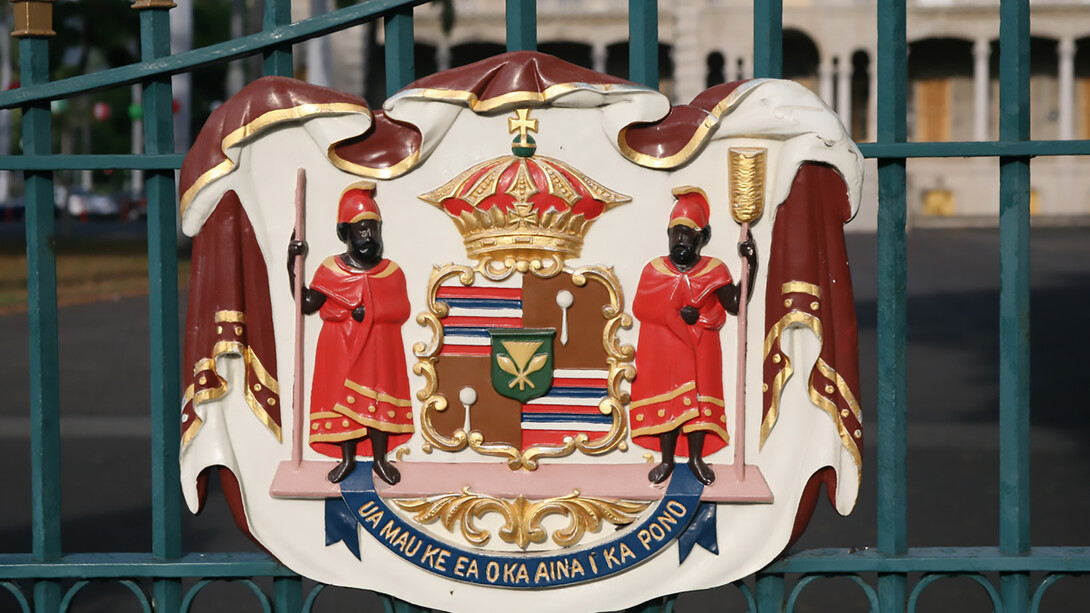
The Royal Coat of Arms of the Kingdom of Hawaiʻi, formally adopted in 1845 under Kamehameha III, stands as one of the most powerful and enduring visual assertions of national sovereignty. Conceived at a time when the kingdom was rapidly transitioning into the international political sphere, the seal was not merely a decorative emblem but a deliberate diplomatic tool. Its design integrated traditional Kanaka Maoli symbols of authority with the conventions of European heraldry, creating a legible, legitimate identity for the Hawaiian Monarchy. This analysis is structured to examine each component of the seal separately, from the shield's divisions to the supporting figures and the motto, and then demonstrate how these individual elements work synergistically to validate the Hawaiian state's legal equality, historical depth, and unique cultural foundation in the eyes of Western powers.
The need for a Western-style coat of arms arose in the 1840s, a crucial period when Kamehameha III sought formal diplomatic recognition to safeguard Hawaiʻi from colonial annexation, a threat realized through the 1843 Paulet Affair. To be recognized as a sovereign nation, Hawaiʻi had to visually demonstrate its status using universally understood emblems of monarchy. The resulting design, primarily attributed to Royal Advisor Timothy Haʻalilio and artist Jules Dudoit, expertly bridged two worlds. The final seal, a masterpiece of cultural synthesis, provided an undeniable visual language of statehood that mirrored the emblems of the great European powers.
The shield and its divisions
The central element of the seal is the quartered shield, which visually encodes the political history and inherent legitimacy of the Kamehameha dynasty.
The quartered division
The shield is divided into four quarters: the first and fourth (upper left and lower right) are striped, and the second and third (upper right and lower left) bear unique charges.
The Striped Quarters (Kāʻei / Sovereignty): these fields contain eight stripes of white, red, and blue, representing the eight inhabited islands of the Hawaiian archipelago. These stripes are drawn directly from the design of the Hawaiian national flag (Kāʻei), which itself represents the Kingdom's authority over the entire chain. By placing the flag design on the shield, the kingdom asserted that the monarch's claim to all the islands was intrinsic to the state's official identity, a clear statement of territorial integrity.
The Puloʻuloʻu (Kapu/Authority): the second and third quarters feature a white ball atop a staff. This is the puloʻuloʻu, or kapu stick, an ancient and sacred symbol of the sovereign's power and sanctity (kapu). In pre-contact Hawaiian tradition, this staff marked a place, object, or person as protected by the highest religious and civil law. Its inclusion serves as a direct, unadulterated reference to the historical foundation of Hawaiian governance, signaling that the monarchy’s authority was derived not just from Western law but from a sacred, ancestral mandate predating European contact.
The Moi Spear and Pula (Unity)
At the center of the shield is an inescutcheon (a small shield within the larger one) featuring a triangular device. This charge represents the two spears of the Moi (the high chief or king). These spears, typically placed point-down, symbolize the peaceful unification of the islands under Kamehameha the Great—a commitment to peace and the cessation of conflict. The central position of this symbol underscores that the foundational act of the current sovereign state is unity, lāhui.
Monarchy and protection
The figures and symbols surrounding the shield reinforce the historical narrative and legitimacy of the reigning house.
Ancestral lineage
Flanking the shield are two life-sized figures:
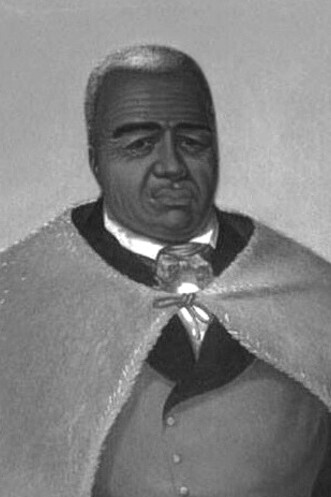
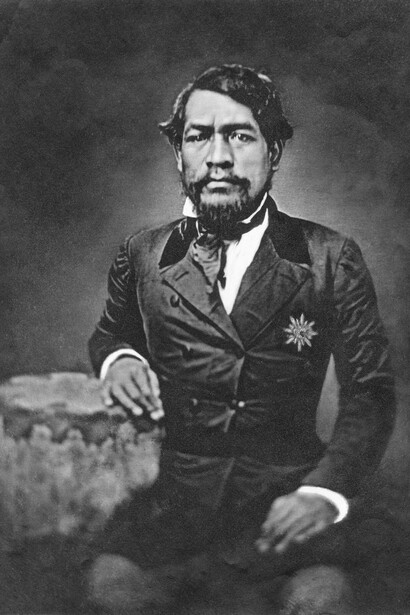
Kamehameha I: the figure on the viewer’s left represents Kamehameha the Great, the conqueror and unifier. He is dressed in the royal ʻahuʻula (feather cloak) and mahiole (feather helmet), holding a spear. This figure connects the seated monarch to the foundational power of the dynasty.
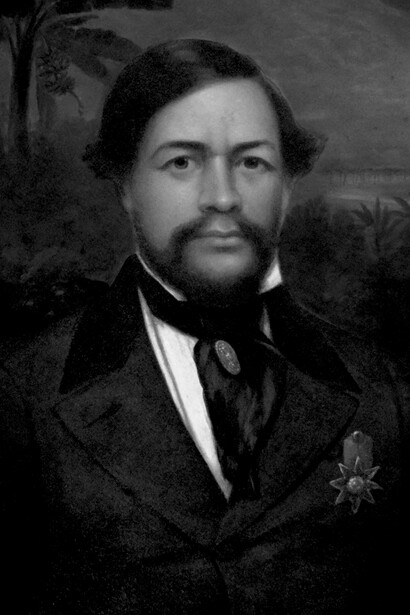
Kamehameha III: the figure on the viewer’s right represents the king who adopted the constitution and secured international recognition, often depicted holding the national flag or a spear. Together, the supporters represent the past strength and the present constitutional authority of the kingdom, physically upholding the sovereignty of the realm.
The crest and crown
Above the shield is the royal crown, an obvious Western symbol of monarchy, adopted to assert equality with European royalty. Below the crown sits the Puloʻuloʻu, repeating the reference to sacred kapu authority, ensuring the Hawaiian identity is always present above the Western symbol. Finally, the mantling (the drapery around the shield) is depicted in the royal colors of yellow and red, representing the precious feathers of the ʻahuʻula.
Ua Mau ke Ea o ka ʻĀina i ka Pono
The motto, inscribed on a scroll beneath the shield, is arguably the most powerful component of the seal. "Ua Mau ke Ea o ka ʻĀina i ka Pono" is translated as "The life of the land is perpetuated in righteousness."
This phrase, spoken by Kamehameha III in 1843 upon the restoration of Hawaiian sovereignty after the five-month British occupation, serves several rhetorical functions:
The first way is by tying the concept of national "life" (Ea), which in this context means sovereignty, health, and spirit, directly to the principle of "righteousness" (Pono). It suggests that the Kingdom's continued existence is morally justified and legally sound, contrasting its principled stance with the unjust actions of foreign interlopers. The second is with Pono, a complex Hawaiian concept meaning balance, justice, moral correctness, and spiritual well-being. By grounding the nation's survival in Pono, the monarchy asserts that its governance is guided by an inherent, high moral order unique to Hawaiian culture, separate from external Western definitions. Lastly, there is a declaration of permanence. The phrase asserts that sovereignty is not merely a transient political condition but a continuous spiritual and moral state. This motto thus transforms the seal from a static emblem into a perpetual promise of national endurance and resistance to colonial erasure.
Synergy and the assertion of international legal personality
The seal’s true power lies in the synergistic relationship between its indigenous and European components, which together assert Hawaiʻi's claim to what international law calls legal personality. The use of the royal crown, the structured shield, and the supporters follows the rigid conventions of European monarchy, signaling to Britain, France, and the United States that Hawaiʻi recognized and adhered to the political grammar of the global community. This adherence established diplomatic common ground.
However, within this European framework, the uniquely Hawaiian elements, the puloʻuloʻu and the ʻahuʻula of the supporters, perform the crucial work of decolonization by assertion. They communicate that Hawaiʻi’s sovereignty is not derived from European recognition but merely expressed through European forms. The puloʻuloʻu is the constant visual reminder that the king's authority originates from an ancient, sacred, and non-Western kapu system. This juxtaposition is not merely aesthetic; it is a profound political statement asserting that Hawaiʻi maintains its cultural integrity and historical autonomy while engaging on equal footing in the international arena. This synthesis of tradition and modernity, packaged into a single, official emblem, served as an irrefutable symbol in diplomatic correspondence, treaties, and currency, functioning as a silent, continuous declaration of independent statehood that was difficult for foreign powers to dismiss outright.
The Royal Seal of the Hawaiian Kingdom is a foundational document of statehood, codified in visual form. Every component, from the eight stripes representing the territory to the puloʻuloʻu signifying sacred law and the powerful motto asserting the permanence of the nation, was intentionally selected and integrated. The synergy between the ancient symbols of kapu and the modern visual language of monarchy ensures the seal functions as a cohesive, powerful statement. It successfully leveraged the visual grammar of European heraldry while centering the legitimacy of the Kanaka Maoli political structure. As a political artifact, the seal ensured that Hawaiʻi took its place among the recognized nations of the world, providing a symbolic defense that outlived the monarchy itself and continues to serve as an icon for the enduring sovereignty movement today.
References
Derrick, S. (2021). The Archival Turn in Native Hawaiian Literature. University of Hawaiʻi Press.
Kuykendall, R. S. (1938). The Hawaiian Kingdom, 1778-1854: Foundation and Transformation. University of Hawaiʻi Press.
Liliʻuokalani, Queen. (1898). Hawaiʻi's Story by Hawaiʻi's Queen. Lee and Shepard.
Trask, H.-K. (1999). From a Native Daughter: Colonialism and Sovereignty in Hawaiʻi. University of Hawaiʻi Press.
Walker, S. P. (2012). Heraldry and Identity in the Pacific Monarchy. Pacific Studies Journal.

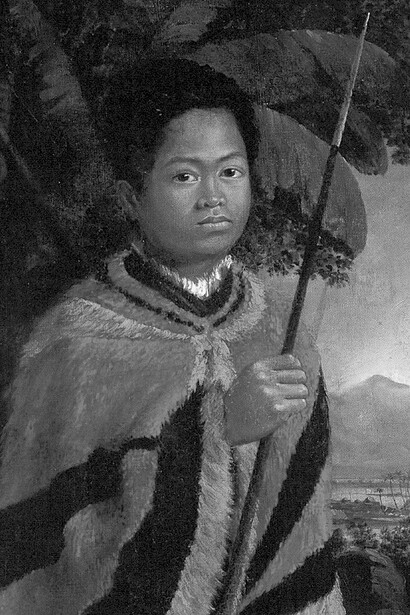
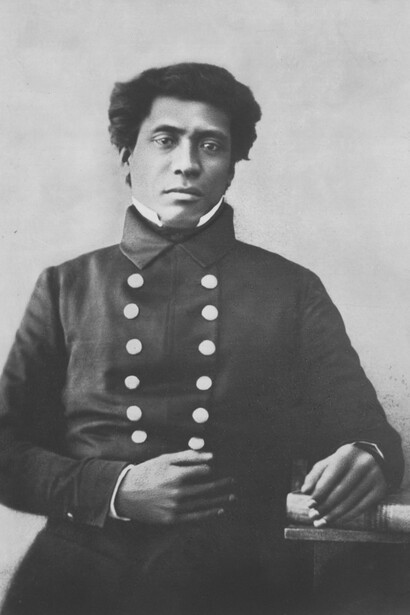
![Kamehameha I (Hawaiian pronunciation: [kəmehəˈmɛhə]; Kalani Paiʻea Wohi o Kaleikini Kealiʻikui Kamehameha o ʻIolani i Kaiwikapu Kauʻi Ka Liholiho Kūnuiākea; c. 1736 – May 8 or 14, 1819), commonly known as Kamehameha the Great, was the conqueror and first ruler of the Kingdom of Hawaiʻi](/attachments/6f4c24498d65e9b0db0fe6c569b0c279820668d8/store/fill/410/615/660240723909579e4d66c2374cab54296153ff457c15b79d9db7956f45d8/Kamehameha-I-Hawaiian-pronunciation-k-at-meh-at-meh-at-Kalani-Paiea-Wohi-o-Kaleikini-Kealiikui.jpg)