English
 Español
 Français
 Deutsch
 Italiano
 Português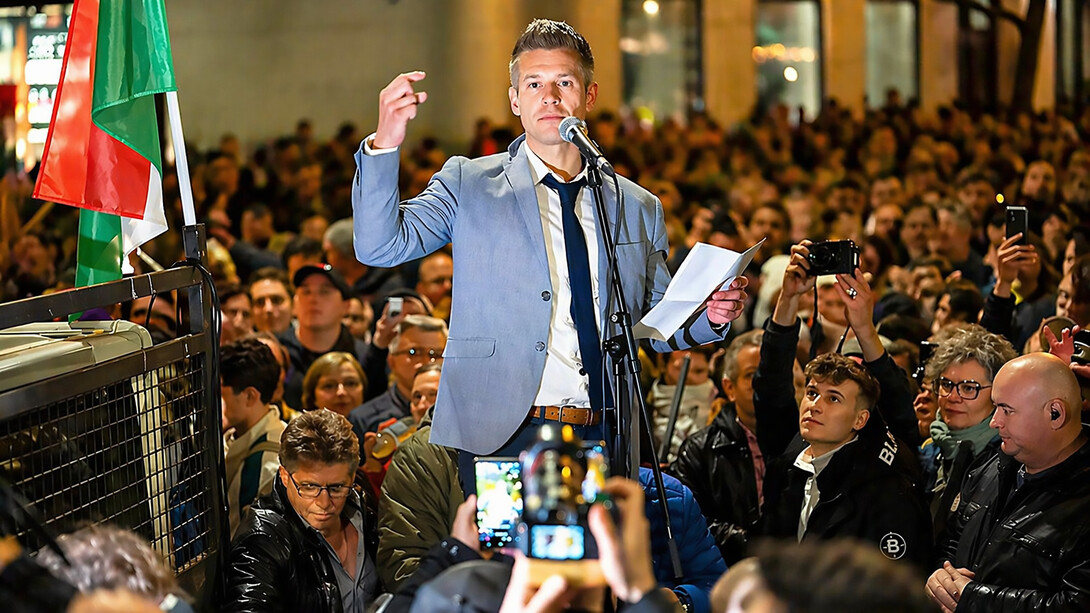
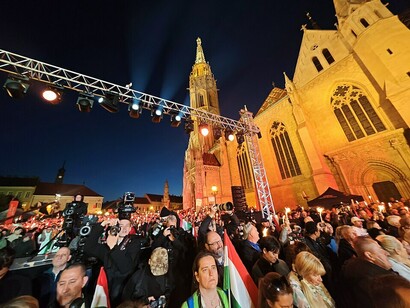
This Monday, April 13, is not merely a point in time but a point of condensation within the network of social meanings. A day when everyday speech—half sentences, sighs, and ironic remarks—suddenly acquires a ritual charge. Statements such as “I feel like moving back home" or “I’m exhausted, I’ve lost my voice, but this Monday feels good” are not simply individual expressions but collective status reports: temporary rewritings of the community’s narrative about itself.
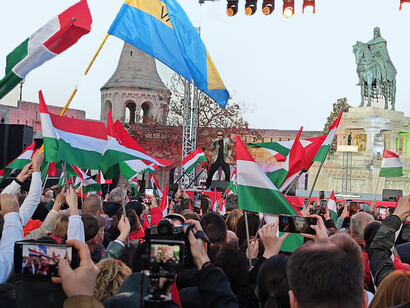
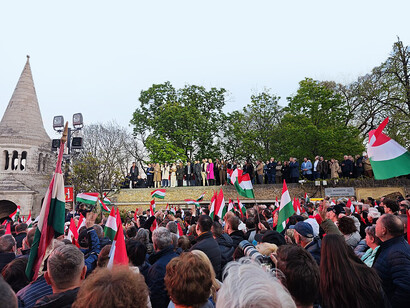
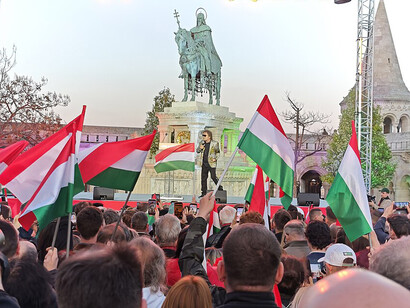
Hope, in this context, is not an abstract emotion but a social practice. It manifests in bodies, gestures, and forms of presence. In anthropological terms, it is a liminal state: a transition between the “no longer” and the “not yet.” A space where established regimes of meaning begin to falter, and temporary new configurations emerge. Within this transition, something previously unimaginable becomes possible: that national symbols—flag, turul, and rhetoric—partially detach from the political contexts that had long appropriated them.
Yet this detachment is never complete. Symbols cannot simply be purified. They are layered, historical, and burdened. A waist bag adorned with the torul can be at once ridiculous and moving, ideological and archaic. A mustached man in a Hungarian flag T-shirt is not only a representative of a political camp but also a cultural figure toward whom one feels ambivalence: rejection and recognition at once. This ambivalence is not a flaw but the foundational condition of social meaning-making.
The “merrymaking through tears” mentality, in this reading, is not a national defect but a collective mechanism of emotional regulation. A kind of cultural technique that allows tensions to be held simultaneously. It does not resolve contradictions but sustains them. And precisely through this, it creates room for maneuver: it allows for both critique and celebration, distance and identification.
The political system that has developed over the past decade and a half is not merely an institutional structure but a medium that produces habitus, modes of perception, and patterns of reaction. It is a social space in which the possibilities for action are constrained, yet not eliminated. Indeed, in certain respects, it is precisely these constraints that generate new forms: informal networks, alternative publics, and micro-level strategies of resistance.
Within this space, the generation we are now speaking of has taken shape. Not revolutionaries in a heroic sense, but rather practitioners: actors who have learned that political participation is not a single act but a process. They do not wait for salvation, because the experience of lack has become part of their socialization. Instead, they act—often in fragmented, often contradictory ways, yet consistently present.
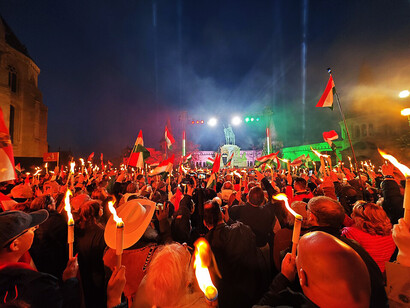
The more than three million votes, in this sense, are not merely quantitative data. They are the imprint of a collective performance. A sign that individuals were willing to step out of the private sphere and participate in the creation of a shared symbolic space. The same can be said of voting abroad and re-registrations: these movements indicate a reconfiguration of the social body.
The experience of the past—particularly the disillusionment following the regime change—remains present as a layer of collective memory. The voices urging caution do not express mere pessimism but articulate historical experience. At the same time, the present differs in that the intensity and consciousness of participation represent a different quality. There is not only expectation but also activity.
Thus, hope becomes a structural factor. It matters not because it “feels good" but because it enables orientation toward the future. On a psychological level, it generates motivation; on a sociological level, it stabilizes patterns of action; and in anthropological terms, it initiates new processes of meaning-making.
National pride, within this constellation, undergoes transformation. It detaches from the logic of exclusion and—at least temporarily—assumes a more inclusive form. Conflicts do not disappear, but they become organized differently. The emphasis shifts from the declaration of identity toward the practice of participation.
And perhaps this is what is truly irreversible: not an election result or a political configuration, but the experience that social reality is not given but can be shaped. That participation is not an exception but a possibility. And that this possibility—however fragile—has now become perceptible on a collective level.
This Monday, then, is not only a date or a worn mandate but a vibration deep within the collective nervous system—a barely perceptible yet all-pervading movement in which the body begins to remember that it wants to live. Survival is not merely a biological automatism but also a decision. And that this decision sometimes begins with resistance, or letting go the already known path.
These sentences are not simple reactions. Not post-election euphoria, not a fleeting carnival of the streets, but symptoms of a deeper psychosocial reconfiguration. The moment when hope—this often underestimated yet fundamental affective structure—returns to collective consciousness. Hope is not identical to solution. It does not offer ready-made answers. But it creates the conditions for movement. The possibility of action. The capacity for connection.
For the first time—at least for me—pride in the country is not an abstraction, not a historical narrative, but tied to concrete, living people. Not a party, not a prime minister carries the promise of redemption, but the mentality that has taken shape over the past sixteen years—indeed, drawing also from the traumatic imprints of the preceding period—slowly and almost imperceptibly.
The internal dichotomies of the community—its fractures and contradictions—do not necessarily weaken it. Under certain conditions, these are precisely the cracks through which light enters. Where connection becomes possible. Where, at the end of the day, we still close ranks.
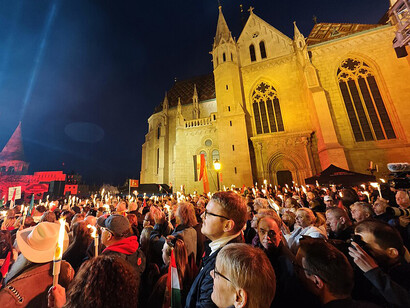
Something has been released. A generational energy that was previously latent has now manifested. It was not entirely foreseeable or entirely articulable, yet it is now present. In bodies, in streets, in discourse.
Those who remember the euphoria of 1989 may approach this moment with bittersweet caution. Their voices matter. As part of collective memory, attention and caution are essential. Yet the present situation is not merely repetition. The country is no longer only undergoing change—it is actively participating in it.
This is not a solution. It is a possibility. It is hope.
And hope—psychologically, socially, and perhaps even mythologically—is the minimal unit of energy that generates movement. Without hope, there is no direction. No image of a goal. No progression. And where there is no progression, pain, exhaustion, and discomfort will eventually halt the system.
Hope has returned. Not as a naive illusion, but as a force that compels action.
This phenomenon has brought those sentences, like “I want to move back home!” up to the surface. They were there, unripe and unspoken. Didn’t see the sunlight yet.
“I felt the growing urge to move back home"—not to sit on the sidelines and wait, but to actively take part in life there and contribute to making things better. There's a sense of responsibility in it, but also a kind of excitement: to be present, to engage, and to help shape the place that shaped us.
The sun came up. Every difficulty upholds this law. When we have hope, we are also able to go out under the sun.