English
 Español
 Français
 Deutsch
 Italiano
 Português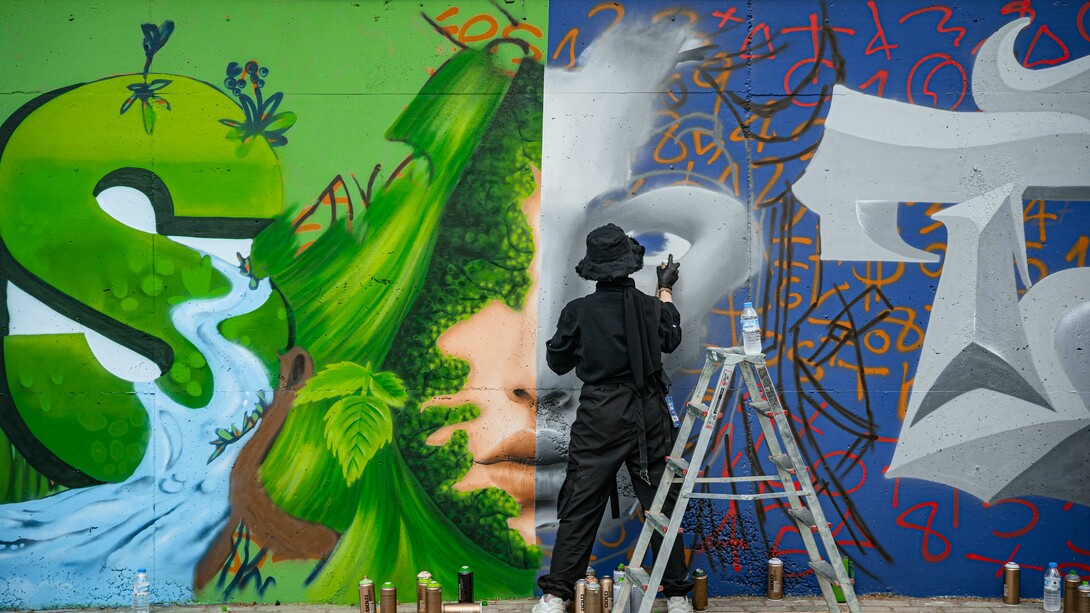
Somewhere along the way, we decided that where art lives matters almost as much as what it is. And that’s how we ended up with a term like “street art”—a category that feels descriptive on the surface but quietly carries a whole system of assumptions underneath it. The label appears neutral. It rarely is.
Before going further, the terms need untangling. Graffiti, street art, and public art often overlap, but they are not interchangeable, nor do they exist in a hierarchy. Graffiti is rooted in writing culture and in the marking of public space through names, symbols, and codes, often without authorisation. Street art is a related but distinct term, often associated with practices such as stencils, stickers, paste-ups, and murals. Public art, meanwhile, refers broadly to art in public space, whether officially sanctioned or not. That distinction matters more than it seems.
“Street art” did not emerge in a vacuum. The term developed in dialogue with graffiti culture and other forms of unsanctioned public expression that expanded across major cities in the late twentieth century. New York’s graffiti scene was central to that history, but the label “street art” would later stretch beyond it, covering practices that graffiti alone could not fully describe. But labels don’t just organise—they frame. Calling something “street art” does not remove it from the category of art; it separates it from the kind of art institutions are quicker to validate, preserve, and elevate. That separation may sound subtle. In practice, it isn’t, because once a category stops being descriptive and starts signalling legitimacy, it becomes something else entirely—a verdict disguised as vocabulary.
Here’s where the question stops being rhetorical. If a mural is removed from a wall and placed inside a gallery, what exactly changes? Formally, the image may remain the same, but context is never neutral. The wall, the street, the audience, the legality, the temporality, and the institutional frame all shift the meaning of the work. So the question is not whether the piece stays identical; it’s whether its category, its reception, and its power change with it. New York’s graffiti history makes this contradiction visible. Artists who once worked illegally on subway cars later saw related practices preserved on canvas, reframed, and absorbed by galleries and museums. The work did not suddenly become expressive when it crossed the threshold. What changed was everything around it—and the category followed.
There is also a persistent stereotype attached to the label: that street art comes from outside the system—outside formal training, outside legitimacy, outside access. Sometimes it does. Sometimes it doesn’t. The history is far messier than the myth allows. Some artists associated with graffiti or street-based practices had formal art education; others did not. Some moved between institutions and public space. Others rejected both. The label flattens those differences and turns biography into shorthand for value. And in doing so, it quietly reinforces a familiar narrative: that legitimacy still belongs somewhere else.
Street art is accessible in a way most institutional art is not. It does not require a ticket, a curated environment, or even intent. It exists in the flow of daily life, interrupting rather than waiting to be encountered. And yet, accessibility is often misread as inferiority. Similar visual languages, strategies, and references can appear both on the street and inside institutional or commercial spaces. One is framed, preserved, and priced accordingly. The other remains exposed—physically and culturally. The issue is not classification itself; art history depends on categories. The problem begins when a category quietly becomes a verdict.
The boundary becomes even less stable when the work is commissioned, sanctioned, or absorbed by institutions while still borrowing the visual language of the street. Not everything in public space is street art, and not everything that comes from the street remains unchanged once it is commissioned, relocated, or institutionalised. At that point, the label starts to slip. Because what exactly is being described—the origin of the work, its location, its intention, or its level of approval? And more importantly, which of those determines its value?
Art history is full of movements that were first dismissed, resisted, or treated as disruptions before being absorbed into the canon. That does not make every outsider practice equivalent, but it does expose how often institutions confuse unfamiliarity with lesser value. Street art doesn’t break from that history. If anything, it continues it—just without waiting for permission.
Maybe the issue isn’t whether “street art” is a valid term. Maybe the issue is what the term does once it’s used. Because the moment a label begins to influence how seriously a work is taken, how quickly it is legitimated, or how much it is worth, it stops being just a description. It becomes part of the system that decides what matters.
And once you see that, the distinction starts to feel less stable—not because street art isn’t art, but because it always was. The real question isn’t what it is. It’s how we’ve been taught to see it—and whether we’re willing to question that.