English
 Español
 Français
 Deutsch
 Italiano
 Português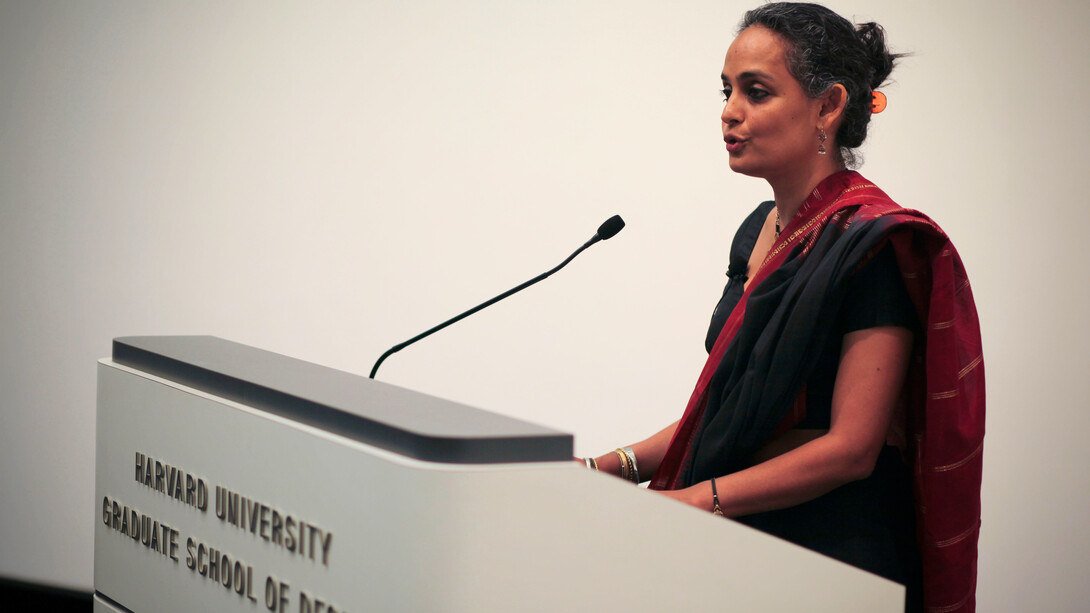
Arundhati Roy is different. She is Indian, but she is not Hindu. She won the Booker Prize with her first novel and then did not publish another work of fiction for more than two decades. She divorced to protect her husband. And the list could go on. In 2025, she published her autobiography, Mother Mary Comes to Me—a clear nod to The Beatles, of course, and a perfect excuse to write about this extraordinary writer.
Roy was born in 1961 in the state of Meghalaya, in northeastern India. Her mother, Mary, a Syrian Orthodox Christian, fled the monotony and violence of life with her husband on a tea plantation and returned with her two children to Kerala, in the south of the subcontinent. Her family refused to help her and denied her inheritance, as stipulated by Christian succession law at the time. Mary had studied education in Delhi and Madras before marrying, so she began teaching to support herself and, in 1967, founded her own school in two borrowed classrooms. Mrs. Roy’s school, as her daughter calls it in her memoirs, was a success. It is called Pallikoodam and is now famous throughout India. Its campus was designed in the 1970s by the English architect Laurie Baker, a pioneer of eco-architecture.
Given this background, one might assume that Mary was a loving, nurturing mother. She was not. What is striking in Roy’s memoirs is the way she recounts the details of a violent and deeply conflictual relationship without passing judgment. She understands that her mother had to become a despot to survive. In the book, she calls her a gangster. Fascinated by the construction process of Pallikoodam, Arundhati decided to study architecture. At sixteen, she enrolled at the University of Delhi and made the one-way journey with a knife in her backpack and the firm conviction that there was no turning back. She needed to separate from her mother to build a life of her own—or else she would end up crushing her. She did not return home for years. Meanwhile, her mother was fighting a legal battle, which she would eventually win, to overturn the Christian succession law.
It is not the aim of this article to summarize Roy’s life story; readers can turn to the book itself and draw their own conclusions. Nor is it my intention to write a piece in the tone of white feminism—of the “what a singular woman who overcame every obstacle” variety. Roy herself is explicit about the fact that she was able to do what she did because she had privileges, such as an English-language education and access to university. By 1981, when she was a university student, UNESCO data indicated that the literacy rate among Indian women was only 40 percent.
As mentioned earlier, Roy won the Booker Prize in 1997 for The God of Small Things. Instead of settling into a comfortable life of writing fiction from her desk, she became a militant writer who traveled through Kashmir and lived among the Naxalite guerrilla movement, both conflicts that remain active.
From the mid-1990s onward, she emerged as a prominent voice warning against India’s nuclear armament and the rise of Hindu nationalism under Narendra Modi. In her memoir, she provides all the details about the legal and media campaigns waged against her, insisting that she is also condemned for projecting a “bad image” of India abroad. She laughs at this accusation and appears in court whenever summoned. After all, she is not the one inciting massacres against Muslims or jailing citizens under faux charges. And, as she argues in her memoirs, the primary threat to national security is not religious diversity but extreme poverty.
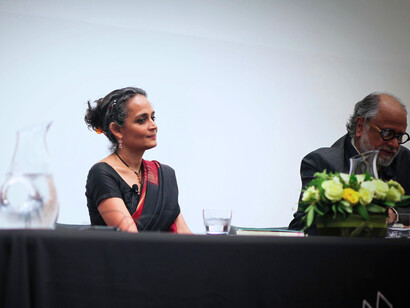
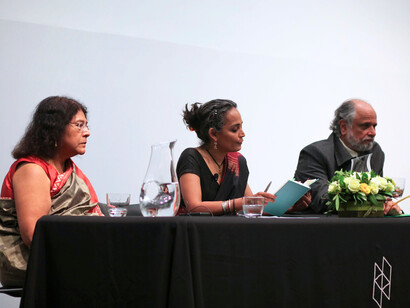
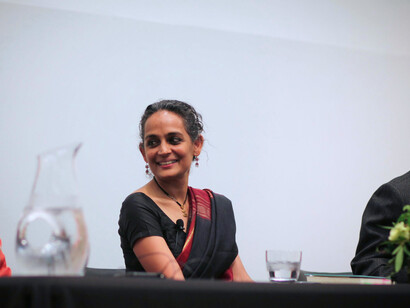
Since the publication of her latest book, Roy has used every public appearance to remind audiences that while they sit comfortably in their seats waiting to hear her read, Israel is a genocidal state exterminating Palestinians, and thousands of people in India are suffering political imprisonment. She says she could not act otherwise, because she is her mother’s daughter. To be at peace with her conscience means unsettling others. No one likes being reminded that there is more they could do than simply sharing an Instagram story about the genocide in Gaza.
In early March 2026, during a public reading in the city of Gurgaon, Roy accused the Indian government of cowardice for its position on the United States’ attack on Iran.1 There, she denounced not only what is already widely known—that India is a wealthy country with profoundly unequal distribution, that the cotton industry is an ecological disaster, and that the state is complicit with Israeli and U.S. governments—but also realities that rarely reach the world’s mainstream media. She revealed that India had sent workers from its poorest classes to Israel to replace Palestinians, and that these workers are not allowed into bomb shelters. She even mocks Indian cinema, a key instrument of Modi’s soft power, and its films, which oscillate between the ridiculous and the aestheticization of poverty.
This is what fascinates me most about her. She does what she wants, when she wants. From childhood, she accepted the position of outsider. She was a fatherless child in a small town in the interior of a deeply conservative country. In a society where caste and family bonds are everything, she chose to live alone, to the extent that she consistently keeps a distance from her parents, always referring to them by their first names. She could have repeated the formula of The God of Small Things, and she chose not to. She returned to fiction in 2017 with The Ministry of Utmost Happiness, a complex novel whose protagonist is a trans woman2, a survivor of a massacre in Kashmir, who builds a guesthouse for other outcasts in a cemetery.
One curious—or perhaps psychoanalytic—detail is that Arundhati did not meet her father until she was an adult, yet both she and her mother kept the surname of this unruly and absent man. Two women who became icons of Indian feminism retained the name of a man who embodied everything destructive about patriarchy. But lineage works that way. As her father told her in every meeting they had: "This is India, my dear".
Notes
1 You can watch her entire speech here ‘Iran is Not Gaza’:Acclaimed Writer Arundhati Roy.
2 This is a simplification, but in India, trans and gender people have long been known as hijras, a community with precolonial roots traditionally linked to ritual roles. Despite recent legal recognition of a “third gender,” hijras continue to face systemic discrimination, violence, and social exclusion.