English
 Español
 Français
 Deutsch
 Italiano
 Português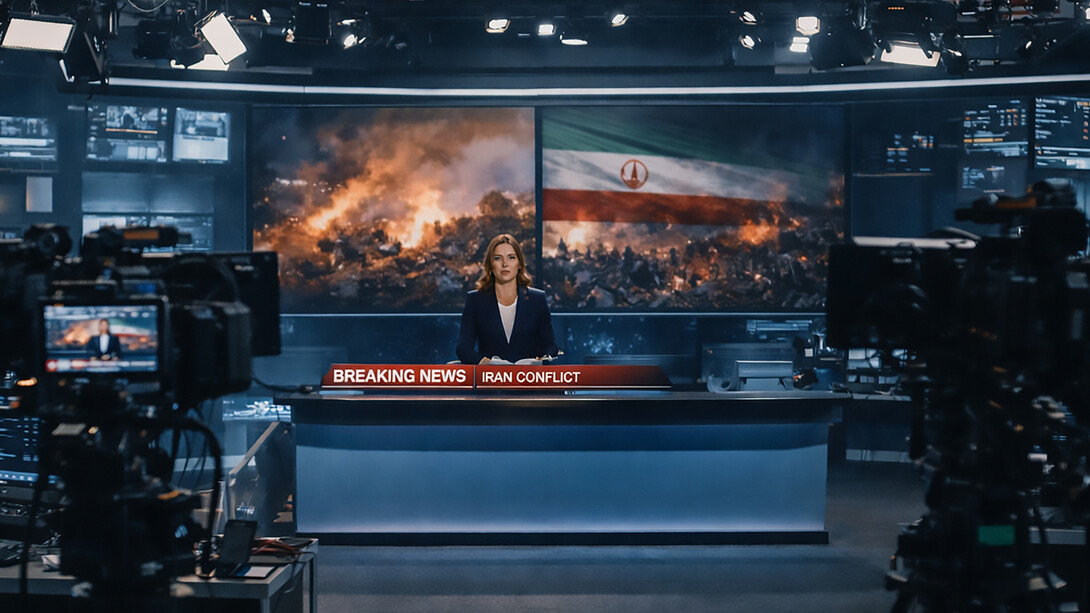
Diplomacy used to depend on delay. Messages were drafted, checked, delivered through formal channels, and only later made public. In the current war involving the United States, Israel, and Iran, that order has partly flipped. Leaders still use back channels, envoys, and intelligence contacts, but they also communicate through posts, clips, official accounts, and rapid public statements. Social media is no longer just where war is discussed. It has become one of the places where diplomacy itself happens.
This matters because social media does not simply carry messages. It changes what messages become. It rewards speed, certainty, emotional force, and public visibility. It pushes leaders to speak quickly, to appear decisive, and to frame events in ways that will dominate the next news cycle. A threat becomes a post. A pause becomes a post. A peace signal becomes a post. And once diplomacy takes that form, it begins to change character.
A useful way to understand this is to start with a simple point: war is held together not only by weapons but also by communication. Conflicts continue because people keep producing meanings around them. They repeat ideas like threat, deterrence, credibility, survival, red lines, retaliation, and security. These words do not just describe a situation. They help organize it. They shape what counts as reasonable, what counts as weakness, and what kinds of action seem necessary.
Social media intensifies this process. It speeds up the cycle between statement and reaction. A government says something, markets respond, journalists amplify it, supporters cheer it, opponents deny it, and military meaning is attached to it almost instantly. Under those conditions, communication is no longer just commentary on diplomacy. It becomes part of the diplomatic event itself.
That is exactly what we are seeing in the US-Israel-Iran conflict. Public messaging is no longer a side show to the war. It is one of the arenas in which the war is being managed. Leaders are not simply talking to one another. They are talking to several audiences at once: their own publics, their enemies, their allies, financial markets, military planners, and the wider international community. Every statement has several targets. Every post has several consequences.
This makes social media diplomacy powerful, but also unstable. In older forms of diplomacy, states could send messages quietly, adjust their position without humiliation, and test possible outcomes without immediately committing themselves in public. Social media makes that harder. Once a message is posted in public, it becomes part of a leader’s image. It is no longer just a diplomatic move. It is a performance of strength, resolve, and control. That means leaders can become trapped by their own rhetoric.
A government may want to leave space for compromise, but social media punishes ambiguity. It rewards sharp language. It turns hesitation into weakness and nuance into confusion. In wartime, that is especially dangerous. Diplomacy often depends on careful wording, partial openings, strategic vagueness, and the slow lowering of tension. Platforms tend to work against all of that. They push communication toward drama, clarity, and confrontation.
In the case of the US-Israel-Iran conflict, this creates a particularly volatile environment. Each side is trying not only to act but also to define what its actions mean. A strike is presented as defense. A threat is presented as deterrence. A delay is presented as strategic patience. A refusal is presented as dignity. These are not neutral descriptions. They are attempts to shape the field in which the next move will be understood.
This is why social media diplomacy is not just propaganda. Propaganda suggests something secondary, as though the real decisions happen elsewhere and the messaging merely follows. That is too simple. Today, public communication helps produce the conditions in which decisions are made. When a leader issues a public threat online, that message changes the atmosphere in which diplomats, generals, journalists, and citizens interpret what comes next. It can harden positions, raise expectations, and make retreat more costly.
The problem becomes even clearer when we remember that platforms do not show all messages equally. Social media is structured by algorithms, by virality, by repetition, and by outrage. Messages that are cautious or qualified tend to travel badly. Messages that are forceful, dramatic, or humiliating travel well. So the platform environment itself favors the kind of diplomatic language most likely to intensify conflict.
This means social media does not just accelerate diplomacy. It distorts it. It selects for certain kinds of public speech and sidelines others. The result is a communicative environment in which escalation often appears more natural than restraint. Threats are easier to circulate than revisions. Certainty is easier to display than doubt. Public defiance is easier to perform than quiet compromise.
In a conflict like this one, that matters enormously. The United States, Israel, and Iran are not simply exchanging military force. They are also competing to control interpretation. Each wants to decide how the war is seen: who is the aggressor, who is defending themselves, who is acting rationally, who is desperate, who is winning, and who is losing legitimacy. Social media becomes a battlefield of perception, and perception in turn affects the real political space for negotiation.
This creates a dangerous feedback loop. A government posts a strong message to reassure its domestic audience or deter its opponent. That message is then read by the other side as provocation. The other side replies publicly, not wanting to look weak. The exchange escalates, not necessarily because either side wanted immediate war at that moment, but because public communication has narrowed the space for anything else. In this way, diplomacy conducted in public can begin to undermine diplomacy itself.
There is also a deeper issue. Social media creates the appearance of transparency. Leaders seem constantly visible, constantly speaking, constantly in command. But this visibility can be misleading. More communication does not necessarily mean more understanding. It may mean more noise, more positioning, and more pressure to simplify. The public sees more of the performance of diplomacy, but often less of its actual substance.
That is one of the paradoxes of the current moment. Social media seems to make diplomacy more open, yet it can reduce the room needed for serious diplomatic work. When every message is instantly public, every adjustment can look like weakness. When every statement is judged in real time, leaders become more concerned with appearance. When every diplomatic gesture is folded into the logic of the feed, symbolic victory can take priority over de-escalation.
What we are witnessing, then, is not the disappearance of diplomacy but its transformation. Formal diplomacy still matters. Private talks still matter. State intermediaries still matter. But they now operate alongside a second layer of diplomacy that is public, performative, and immediate. This second layer does not replace the first. It shapes it. It changes the pressures under which official diplomacy has to work.
In the US-Israel-Iran war, social media has become part of the diplomatic battlefield because it changes timing, audience, and consequence. It accelerates signals, widens exposure, hardens reputations, and makes every statement part of a struggle over credibility. It does not merely report conflict. It helps organize it.
The central danger is not only misinformation, though that matters. The deeper danger is that platforms make it harder for political actors to slow down, revise, or step back without public loss. And if diplomacy loses the capacity for revision, it risks becoming just another form of escalation.
That is why social media diplomacy has to be understood as more than a communications issue. It is a political condition of contemporary war. In this conflict, it is one of the mechanisms through which pressure is applied, meanings are fixed, and possible futures are narrowed. The feed does not replace the battlefield. But it increasingly helps decide what the battlefield is allowed to mean.