English
 Español
 Français
 Deutsch
 Italiano
 Português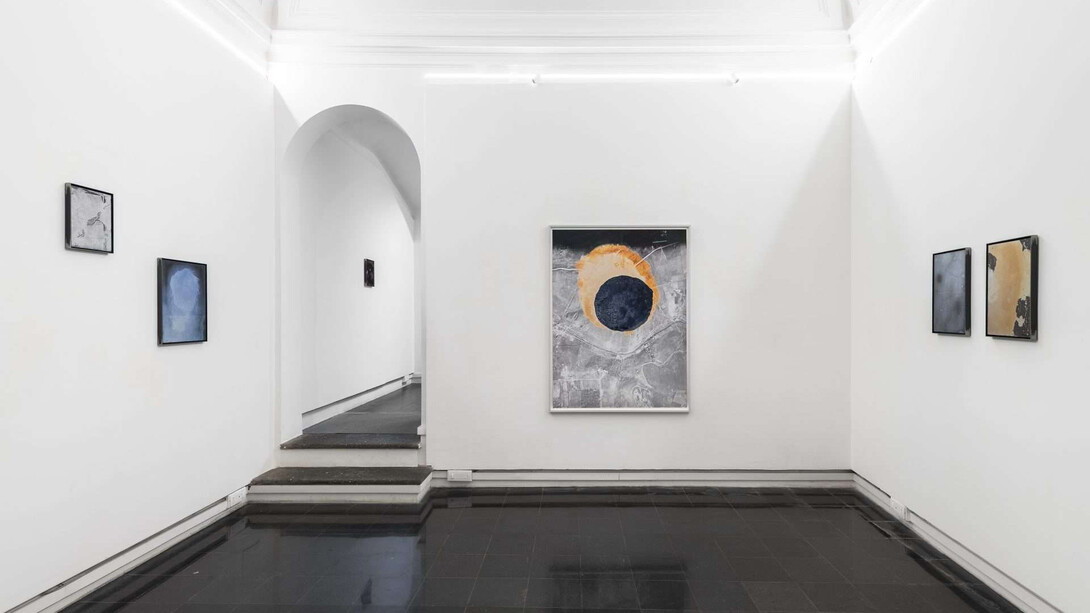
For Walter Benjamin, the trace (Spur) is both a material imprint and a specific mode of presence of absence - something that remains accessible through the signs it leaves behind. The trace makes the past comprehensible, readable, almost tangible, manifesting itself as the residual mark of an event or a vanished object, one that can be reconstructed from its remnants. Within the logic of proximity inscribed in this concept, a connection can be drawn to Giorgio Di Noto’s practice (Rome, 1990), which develops through sustained reflections on the archive and the erasure. Indeed, it is the production of new systems of traces - and therefore new images - that characterizes the body of work presented at Galleria Eugenia Delfini; these works continue the artist’s experimentation aimed at subverting the usual relationship between photography and reality, between documentation and representation, maintaining continuity with a practice in which new systems of signifiers are made tangible, both inside and outside the image.
the appearance of nearness follows Benjamin’s distinction between aura and trace. In the experience of the aura, the object’s fascination paradoxically becomes an inaccessibility for the subject; in the trace, by contrast, the object relinquishes its sacral distance and becomes investigable. “The trace,” Benjamin writes in Das passagen-werk (1927–1940), “is the appearance of nearness, however distant the thing that left it may be. The aura is the appearance of distance, however close the thing that produces it may be. In the trace we take hold of the thing; in the aura, it takes hold of us.” the appearance of nearness thus speaks of the apparition of something that, though distant - both perceptually and temporally - nevertheless asserts its closeness in the inframince embedded in the trace-sign itself. In its manifestation, the trace seizes the image, transforming it into a readable and appropriate form through the activation of the survivals from the past.
Developed from archival materials (photographic plates and aerial prints), the selection brings together three cycles. The first originates in non-digitized plates discovered during a residency at the Polo Biblio-Museale Leccese. The second, Hidden collections, partly included in a recent exhibition at the Museo Nazionale Romano, developed from research in the Museum’s photographic archive housed at Palazzo Massimo. The third results from recent experimentation with erasures and censorship in aerial prints taken during and after World War II, preserved at the Aerophototeca of the ICCD in Rome.
The research underpinning this new series of works is informed by an analytical process that considers the image-sign as an emergence. Using plates found in archives or storage, allows the artist to isolate and emphasize the peculiarities that the plate, tout court, contains in potential. By bringing overexposed plates into positive, for example, Di Noto is able to obtain unexpected markings and colorations; or, by emphasizing erasures, he can elaborate more on one detail rather than another. Part of this experimentation relates precisely to erasure, a direct intervention on the plate, widely practiced in documentary photography to isolate a context or object, or to censor part of an image. The plates from which Di Noto extracts his image-signs are functional devices, acting as intermediaries, carrying the sign from an implicit state to a revealed one. His aim is a maieutic operation: the birth of the sign. At the same time, it is an analogical approach that counterpoints the more familiar digital image-processing methods: segmenting, masking, erasing, isolating, superimposing.
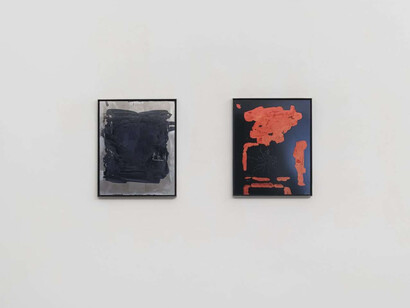
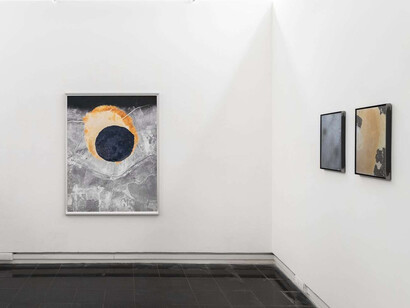
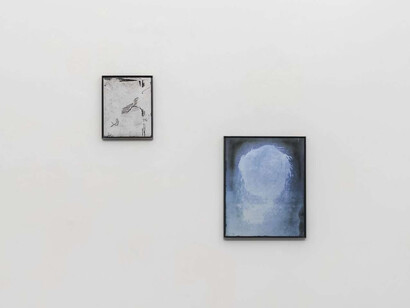
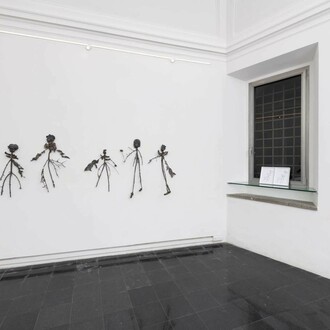
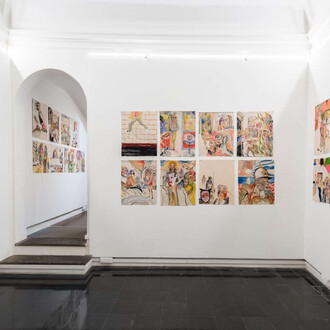
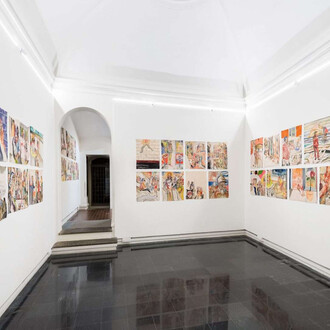
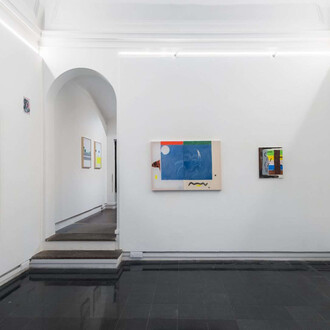
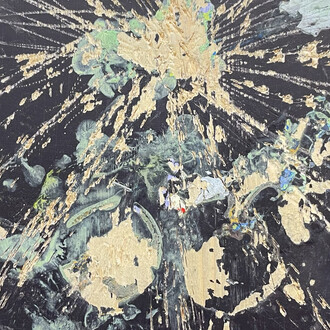
In the gallery, the installation of the works unfolds as a sequence of counterpoints, resulting from successive formal, chromatic, and compositional references. Each work functions as a palimpsest, a stratigraphic image from which infinite sign variables emerge: swirling luminous circles; uncertain outlines; unrecognizable objects; mappings; color elaborations produced by oxidations or more or less controlled manipulation processes, ranging from magenta to cyan, up to vibrant golden-yellow color bubbles.
Di Noto emphasizes an effect of nearness that, on one hand, results from the appropriated image - never considered a surrogate image, but rather elaborated to allow the sign to re-signify itself; on the other hand, it is an effect of nearness produced by the reception and projection of the sign into the external world. This dual-speed exchange structures the gaze and gives the sign a dual trajectory: the sign as a temporal matrix; the sign as a functional trace.
The archive, as both a point of departure and a point of reference, is activated in a preposterous key to show how, far from being an orderly repository of progressive chronologies, it is a living device capable of bringing the artist closer to the investigation of the evidential aspects that the image-representation, at first glance, seems not to possess. In doing so, Di Noto engages in a reconnaissance that aligns with the reflections of theorist and artist Mieke Bal on temporality in art and cultural history, understood not as a linear reworking of the past, but as an active reframing.
What do the images preserved in the archive tell us, and what traces can be rediscovered by investigating the proximity concealed in their clues? In attempting to answer these questions, Di Noto’s works find room for re-signification in markings, oxidations, scratches, censorship, even errors. In this methodology - which follows a very clear process, from the found image to the shot - there is a fascination with departing from the domain of “pure photography,” an approach Di Noto develops from an in-depth knowledge of the medium. It is not a matter of rejecting the label – photographer - nor of emphasizing the boldness of the manipulations and interventions. What predominates is the skill employed in remodulating the aesthetic experience through a form of benevolent disavowal. To betray the staging of the photographic image means rethinking its immutability to imbue it with imaginative value, starting from the semantic ambiguities the image hides.
When speaking of photography, one often experiences a sense of displacement linked to the longstanding debate about the relationship between representation and reality. What remains of the image of reality that photography should, by definition, convey? Perhaps this question underlies Giorgio Di Noto’s interest in medium’s meta-linguistic vocation. It is meta-linguistic insofar as the artist situates photography in a hybrid territory, where disparate approaches, techniques, and reflections collide. At the core is commanding mastery of the medium and its potential - analog cameras, large-format cameras, modern and experimental printing techniques; on another level, there is the capacity to push the medium not only to tell stories, but above all to tell itself in a self-reflexive way. The image-sign is the ghost, or, as Rosalind Krauss puts it, the optical unconscious. Krauss, expanding the term from Benjamin, defines the optical unconscious as the ensemble of structures, drives, and non-visible or uncontrollable processes operating within the visual field, challenging the modernist idea of vision as transparent, rational, and fully conscious. Di Noto is present behind the camera, yet he allows the image - whether taken, extracted from a historical archive, or sourced from the web, as in some of his other works - to manifest as a visual device rather than a faithful reproduction of reality.
The artist operates arbitrarily, through choices, subtractions, and remediation processes. The result is a true transformation of the visual referent, which manifests with varying characteristics. By photographing archival materials under different lighting conditions, or by applying silver pigment to the back of the resulting print, Di Noto emphasizes certain features while sacrificing others. The image is thus mediated, foregrounding the possibility of rediscovering the boundary between visible and hidden, fidelity and vision. Here lies the attention to the disappearance of the recognizable and the preference for a sign-based surface where details of ripples, veils, and color fields concentrate. Photographic plates, film, and found materials serve as bridges between the memory embedded in the given image and its new formulation, or contemporary actualization.
In Plato’s cave is the title of the essay in which Susan Sontag reflects on the relationship between photography, reality, and knowledge, starting from the famous myth of the cave; just as the cave’s prisoners mistake shadows for reality, modern humans risk confusing photographs with an image of reality taken as incontrovertibly true - a world-image. For Sontag, photography occupies a distinctive epistemological position: compared to other forms of representation, it is commonly perceived as direct proof of reality, as though the photographic image - by virtue of its link to the referent - were a neutral record of what existed before the lens. In this logic, something is assumed to have existed because it was photographed. By offering the viewer a “selective miniature” of reality, removed from the flow of experience and isolated, incontrovertible in its fictive truthfulness, photography and the act of photographing amount to an act of symbolic appropriation: the photographer possesses what he photographs, removes it from its original context, and makes it available to the gaze. Between what is worthy of remembrance and what may be ignored, a process of revelation and concealment is already underway, implicitly guided by an almost systematic criterion of selection.
Sontag’s account can be reread by considering Plato’s cave not as a space of denial and withdrawal of the gaze, chained to the reproducibility of shadows, but rather as a counter-space where deposited memories demand further effort to become visible. From this perspective, Giorgio Di Noto’s position - simultaneously internal and external to the field of photography- opens the possibility of analyzing the grammar that organizes our way of seeing as a cultural code, showing how a mediated and illusory relationship with reality can generate a form of knowledge, certainly partial, yet capable of revealing the intrinsic potential of the image.
Notes
1 Mieke Bal, “Quoting Caravaggio: contemporary art, preposterous history”, The University of Chicago Press, 1999.
2 Susan Sontag, On photography, 1977. New York: Farrar, Straus and Giroux.