English
 Español
 Français
 Deutsch
 Italiano
 Português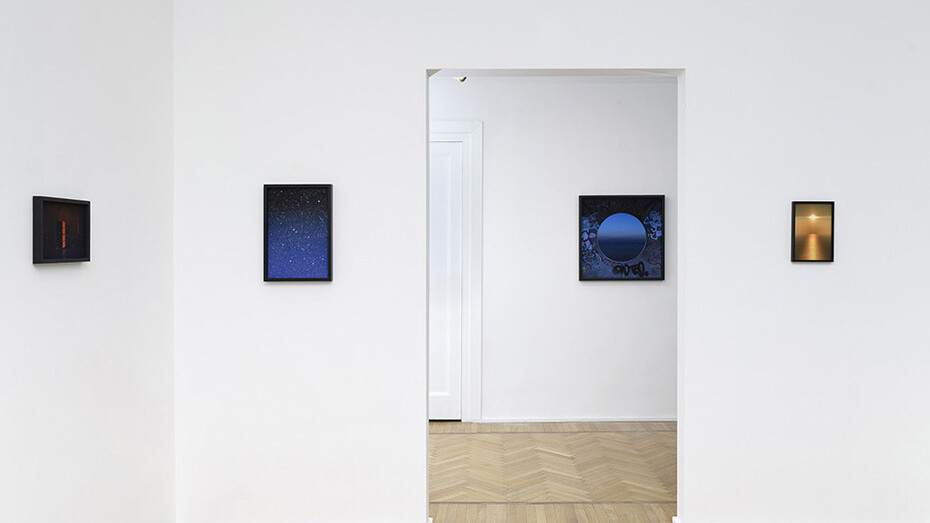
Galleria Continua is pleased to announce the solo exhibition of Giovanni Ozzola, one of the leading figures on the international contemporary scene, recognized for his research into light, space, and landscape.
The exhibition title, Il cielo dentro (The sky within), suggests that infinity does not exist only outside of us, but can also expand inwardly: a connection to the whole that arises precisely at the point where a boundary becomes a threshold. It is the inevitable pull of the horizon that brings a fertile contradiction to the forefront: infinity not as distance, but as an expanding inner space. Not an escape from reality, but a perceptual condition — the possibility of feeling connected to the whole while remaining inside a body, inside a skull, inside a bunker, as the artist states.
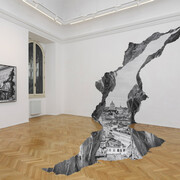
Conceived for the Roman spaces of Galleria Continua, the project leads visitors into a territory where interior and exterior meet: a border space, constantly inhabited. The tension between outside and inside does not resolve into a narrative sequence, but remains active as a threshold. It is the point where the visible comes to a halt and the desire to move beyond it emerges, while the boundary at the same time protects and contains, like skin.
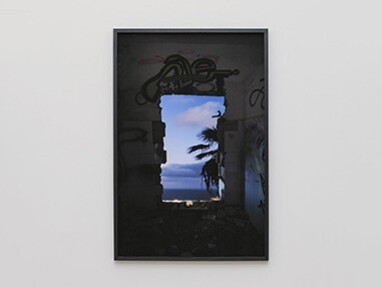
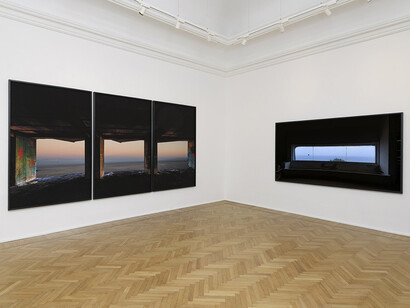
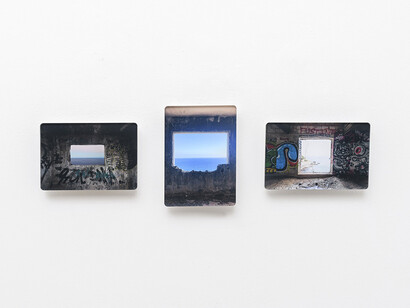
Within this liminal dimension lies Bunkers, artworks that investigate places built for protection and isolation — semi-derelict concrete structures marked by time and memory — through a gaze capable of reversing their original function. The images do not merely depict wartime ruins; they establish a visual relationship between the enclosed space and the luminous horizon that opens beyond the slits, between the opaque density of the interior and the distant sky or sea. The works arise from repeated encounters over time with abandoned sites, traversed and recognized as images that have continued to resurface since 2006. This is neither a systematic inquiry nor a photographic project understood as genre or documentation: what emerges is an experience, explains Ozzola.
In these works, the horizon reveals itself as both possibility and risk: a place of liberation and, at the same time, a space in which one can lose oneself to the point of dissolution. The light that draws us in promises openness, yet also implies the loss of a fixed point. The bunker, laden with experiences and memories, is its counterpart: an interior from which to escape and, simultaneously, an interior that protects and shapes us. The marks on the walls are not decorative, but traces of life — scars, memories, layers. Fragmentary alphabets and repeated gestures settle like sediments of time. The openings function as eyes — organs of orientation through which the gaze seeks an exit and measures distance. Ozzola’s bunkers place light and darkness, fear and stillness, the artificial and the natural, identity and dissolution into the whole in tension, ultimately generating harmony through contrast.
A starry sky introduces a further horizon, recalling a work created by the artist at Palazzo Esposizioni Roma for the 18th edition of the Quadriennale d’Arte. It is not decoration, but a device that opens the space to a shared unknown: the material of the walls and that of the stars belong to the same substance; interior and exterior become equivalent. On new Pillars of Hercules, the microscopic and the macroscopic, science and spirituality begin to converge, concludes Giovanni Ozzola.
Appunti senza parole (Notes without words) is a small sculpture composed of images: print proofs and visual fragments preserved over time are accumulated, layered, and bound by hand until they form a three-dimensional presence endowed with thickness, weight, and volume. The image does not remain surface; combined with other images, it transforms into body, into matter, into sculpture.
Ozzola’s works do not describe places; they activate them. Each image traces a possible route, directs the gaze, suggests a direction. They accumulate traces as time does, layering signs, memories, and presences that belong not only to the depicted space but also to those who move through it. What interests me is not telling the story of the boundary, but making it perceptible as a living threshold. The exhibition does not represent the boundary as a theme. It puts it into motion. It transforms it into an active field, a space where something can happen: a perceptual shift, a moment of awareness, an opening. It is at that point that the image ceases to be surface and becomes presence, and space ceases to be distant and becomes shared experience, the artist explains.