English
 Español
 Français
 Deutsch
 Italiano
 Português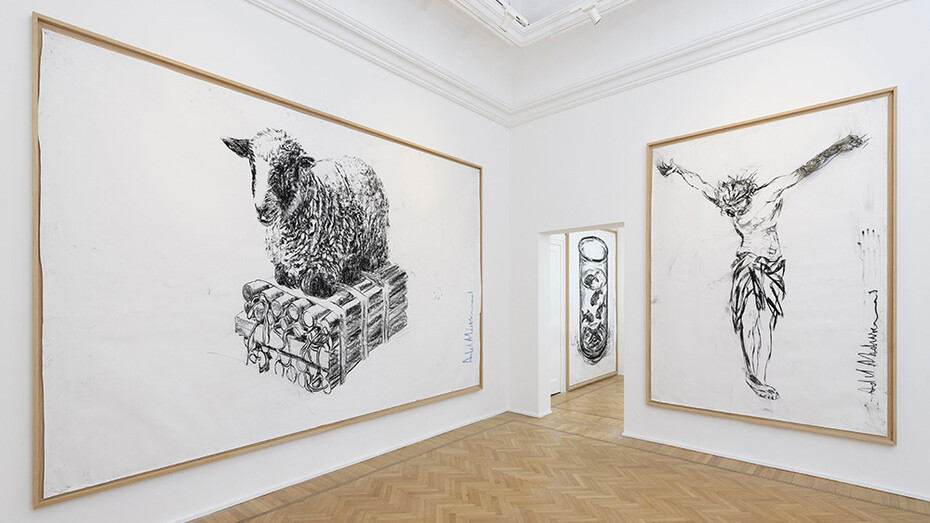
Galleria Continua is pleased to announce Adel Abdessemed’s solo exhibition, inaugurating a new program of exhibitions, projects, and collaborations dedicated to the vitality of contemporary artistic research. The gallery returns to enliven the cultural scene of the capital, reaffirming its vocation for building dialogues between languages, generations, and territories.
The exhibition by Adel Abdessemed, a French artist of Berber origin internationally recognized for the poetic and political power of his work, opens a season that will feature a succession of exhibitions and site-specific interventions capable of weaving together reflection, emotion, and current realities. Coming to prominence in the early 2000s, Adel Abdessemed marked the beginning of the 21st century with works of striking visual and emotional impact. Integration, racism, nudity, and the breaking of religious taboos are central themes in his work; the artist interprets them across all expressive media from video to photography, from drawing to painting, from performance to installation engaging in a constant re-examination of parameters and media. This approach also manifests in his references to other arts and genres, as well as to other established cultural tropes and images.
Primavera romana, the title of the exhibition conceived by Abdessemed for his first solo show in the Eternal City, brings together a rich group of drawings that range from intimate scale to large formats. Developed in thematic clusters and created between 2010 and 2025, these drawings transcend the limits of technique in order to capture the essence of their subjects. The line virtuosic and precise yet also instinctive, rapid, passionate, at times brutal conjures up intense images to which the artist gives new symbolic life and meaning, transforming the ordinary into something that questions and provokes the viewer. In these words, Adel Abdessemed introduces us to the exhibition: Primavera romana, an introspective season in which Rome awakens its deepest secrets... An intimate dialogue with the Eternal City... its light, its shadows, and its silences... This city that watches as much as it allows itself to be watched...
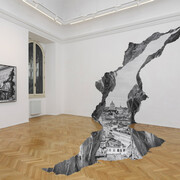
In the first room we are welcomed by Histoire de l’art, a large charcoal drawing on paper depicting the crucified Christ, to which a double-edged strand of barbed wire has been added as an arm. A few months after arriving in France, Abdessemed went to the Unterlinden Museum in Colmar to see Grünewald’s Isenheim Altarpiece; in response to one of the most sublime and realistic expressions of Christian suffering, the artist created a series of drawings (Histoire de l’art) and four life-size sculptures (Décor) forged from intertwined galvanized steel razor blades. The extraordinary power of the figure of the Passion of Christ its ability to embrace the suffering of all was reinvested in Décor. By contrast, Histoire de l’art is more interested in the art historical Christ, the human and divine body that has continually inspired extreme experimentation by artists. The drawn lines mesh with the tangled lines of barbed wire, making the arm literally leap into three dimensions.
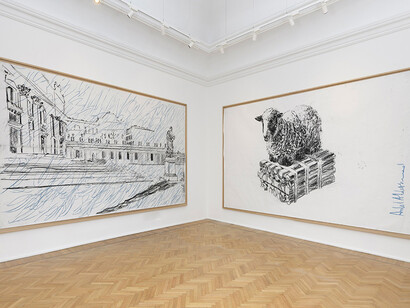
Far from breaking apart the figure, the shift in technique greatly heightens the work’s expressive force, explains art historian Giovanni Careri. On the opposite wall hangs an image equally powerful in meaning and scale, Politics of the Studio, Pope: St. Peter’s Square, empty, silent, swept by rain and wind, with a solitary Pope praying in the background. In the same room are two drawings from the recent series Politics of Drawing: a donkey gentle and peaceful, generally associated with humility and innocence and a lamb, the sacrificial animal in Christianity, symbol of purity and redemption. The lamb is crouched atop an explosive charge.
Regarding this series and the animals that populate it, David Elliott writes: As explosive creatures destined for contemplation, they seem serene, focused, indifferent to the dynamite beneath them because they have been transposed into a zone of free reflection in which essence, potential, stillness, happiness, transformation, joy, or even death drift through the mind’s eye like the characters of a haiku. (…) Appearing, disappearing, and reappearing throughout Abdessemed’s work as symbolic, sometimes ironic, expressions of energetic reorientation, they emulate and celebrate the risks, joys, passions, and beauty of our entire universe, in honor of that Big Bang that set everything into motion.
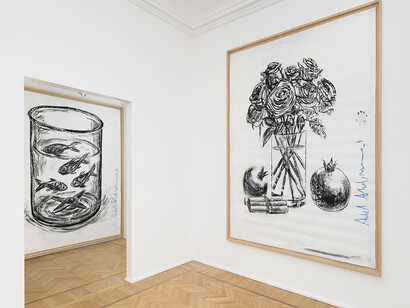
Politics of drawing also unfolds in the series Politics of drawing, glass of water, where fish move within the confined space of a glass. For me, fish in a glass become a living still life... a suspended glimmer... between movement and stillness... where life seems to rest on the edge of its own silence... the artist states.
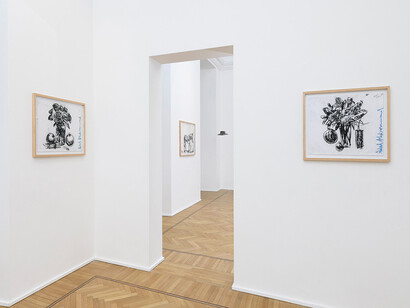
In the Nature morte series, Adel Abdessemed engages with the inanimate world of objects, depicting using charcoal and pastel—vases with striking arrangements of cut flowers, branches, pomegranates, but also fuses and bundled sticks of dynamite arranged artistically around their base. These works convey a powerful tension between the aesthetic beauty of the images and the violence of the underlying ideas; the artist uses drawing to construct a new order that allows fear and wonder to intrude: a revolutionary Ikebana alphabet where anything can suddenly happen and where explosions are always imminent. Adel received the secrets of the Pomegranate in the cradle. The Pomegranate is the fruit of the struggle between life and death. The fruit of the Song of Love in the Song of Songs. The fruit that “embodies” Persephone’s strange destiny, states writer Hélène Cixous.