English
 Español
 Français
 Deutsch
 Italiano
 Português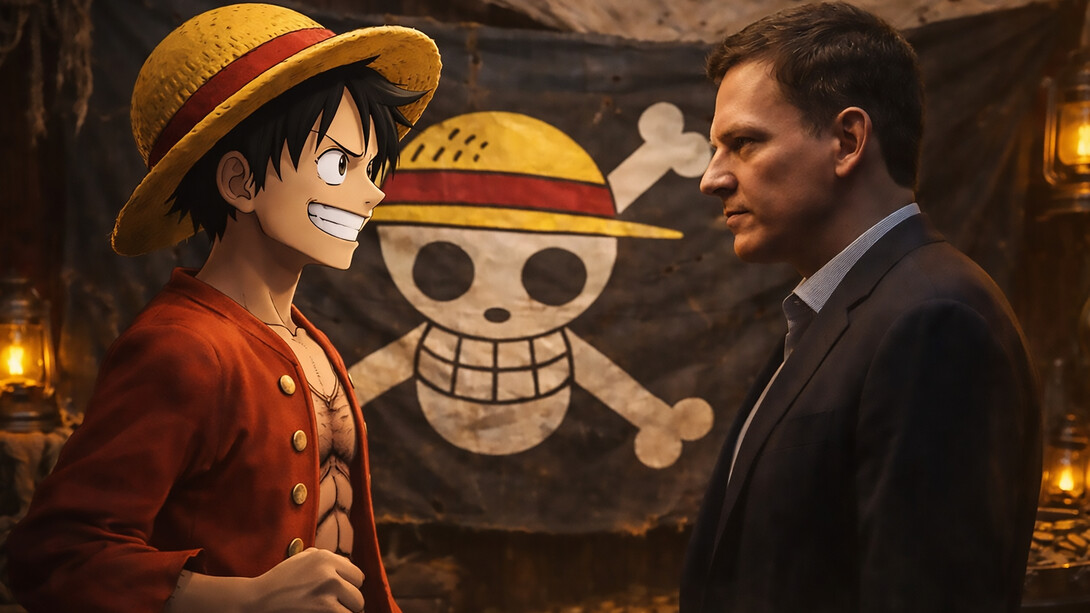
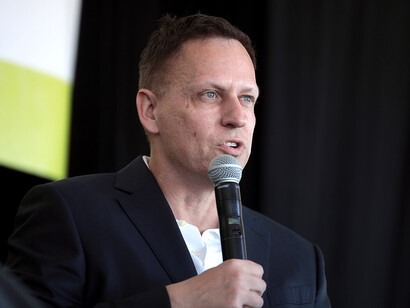
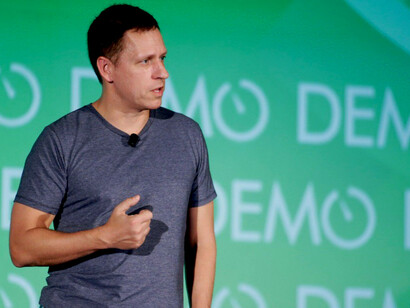
By now, I believe most of us are at least vaguely familiar with a tech billionaire talking about the Antichrist and Armageddon, who’s hesitant to say that humanity should survive1. But it was primarily Thiel’s opinion article on One Piece2 that piqued my curiosity about what a man of his position could say about the world.
The eccentric billionaire
Although I found Thiel’s reasoning and interpretation of One Piece silly, if not "wrong," I still have to say I was surprised that a billionaire can be eloquent and eclectic on ideas such as faith, mythology, and literature. Unlike Jobs or Musk, who threw around “big ideas” for the brand’s image's sake, Thiel's opinion article is thought-through and honest; it has substantive meaning behind it.
In response to facing my own prejudices (and to the best of my knowledge, no billionaire was ever hurt by them…), I decided to read a bit more about Thiel and, even more so, find out what exactly his philosophical position is. And by reading more about him and his texts/interviews where he details his political views, I came to believe that he’s encapsulating the USA's current ideology perfectly.
To add to this, his direct influence in the elections and governance could make a strong case that he is the USA’s most prominent ideologue.
There’s plenty of evidence that Thiel’s influence cannot be overstated. But at its core, his ideology is disappointingly nothing new—it's a standard mix of neoconservative (the West is built on white Christian values) and neoliberal values (exponential growth, less regulation for big companies), shrouded in the “esoteric” lingo. It aims to justify and maintain the exploitative hegemony of the USA’s capitalism.
Social capital
I will not go into detailed analysis on how his work on PayPal and financing startups like Facebook, LinkedIn, or YouTube got him to his current position, but I will highlight the fact that so many of the key governmental positions in the current Trump administration are occupied by people supported by Thiel (e.g., J.D. Vance, Ted Cruz) or that were affiliated with his companies (a number of positions in the Department of War, DOGE, and similar). For a full list and a lot more details, do check the end of this article3.
Thiel has also been in contact with Epstein (but who hasn’t at this point?), and Trump’s camp considers him one of the biggest contributors to his election victories4. He’s also personally connected with the world's richest person, Elon Musk.
Both of them share affinity for Trump and disdain for the democratic process they purposefully subvert. This goes along with lofty ideas such as Thiel’s quest for immortality and Musk’s goal to “make humanity an interplanetary species” by occupying Mars. The ambition of both of these men is to find a place where they wouldn’t be restrained by governments, a place of complete freedom (i.e., a techno-capitalist utopia). In one of the interviews, Thiel sympathetically says how sad it is that Elon gave up on his Mars dream “because woke AI would follow him there too," indicating that they’re both so disconnected from this world they might as well already be on Mars.
Mythologization of the existing state
Another one of those utopian ideas is a strange manifestation of the übermensch, called “The Founder." The Founder is a mythologized elaboration of entrepreneurial influence on society and history. For Thiel, this is the role of a special someone who creates new realities (new technologies, institutions, or monopolies) instead of merely competing within existing systems. But you can read more about that here5 (or in his book “From Zero to One," if you’re into that).
This is also one point where the contours of his political opinions are visible. Democracy, by definition, is meant for everyone, while excellence, by definition, is not. “Fate leads the willing and drags along the reluctant." Thiel quotes Seneca, but his interest is not with the practicality of interest to ~8,000,000,000 reluctant humans, but with finding the fate-following, willing individuals that will accelerate humanity’s development.
He puts his money where his mouth is, so his Thiel Fellowship and 1517 Fund do support young dropouts with great ideas. My not believing in the principle of his idea does not take away from the contribution of his praxis. On the other hand, history also shows us that when rich capitalists help brilliant young scientists, artists, or bodies, the latter ones get exploited and drained out, while the former reap the exponential benefits.
Acceleration of humanity’s evolution through science and unrestrained capitalism is one of the defining features of these ideas. Because it is stagnation that is the Antichrist—the sense of false security made by all-regulating governmental authorities that stop humanity from progressing and advancing. The Antichrist is someone who uses fear of Armageddon to justify a world totalitarian society that stops all progress.
Confronting the Antichrist while avoiding Armageddon is one of Thiel’s main concerns. The Antichrist is, in a sentence, a political or technological system that promises to eliminate conflict and create global peace by concentrating extreme power and completely reducing human freedom. At times, it’s the woke ideology, sometimes it's Greta Thunberg, it might be governmental regulations, or also it’s Islam; it’s almost as if the Antichrist purposefully opposes Thiel’s political views.
In my opinion, this necessity to associate mythological themes with the most mundane of things is not just out of self-aggrandizing need. Thiel more than once highlights that he uses “Antichrist” and “Armageddon” as theoretical frameworks (at times metaphorical, at times literal) and as a way to obscure his intentions. Lastly, I think both Thiel and Musk consider mythology and the occult as something cool (and I do too, just not how they are doing it). In the contemporary media ecosystem, this gives them added symbolic value.
Specifically, saying “we’re threading a path between Armageddon and Antichrist” is a lot more captivating; it sounds a lot more purposeful and a lot more meaningful than “woke regulations negatively impact the profit margin of AI companies." But in this situation, these two sentences refer to the same thing.
Thiel’s political ideology
Thiel put himself on the political map by declaring himself a libertarian who no longer believes democracy and freedom are compatible, as stated in his 2009 text6. This is also where he articulates the possibility of occupying, colonizing, or creating new (political) living spaces.
Another key moment necessary for understanding Thiel’s ideological position comes from 2007 text “The Straussian Moment7," where he calls for the West to stand united under the threat of Islam. Islam is here reduced wholly to a terrorist existential threat, incompatible with the modern West, and we’re just expected to take it as a given.
Christianity is at the core of his philosophical and political ideology. Thiel, influenced by René Girard, believes that Christ is a figure who revealed the societal need for a scapegoat. A scapegoat is (an innocent) person or group that a community collectively blames and punishes in order to restore unity and reduce conflict. Thiel mostly rejects violence but correctly points out that forcefully pacifying social antagonisms cannot resolve the differences between groups.
I say mostly rejects violence, but he’s aware of the political realities and the workload of secret governmental agencies, a workload that’s needed to maintain the peace and prosperity of the West. He sees war as outdated and something the West has left behind, but a simple military operation or assassinations are ok to maintain “the global Pax Americana." “Thou shalt not kill, just maim your enemy," as the sixth commandment goes, I think.
After MAGA - Peter Thiel
If there is a single point that Thiel’s political activity is trying to answer, then it’s the question from this paragraph in his 2007 book. essay “The Straussian Moment":
“The modern West has lost faith in itself. In the Enlightenment and post-Enlightenment period, this loss of faith liberated enormous commercial and creative forces. At the same time, this loss has rendered the West vulnerable. Is there a way to fortify the modern West without destroying it altogether, a way of not throwing the baby out with the bathwater?”
So there was a strange sense of familiarity when I heard Rubio’s speech at the Munich Security Conference in February this year:
For five centuries, before the end of the Second World War, the West had been expanding—its missionaries, its pilgrims, its soldiers, and its explorers pouring out from its shores to cross oceans, settle new continents, and build vast empires extending out across the globe. (…) The great Western empires had entered into terminal decline, accelerated by godless communist revolutions and by anti-colonial uprisings that would transform the world and drape the red hammer and sickle across vast swaths of the map. (…) The question before us now is whether we still possess that same clarity of purpose—whether we are still willing to defend the civilization we inherited and to work together to build its future.
Marco came to Europe to preach to the European leaders about the importance of the USA’s hegemony, colonial and Christian exploitative practices, and the necessity/justification of continuing to do so. But the similarities of those two quotes give an insight into why Thiel is a nodal point in understanding the new Pax Americana deal: they have their own idea of what the West and the Rest are and are acting upon it.
I can't say that Rubio is directly influenced by Thiel, but there’s a certain preoccupation that their ambitions share; the highlighted questions are a quest for utopia.
Ideology and utopia
Yet there is a strange appeal and conviction in Thiel’s narrative political narratives, one that’s not explainable by “interesting” esoteric phrasing. This appeal, and its transformative power, is the utopian aspect of his views.
I’m not using the term utopia as something improbable or unrealistic. To clarify the terms: for Karl Mannheim, ideology is a mode of thought that stabilizes and justifies the existing social order (often unconsciously distorting reality), while utopia is a mode of thought that transcends the present order by envisioning ideas capable of transforming it. In other words, ideology is a set of ideas that conceal the fact that there’s a clear discrepancy between the idealized world and the actual world. Utopia recognizes this discrepancy and aims to transform social reality towards this idea.
So for Thiel, “theology reformulates the question [of one World State or Apocalypse]: 'Antichrist or Armageddon?'" “Neither,” the Christian replies. He prays for new miracles, new technologies, and strange new possibilities. ” i.e., utopia.
And for some reason, when I was reading this, I remembered Marshall D. Teach from One Piece enunciating, "People's dreams... never end!”
This ambition, the utop"utopia"ian aspect of Thiel’s narratives, is what gives the standard neocolonial, neoliberal, and neoconservative rhetoric a renewed strength and appeal. Yes, in pursuing this quest, Thiel radicalizes some of the existing ideological constellations, and at the same time, this utopia is the radicalized form of these existing ideologies. Combined with the obvious exploitability/vulnerability of the existing democratic systems, ones that tech billionaires are keenly aware of, this utopia is not just dangerous but also dangerously close to realizing itself.
To note: someone’s utopia is someone else's dystopia. Thiel is very clear on which side he is on. Even if he’s considerate towards a regular human being, the fact remains that the majority of humanity is omitted from this utopia. By being a Western Christian, a capitalistic paradise is something preordained for the Western Christians; not everyone is invited.
Good guy antichrist
There are plenty of ways and plenty of points that could be tackled to point out why Thiel is wrong. Explaining the ethics of why colonialism is bad, why neoliberalism is horrible, and why neoconservativism is unnatural would make a good starting point. I’ll also refrain from being the village atheist, as if coming to Israel and Iran and saying, “Hey guys, Allah and Yahweh don’t exist; isn’t it time to stop the fighting?” would be met with approval.
And although I think my cynicism is obvious throughout the text, to be intellectually fair to Thiel, he’s not always approaching the Antichrist literally, but as a metaphor. Hence, the provocative subtitle of this section.
For René Girard, and by extension Peter Thiel, “Satan” is the very logic of scapegoating. The formally recognized representative of Satan on Earth is the Antichrist. In Thiel’s narratives, it is the Antichrist who functions as the scapegoat needed for the realization of his utopia.
A psychoanalytical reading is helpful to understand this.
What Girard and Thiel call “Satan” is what Laclau and Mouffe would recognize as social antagonism. Antagonism is defined as “the ‘experience’ of the limit of the social … the impossibility of [a society] fully constituting itself." In other words, there’s always something that’s not fully a part of our political beliefs, and this something is incorporated by someone, i.e., our (political, ideological) opponents. This someone is the one responsible for the inability to achieve a total unification of a society, in other words, a certain utopia.
This is the function of the scapegoat, or what Žižek would call “ideological phantasm," and this is what the Antichrist represents in Thiel’s narrative. It is a projection of all the negativity that renders the realization of utopia unachievable onto a specific group of people. The logic follows through in such a way that “if we could only resolve that one thing, we would have unity, peace, and prosperity.” It also provides an explanation of existing circumstances, so the more rigid the ideology, the more “existential” the threat feels; in response, the more dire the consequences.
Let’s take specific examples: for Nazi Germany, the impossibility of a pure and unified nation was projected into Jews (hence the Final Solution); for the Israeli state, this is projected into Gaza Muslims (hence the genocide); for Iran’s sharia regime, this is projected into the Americans, Israel, and women’s sexuality (hence the Jihad and terrorism); for a USA citizen, it’s the Epstein class; for a communist, it’s the capital; for conspiracy theorists, it's the media; for Thiel, it’s the Antichrist (and all the meanings he provisionally inputs to the term).
For me, it’s a certain tech billionaire… I’m joking, but I hope the point is clear—there is always some truth and a lot more projection when handling this inability to achieve the wanted utopia. The stronger this conviction is, the more subhuman your opponent seems, and the more self-righteous your own position is.
The truth is, there will always be something that’s excluded from the total unification of a society. And I think this is a crucial point to make: Thiel’s Antichrist would always fail miserably in this mission of creating a totalitarian world government. The threat of Thiel’s (metaphorical, conceptual, philosophical) Antichrist is just not real.
Just like on an individual-identity level and on a social one, we’ll always aim for something more, and something will differ from the ideal image we’re aiming for. In a sense, everyone is always searching for that one piece that’s always missing, but instead of demonizing it, I believe that’s where freedom comes from. And it’s what makes existence worthwhile, too.
Dangers of Christian ideology
And this is why I think understanding what Thiel, but also Rubio, Trump, and the rest of the USA’s administration refer to as “Christian values” is important. I’m definitely not here to condemn faith or someone’s beliefs, but I am quite sure that religions need to be protected from politics (not the conventional other way around).
One specific example that I’d like to point out is the reading of the Epstein files as Satanic. The pedophilia, murders, and everything mentioned are evil. But calling this Satanistic whitewashes the responsibility of the whole “Christian” elite associated with Epstein. It places the blame on something theological or metaphorical, something abstract, instead of the tangible capitalist-patriarchal system that enables and creates this sort of elite. Christ and its political representatives here on Earth become the logical alternative to conflict framed this way.
Seeing the pedophiles as Satanic mystifies the reality, making the real, concrete struggle against the concrete, specific actors and institutions irrelevant in the bigger picture of the God vs. Satan dynamic.
It is Satan that’s innocent here; the real perpetrators have a specific, human name and are protected by the Christian elite of the USA administration—Thiel, Rubio, and Trump, among others. Christian ideology not only protects the perpetrators, but it aims to capitalize on the Epstein files by “scapegoating” Satan.
Finally, and I think also this is a crucial point to make too: if the Antichrist and Satan are not really a factor, and we can exclude one part of Thiel’s “Antichrist or Armageddon” equation, the only open question is the Armageddon.
And instead of it being another plausible theoretical framework, useful for thought experiments, Zionist Evangelicals literally believe this nonsense and are politically active in achieving it8.
Now, I wouldn’t mind if there’s a real apocalypse and a real seven-headed dragon commences it. But to have some weirdos actively work on it to self-fulfill it (and in the meantime, like Rubio, come to my house to preach how these silly, bizarre ideas make for good values), well, that’s where I draw the line.
It turns out that Christ is a lot more dangerous than the Antichrist. And I wonder why Thiel collaborates with them.
Instead of a conclusion
For anime fans, I know I’m happy not to read Thiel’s opinion on Berserk, as I’m sure we’d have another “Griffith did nothing wrong” pundit. Thank god he didn’t read Attack on Titan; I think we’d all be in a lot more trouble if he did.
Thiel's calling Luffy a Christ-like figure is not completely wrong. Luffy is a sun-god archetype, just like Jesus Christ is. It creates freedom and ruins the old oppressive structures. I find it funny that, if Thiel’s analysis was correct, by now in the One Piece story, Christ would be riding on the back of the Antichrist to bring about Armageddon.
But unlike Thiel’s conception of freedom that is reserved for the powerful, “fate-led” people, not the ordinary ones, I am much more of a fan of Luffy’s conception of freedom: Pirate King (“the most free person in the world”) conquers no one. Luffy wants to create a world where his friends can eat as much as they want. Not a world where the rich and powerful can go to Mars.
Still, I find Thiel’s writing sensible and, at some points, correct, even if I’m on the opposite side of what he’s representing. I do think Thiel is on point with the need to articulate different kinds of political engagement. Because there is something wrong with our democratic systems, and the impossibility of seeking alternatives is just one of the issues that choke our freedom.
And this is something that can be learned from One Piece. Freedom at the expense of others' freedom is not real freedom. Without justice, there will always be something that undermines the oppressive functions of such a freedom that’s reserved only for a part of a society. So, no wonder that Luffy is the world-destroyer, the Antichrist of the One Piece world.
And it’s also no wonder that the Straw Hat flag found its way from utopia to our real life.
References
1 Peter Thiel won't say whether human race should survive AI.
2 Voyages to the End of the World.
3 The Ideal World of Peter Thiel.
4 Peter Thiel's Apocalypse.
5 ‘Founder as Victim, Founder as God’: Peter Thiel, Elon Musk and the two bodies of the entrepreneur.
6 The Education of a Libertarian.
7 The Straussian Moment.
8 The Politics of Apocalypse: The Rise of American Evangelical Zionism.