English
 Español
 Français
 Deutsch
 Italiano
 Português
Social scientists often see the individual as a product of society. But never, never underestimate the impact of personality on society. Or at least, some personalities. The only other personality in recent history who had as great an impact on global developments as Donald Trump was Osama bin Laden, who famously lured the US into disastrous engagements in the Middle East. If Osama was the “Napoleonic” figure of the first decade and a half of the 21st century—that is, one who shifts the train of history onto a different track—Trump has filled that role in the succeeding eleven years.
Canadian Prime Minister Mark Carney made waves in his speech in Davos a few weeks ago. I might disagree with some of his comments, but I am in full agreement with his assessment that Trump has produced a “rupture” in the global order. There is no going back to the pre-2025 order of things, the post-World War II order of "Global Containment" where the US, as hegemon, responded to what it considered a threat to the stability of the global capitalist system wherever this appeared, through military, political, or economic means.
What NSS 2025 is telling us
National Security Strategy 2025, issued last November, is the most forceful statement of the stance that has replaced the paradigm of Global Containment. My take on what Trump is saying in this document—its subtext—is:
The US is overextended, so we’re retrenching to the Western Hemisphere, where we can do anything we think serves our national interest, from kidnapping a chief of state we don’t like, like Nicolas Maduro, to taking over Greenland or Panama, or vetoing any project that compromises our hemispheric hegemony, like the proposed undersea cable from Valparaiso to Asia.
No more export of democracy, no more nation-building exercises like George W. Bush’s foolish venture in Iraq anywhere, including our backyard.
We’ll follow Israel’s lead in the Middle East.
Europe, you’re on your own.
Ukraine and other former Soviet states, you’re in Russia’s sphere of interest.
You folks in the Western Pacific, you have to live with the fact that you’re in China’s sphere of influence, and we might eventually have to draw down our massive but costly military presence in Korea and Japan.
But is Trump still reading the NSS 2025 script?
But are Trump’s recent moves, notably his massive assault on Iran along with his thuggish sidekick Israel, not a departure from this script? This adoption of a spheres-of-influence strategy does not mean the administration will not intervene in other parts of the world. It may, in certain circumstances, like if it’s a low-cost, momentary intervention with air and naval power, like his Dec 25, 2025 bombing of northern Nigeria; or it miscalculates the actual costs of engagement, like the air and naval assault of Iran. What the “Make America Great Again" (MAGA) base does not like is boots on the ground, the commitment of ground forces that could lead to another “forever war.”
It’s important to point out that some influential MAGA personalities like Steve Bannon, Tucker Carlson, and Marjorie Taylor Greene were either skeptical of or opposed to Trump’s snatching of Maduro. And they have been even more vocal about the attack that he launched on Iran, with Carlson angrily declaring that it is “Israel’s war” that the US has no business getting involved in.
Anyway, Trump is the personification of volatility and unpredictability, so if there’s anything I’ve learned from his behavior, it’s to never say never about his future moves.
Trump, the ruling class, and MAGA
In this regard, I agree with the Institute for Policy Studies analyst Phyllis Bennis’ characterization of Trump as the president who has enjoyed the greatest autonomy from any faction of the US ruling class owing to his loyalty to his MAGA base. I think this is best illustrated in his relations with US transnational corporations. For Trump and his close advisers like Peter Navarro, it’s not only China and the world that are to be blamed for the US’s economic crisis.
TNCs share the blame because they relocated many of their manufacturing operations and built their supply chains outside the US owing to their search for cheap labor. One of Trump’s central appeals to MAGA is that he wants to make America great again by bringing back the lost industries and industrial and manufacturing jobs, a process called reshoring or reindustrialization.
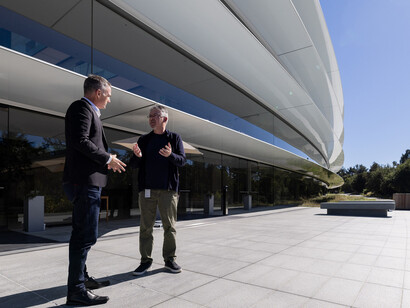
How transnational corporations are relating to the world being shaped by Donald Trump is shown by the moves of Apple. Probably the US corporation that benefited most from globalization, Apple has adjusted to the direction where the wind is blowing, and that is towards deglobalization Trump-style. It is now leading the so-called reshoring process. It has read the handwriting on the wall and, though this will negatively affect its bottom line and scramble its operations, to protect the remainder of its super profits, it is leading the reshoring of its supply chains, with a planned $600 billion investment in the manufacture within the United States of its iPhone, iPad, MacBook, as well as in the fabrication of semi-conductor chips.
Boasting that Apple manufacturing plans will create 450,000 jobs in the United States, CEO Tim Cook admitted to being a hostage to Trump’s push to deglobalize the operations of American firms, saying, “The president has said he wants more in the United States…[and] we want more in the United States.” Where Apple goes, others follow, among them U.S. chipmakers Intel and Nvidia, automotive leader Tesla, and pharmaceutical giant Johnson and Johnson.
A fighting retreat
Trump’s rhetoric is aggressive, blustery, and brazen, but let’s not be fooled. It is a defensive imperialism, a fighting retreat, a response to the overextension of American economic and political power. In fact, Trump and MAGA have recognized a geopolitical and geoeconomic reality that neither the Democrats nor the Bush-Cheney Republicans wished to acknowledge, and acted accordingly. Whether the geopolitical retrenchment to the western hemisphere and the geoeconomic focus on building an economic Fortress America will succeed in shoring up US power is, however, an open question.
So what should we expect going forward?
A lot of Trump’s future moves will be determined by two things: what happens abroad and what happens in the US, and on both fronts, things are not going well for him at the moment.
It is now clear that Trump’s bombing of Iran was a great misadventure to which he was lured by Israel’s Benjamin Netanyahu. Just by hanging in there and leaving Trump with no off-ramp to end the conflict with a credible claim of victory, Iran did not lose and did Trump great damage. The events in Minneapolis, where two white Americans were killed while opposing ICE agents hunting undocumented workers has provoked a strong backlash, forcing him to dismiss the hardline Secretary of Homeland Security Kristi Noem.
Despite his effort to convince Americans that the economy is doing just fine during his State of the Union address a few weeks ago, a majority of them now think the economy is in bad shape, even as Trump keeps on saying he has created a "wonderful economy." Prices had been going up before his war on Iran, but the massive spike in oil prices stemming from it has made his claims increasingly surreal.
Moreover, the Supreme Court judged his global tariff actions as unlawful, the most significant departure from Trump’s wishes that that notably compliant body has engaged in so far.
Not surprisingly, according to the polls, only 32 per cent of Americans feel Trump has the right priorities.
Peak Trump?
So the question many are now asking is: has Trump peaked?
Given the disillusionment setting in, the chances are growing that Republicans are now likely to lose the coming elections for the House of Representatives in November, and there is, in fact, emerging a possibility that the Democrats could also win the Senate. If that happens, then there is likely to be an institutional stalemate that could drastically impact the constitutional future of the US, with massive consequences for the rest of the world.
If domestic sentiment continues to turn against Trump, what will happen in the presidential elections in 2028 if the Republican candidate loses? Will Trump urge the party and his MAGA base to refuse to recognize the results of the elections, as he did in 2020? There are, in fact, great worries that even if he is not the candidate, Trump will not respect the results of future elections. Sometimes it pays to pay attention to people not normally regarded as political experts, like the actor Robert de Niro. Familiar with the psychology of gangsters like Trump by playing them, de Niro has said he is sure Trump will refuse to yield power. He is not alone: Democratic Senator Chris Murphy of Connecticut has expressed strong doubts that Trump will even allow free elections in 2028.
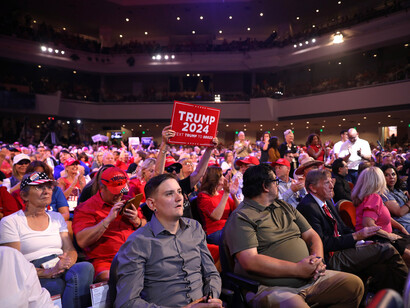
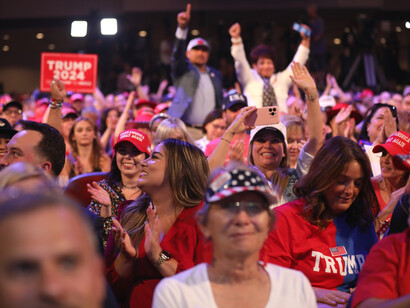
One thing is certain: most of Trump’s MAGA or far-right base will stay with him, through hell or high water.
Towards de facto civil war
Whatever happens in the electoral process, one thing we can be sure of is that the US is headed towards even more political polarization, one that could end in a de facto civil war. We must remember that Trump represents the interests and ideology of the majority of the white population of the US, which is worried that in a few decades they will become a minority. Indeed, I would say that if Trump had not existed, he would have had to be created. In this connection, when the NSS 2025 warns Europeans that they could be headed for “civilizational erasure,” it is, in fact, reflecting the fears of White Americans that they themselves might lose their position of political, economic, and cultural privilege.
It is ironic then that the fate of the liberal democracy in the US may well rest on the 43 per cent of white people who did not vote for Trump in the 2025 elections.
But whatever the electoral results will be in 2028, it is useful to remember what the CIA analyst Barbara Walter wrote in her 2022 book, How Civil Wars Begin:
“Where is the United States today? We are a factionalized anocracy [a degenerating democracy] that is quickly approaching the open insurgency stage, which means we are closer to civil war than any of us would like to believe. January 6 was a major announcement by at least some groups…that they are moving toward outright violence…In fact, the attack on the Capitol could very well be the first series of organized attacks in an open insurgency stage. It targeted infrastructure. There were plans to assassinate certain politicians and attempts to coordinate activity.”
The end of the second Trump presidency may well turn out to be the trigger for something more awful than what we’ve seen so far.