English
 Español
 Français
 Deutsch
 Italiano
 Português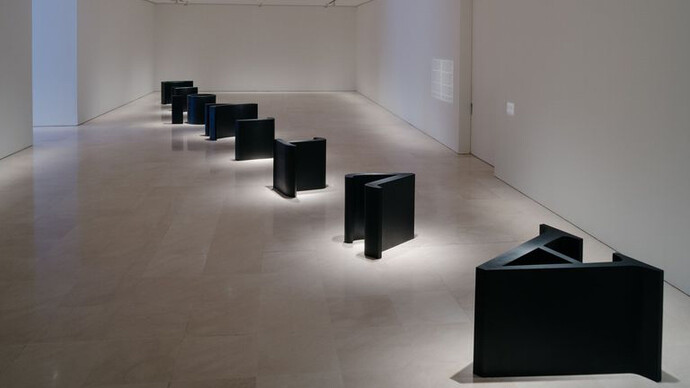
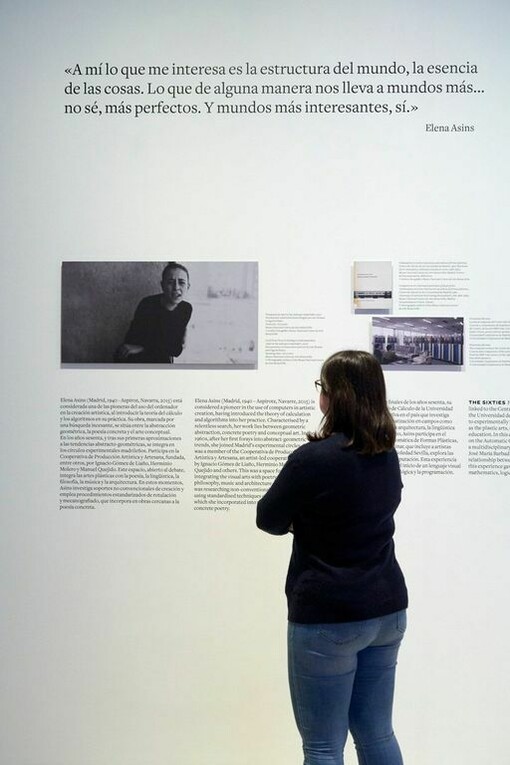
Elena Asins (Madrid, 1940 – Azpíroz, Navarre, 2015) was one of the most unique and rigorous creators in contemporary Spanish art. Her boundless curiosity and strict formal logic made her work a true ode to the discipline of art. Asins was awarded Spain’s Gold Medal for Merit in the Fine Arts (2006) and the National Award for Plastic Arts (2011). She developed a sustained body of research encompassing mathematics, drawing, poetry, programming and image. She refined her practice to the limit, constructing a language made up of knowledge, precision and renunciation.
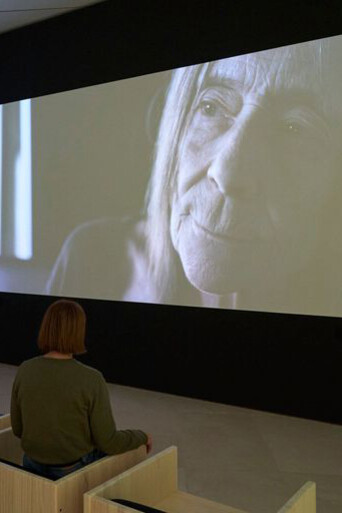
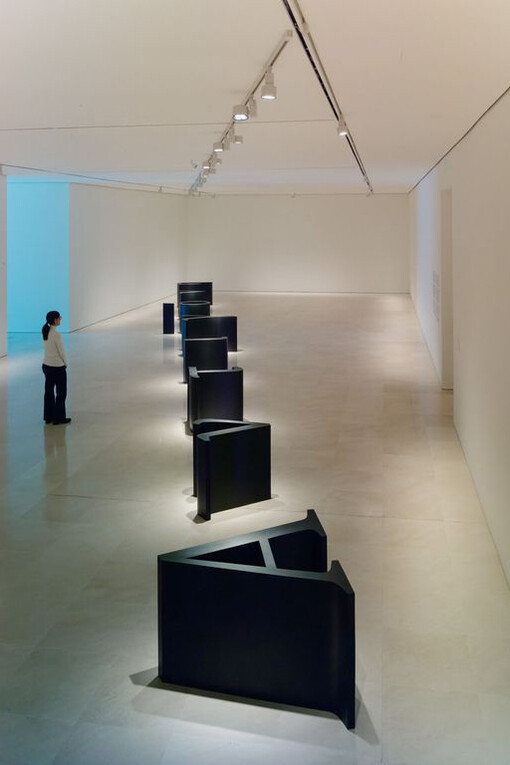
On the tenth anniversary of her death, the Museo Picasso Málaga presents Antigone (Antígona), the artist’s last major work. In this installation, Asins engages with the classical myth using a contemporary experimental language. The sculpture, formed from the Greek characters of the name Aντιγόνη and rendered in intense black, transforms the word into a structure: a sculpture that can be read, and in which form and meaning merge. It is presented with Haemon (Hemón), one of the videos the artist made about the myth. In the video, voice, rhythm and digital music explore the ethical and temporal dimensions of the tragedy.
The myth of Antigone has been continually reinterpreted throughout modernity—by Cocteau, with stage sets designed by Picasso; by Honegger, Anouilh, Brecht and María Zambrano—because it confronts us with universal tensions between law, conscience, justice and affection. Asins’s approach does not seek to illustrate the story, but rather to revisit it from the perspective of structure and visual language, inviting us to relive a conflict that continues to permeate our social and political reality.
This exhibition forms part of the Invited Work series and was made possible thanks to the generous support of the Museo Nacional Centro de Arte Reina Sofía, the institution that safeguards Elena Asins’s artistic legacy.