English
 Español
 Français
 Deutsch
 Italiano
 Português
Across the vast mythic, philosophical, and ritualistic landscape of India stretches an idea both poetic and puzzling—Chiranjeevatva, the state of being chiram jīvati, “one who lives long.” The term Chiranjivi does not merely denote physical immortality; it refers to beings whose lifetimes extend across yugas because their existence is woven into the fabric of cosmic functions. They are witnesses of unfolding epochs, custodians of wisdom, guardians of dharma in its subtle and gross forms, and participants in the divine play (līlā) that sustains the moral order of the universe.
Indian thought does not consider immortality a privilege without purpose. Every Chiranjivi is bound by a cosmic responsibility, a duty that extends beyond the mortal plane. They remain on earth not as relics of mythology but as archetypes, energies, and guardians whose presence signifies continuity in a world defined by cycles.
Tradition widely recognises seven or eight Chiranjivis, depending on regional sources. These include Ashwatthama, Mahabali (Bali Chakravarti), Veda Vyasa, Hanuman, Vibhishana, Kripacharya, and Parashurama. Some traditions add Markandeya, Jambavan, or Devapi, yet the canonical list of seven—sapta chiranjivin—remains the most cited in later Puranic literature.
Ashwatthama: the eternal wanderer bearing karma
Ashwatthama, son of Dronacharya and Kripi, stands among the most complex of the Chiranjivis. Born with a divine gem (mani) embedded in his forehead, he was blessed with protection against hunger, thirst, and fatigue. Yet his immortality is not a blessing born of virtue; it is a penance sealed by destiny.
After the Kurukshetra War, in an act of blind vengeance, Ashwatthama unleashed the Brahmashira weapon toward the unborn child of Abhimanyu—Parikshit. This invoked Krishna’s wrath. Ashwatthama was cursed to wander the earth until the end of the Kali Yuga, to carry wounds that would never heal, to be stripped of his gem and radiance, and to live without the fullness of life. His Chiranjeevatva thus becomes a karmic continuity, a reminder of the consequences of unbridled rage.
In many traditions, Ashwatthama’s immortality ensures the continuity of the warrior memory of the Mahabharata and preserves ancient knowledge of astras. He stands as a living witness to the decline of dharma in Kali Yuga and as a cautionary archetype of egoic wrath. Some folklore suggests he may assist Kalki in the final destruction of adharma.
Mahabali: the king preserved until the next cycle
Mahabali, the grandson of Prahlada, remains immortal by the boon of Vamana. A Daitya king renowned for righteousness, generosity, and devotion, Bali ruled with unmatched virtue.
Vamana’s act of sending Bali to the netherworld was not punishment but divine preservation. Bali was granted the boon to visit his people once every year, a memory celebrated as Onam in Kerala. His immortality represents the eternal survival of just kingship and the preservation of devotion even among Asura lineages. It reminds humanity that divinity favours humility over lineage. Some texts suggest that Bali may govern in a future cycle of Manu, reinforcing the idea that dharma recognises integrity, not birth alignment.
Veda Vyasa: the eternal seer and compiler of knowledge
Krishna Dvaipayana, known as Veda Vyasa, is more than a sage; he is a cosmic phenomenon, a nodal point between knowledge and eternity. As the compiler of the Vedas, the Mahabharata, the eighteen Puranas, and the Brahma Sutras, Vyasa became the custodian of collective human wisdom.
His Chiranjeevatva is not merely personal survival but the embodied immortality of knowledge. Vyasa is believed to remain alive to preserve Vedic wisdom across cycles, reorganising and reteaching it according to humanity’s evolving capacity. Tradition holds that in every Dvapara Yuga, a Vyasa appears to divide and systematise knowledge anew. In this sense, Vyasa represents the eternal transmission of sacred memory.
Hanuman: the eternal servant of Dharma
Hanuman, son of Vayu and Anjana, is perhaps the most beloved of the Chiranjivis. He embodies devotion, courage, humility, strength, and divine wisdom.
Lord Rama blessed him with immortality so that the world may never be without an example of perfect devotion. Hanuman desired to live as long as the name of Rama is sung. Since Rama-nāma is eternal, so too is Hanuman. His presence is believed to be accessible to devotees even today. He aids those in distress, guards sacred spaces, preserves the Ramayana’s living energy, and empowers seekers with clarity and inner strength. Many traditions affirm that he will actively assist during Kalki’s incarnation. Hanuman is not merely immortal; he is eternally available.
Vibhishana: the guardian of Dharma among Rakshasas
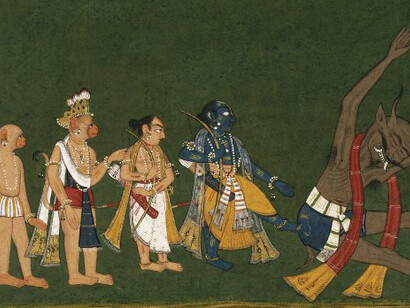
Vibhishana, brother of Ravana, chose righteousness over blood ties. When Ravana refused to return Sita, Vibhishana aligned himself with Rama. After Ravana’s fall, Rama crowned him king of Lanka and granted him immortality as a guardian of dharma.
His continued existence ensures that righteousness persists even within lineages associated with darkness. Vibhishana symbolises the courage to uphold dharma despite familial or cultural pressure. Folklore holds that he still resides in Lanka, protecting it under divine mandate and serving as a reminder of the consequences of egoic downfall.
Kripacharya: the eternal teacher of discipline
Kripa, son of Sharadvan and a survivor of the Kurukshetra War, embodied discipline, emotional balance, and adherence to dharma. Adopted by King Shantanu, he became a master of martial instruction and ethical restraint.
His immortality ensures that martial knowledge and disciplined instruction remain intact even during times of moral decline. Kripa is believed to guide future warriors and to assist in preparing Kalki.
He represents the unbroken continuity of disciplined knowledge and ethical power.
Parashurama: the immortal warrior-sage
Parashurama, the sixth avatar of Vishnu, bridges epochs as both warrior and ascetic. He annihilated corrupt Kshatriyas twenty-one times to restore balance, then withdrew into penance. As an avatar whose mission transcends a single age, his immortality is inherent.
Parashurama continues to preserve the knowledge of dhanurveda, instructing legendary figures such as Bhishma, Drona, and Karna. He is expected to train Kalki in the final phase of Kali Yuga. Parashurama embodies karmic reparation, martial discipline, and the eternal necessity of divine intervention when power becomes corrupt.
The symbolic meaning of the Chiranjivis
Beyond literal immortality, the Chiranjivis embody timeless principles. Ashwatthama represents the burden of karma and the danger of uncontrolled anger. Mahabali symbolises humility and righteous kingship. Vyasa stands for the perpetuity of knowledge. Hanuman embodies devotion and service. Vibhishana reflects dharma upheld within darkness. Kripacharya represents disciplined continuity, while Parashurama signifies divine correction and cyclical balance.
Together, they affirm that although dharma may decline, its guardians never vanish entirely. Knowledge, devotion, discipline, humility, and justice persist through cosmic dissolution.
Chiranjivis and the cycles of Yuga
Each Chiranjivi aligns with specific epochs. Some take birth in Satya Yuga, others rise in Treta or Dvapara, yet all remain as witnesses in Kali Yuga. Many traditions hold that these immortals will converge during the final phase of Kali Yuga when Kalki appears to restore cosmic balance. Their presence ensures that no age is entirely bereft of guidance.
Philosophical foundations of immortality
In Indian philosophy, immortality is not an escape from death but a continuity of responsibility. It reflects service to the universe, the burden of awareness, and the preservation of cosmic order. In spiritual terms, Chiranjeevatva resonates with Lokasamgraha, the welfare of the world, and the steady wisdom of Sthitaprajna. For some, such as Ashwatthama, immortality becomes atonement. For others, like Hanuman and Vyasa, it becomes luminous service.
Do Chiranjivis exist today?
Scriptural traditions affirm that they do, though not in ways meant for public demonstration. Their existence is described as subtle and functional rather than ordinary and physical. They are believed to move among sacred spaces, guide spiritually mature seekers, protect dharmic lineages, and prepare humanity for the eventual restoration of order. Their immortality is cosmic in purpose rather than biological in spectacle.
Conclusion
The Chiranjivis form a luminous thread woven through Indian mythology, philosophy, and ritual. They are guardians of continuity in a cyclical universe. Some carry the weight of karmic consequence; others bear the radiance of divine mission. Hanuman safeguards devotion, Vyasa preserves knowledge, Parashurama guards martial wisdom, Kripa maintains disciplined tradition, Vibhishana protects righteousness, Mahabali stands for humility, and Ashwatthama reminds humanity of the scars of violence.
Together, they constitute an eternal council—visible or invisible—ensuring that even in the darkest age, dharma is never without its torchbearers.
References
Critical Edition. Pune: Bhandarkar Oriental Research Institute (BORI). Multiple volumes, various editors, 1927–1966.
Vālmīki Rāmāyaṇa. Gorakhpur: Gita Press. Standard Sanskrit–Hindi edition, multiple printings.
Bhāgavata Purāṇa. Skandha 8. Gorakhpur: Gita Press.
Viṣṇu Purāṇa. Translated by H. H. Wilson. London: Trübner & Co., 1840; later reprints.
Padma Purāṇa. Uttara Khanda. Gorakhpur: Gita Press.
Śiva Purāṇa. Gorakhpur: Gita Press.
Vāyu Purāṇa. Translated by G. V. Tagare. Delhi: Motilal Banarsidass, 1987.
Kūrma Purāṇa. Translated by G. V. Tagare. Delhi: Motilal Banarsidass, 1982.
Harivaṁśa. Critical Edition. Pune: Bhandarkar Oriental Research Institute.