English
 Español
 Français
 Deutsch
 Italiano
 Português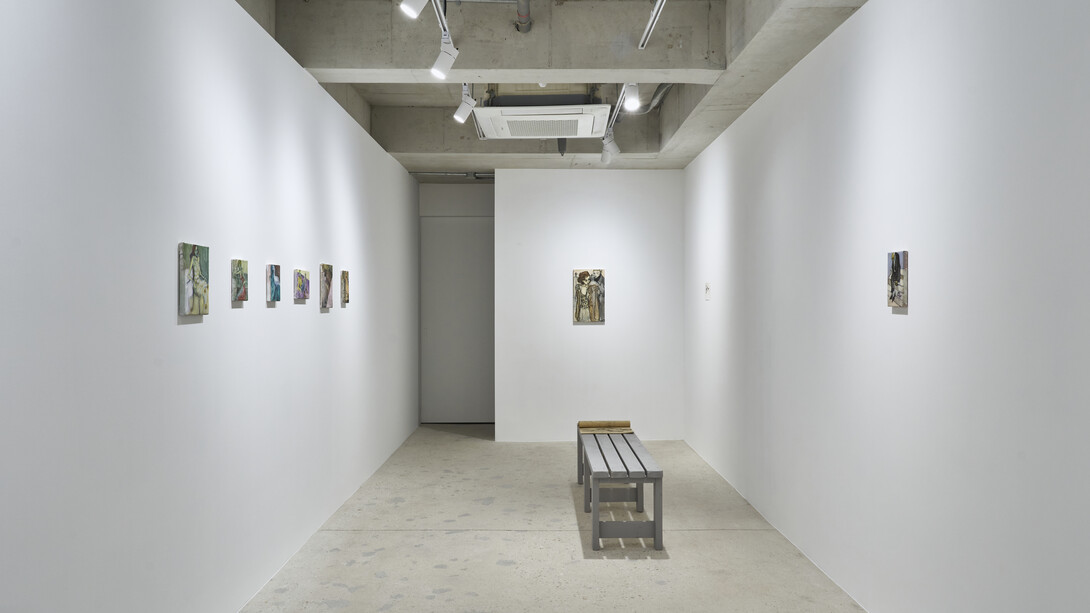
You know when you're at an exhibition, you can't embrace all the works, your mind makes choices and leaves the rest behind. You'll forget many of them, if you're lucky or have a good memory, you might retain two or three. However, most often, attention settles on a single work, and that work comes to represent what you thought of the show.
There are many situations in which we have to make these minor choices, choices that will not change the current state of affairs: leafing through the pages of a magazine, glancing at the numerous ads until an image holds your gaze, choosing one item over another in a shop... Shops, magazines, galleries... Whether or not a purchase is made is beside the point. What matters is the afterimage. You will think about that dress, that cardigan, that painting once you leave.
The comparison may seem a little bold, yet galleries are not so different from luxury department stores, are they? The mechanisms are similar. Beauty owes much to the invisible threads : of labour, costs, consequences.
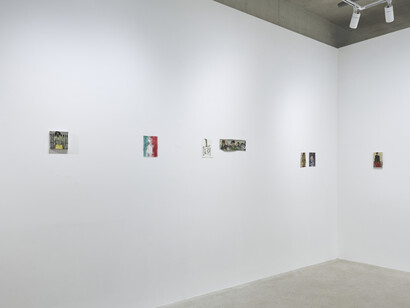
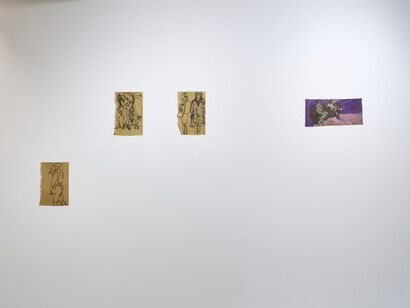
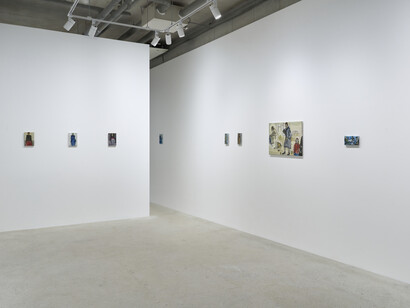
Of course I say this because among the thirty paintings and drawings in The latest thing, my mind chose one to represent the others. It’s a painting of a woman going out. A man is helping her put on her coat, even though she doesn’t seem to need this kind of masculine assistance known as gallantry. Behind them, black fences mark the boundaries of a house, and the title - a postcode, W1 - tells us that we are in Central London. Mayfair, Marylebone, Fitzrovia or Soho, famous streets associated with wealth, fashion and cultural capital. Let’s keep it simple: places with fences.
The woman is wearing a Prada autumn-winter 2000 top with a print depicting workers on their way to the factory. The garment carries an image of collective labour across a body of privileges. The workers march forward, while she remains still. They are many, she is singular. The painting stages a quiet but insistent social demarcation.
Perhaps this is why my mind lingered on this painting. It’s almost the only one set outdoors. It’s also one of the few images that suggest a narrative scene, while most of the paintings are taken from online fashion- show archives or advertisements in Vogue.
I’ve always thought that when these magazines came out, everything in them felt outdated. And that strikes me even more in Alma's paintings: the figures look skinny, late, dead. When the titles are not named after designers - Worth, Balenciaga, Miu Miu in her fairy bouncy skirt - they evoke qualities that are slipping away: very lowering, One’s period is when one is very young...
The woman in W1 appears momentarily absent, absorbed by a private vision, her gaze is drifting and she has that expression you get after catching a glimpse of something that - for a second - reminds you of something you can’t articulate. And I surprise myself: « Of course, she’s into the latest thing », the instant when something seems new, urgent, charged with promise, only to vanish almost immediately.
What is « the latest thing » then? The expression usually refers to something new that is attracting attention, but in Alma Feldhandler’s paintings nothing really looks new. At a previous exhibition, I heard someone ask if the paintings belonged to an estate, thinking they were the work of an artist no longer alive. And it’s true that some of the works give you the impression they’ve been inherited rather than produced recently. But if they appear to come from another era, it remains unclear which one.
Different periods and reigns coexist in The latest thing: Edwardian and Victorian garments alongside late capitalist fashion imagery. This deliberate mix produces a strange equivalence. Clothes from different centuries, images from different regimes of power and production appear to belong to the same moment.
Distinctions between before and after, early and late, dissolve. No era governs another, none is granted precedence or more authority. Like a runway where everyone is equally worn out.
In Alma Feldhandler’s work, newness is always belated. Everything is the latest thing because everything comes at once: late. Unlike the ads she uses, her images do not announce anything. They fall like drops into the ocean of time. Even a small painting, resembling a postcard of the NYC skyline, feels sent from a sunken city.
Alma Feldhandler escapes the reign of the latest thing precisely because her paintings belong to no reign at all. They are not anchored in a sovereign style or a historical authority. This could explain the confusion of the previous visitor. The reign of the latest thing is undone from within. It doesn’t look new because it doesn’t seek to reign.
Novelty is an illusion. Much like the recurring fences in the backgrounds, novelty suggests a division between what is current and what is obsolete. Alma Feldhandler’s paintings quietly dismantle that distinction. She sails through epochs appropriating images without any allegiance. In the end, everything is on the same side of the fence.
A few weeks before the exhibition, she told me: « Damn. I should have also painted a Jolly Roger ! » A smiling skull above crossed bones on a red flag. These were meant to impress the British Royal Navy and merchant vessels in the early 18th century to let them know the intentions of the pirates. It delivered a simple message: no quarter.
To those who still believe the latest thing could change something, it will not. We will not be rescued by novelty. No one will be spared. No mercy will be given. Except maybe for that unbothered Poli walking by the bike stand or the naked hunchbacked Coal miner: the two or three immortal and timeless figures worth remembering.
(Text by Gabriel Gauthier, december 2025)