English
 Español
 Français
 Deutsch
 Italiano
 Português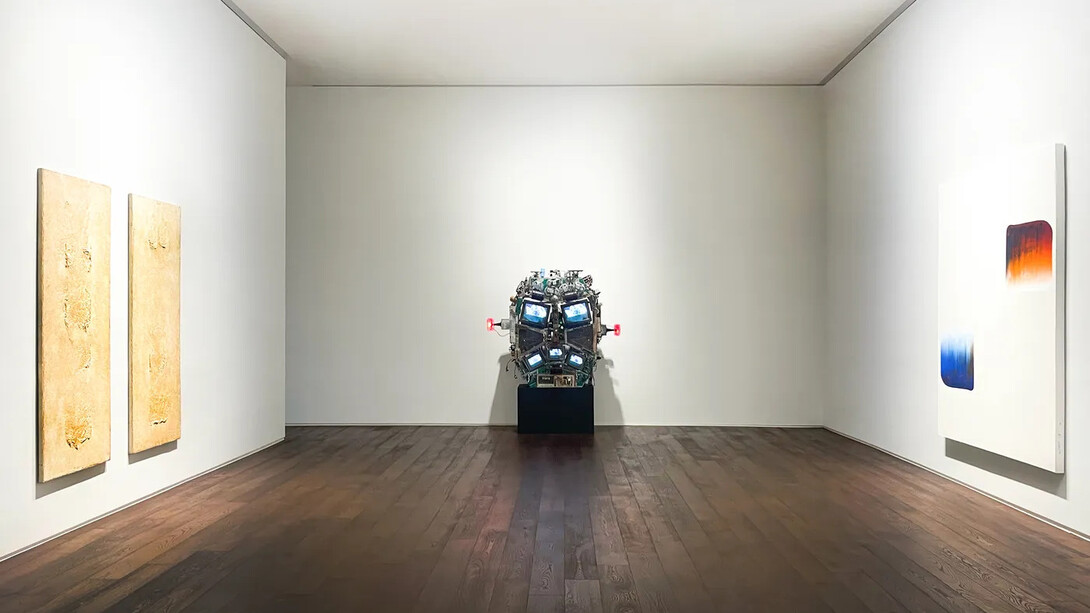
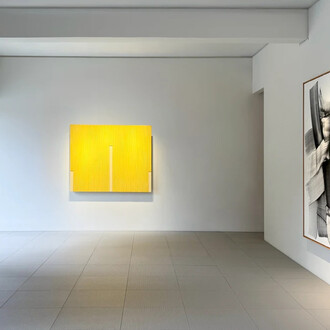
Chung Chang-Sup, a first-generation master of Post-war Korean contemporary art, pursued a sense of beauty and identity in Korean art through the use of abstractness and Hanji paper. Starting with the Informel art movement and progressing into the Monochrome movement, he steadfastly incorporated Hanji paper into his artistic process. His artworks resonate with echoes of Korean tradition while establishing his unique artistic domain. He perpetually explored the harmonious combination of heterogeneous elements, bridging the traditional and the modern, the East and the West, and the intangible and the tangible. In his art, shapeless frames and hues of yellow, black, and adzuki bean gruel create a profound sense that many years have passed, enveloping viewers in absolute silence and captivation. The Korean traditional mulberry paper work developed from the 1970's series Et which means Return, to a series which consists of tapping and shaping of soaked mulberry paper onto a canvas, which was called I# meaning Tak, in the 1980's. Following the tions sucha ches destina turns, ta te hi and in eit aio, so exiliterai 965, ando part insertial rena extentions on Korean art history. In 2010, there was a large-scale retrospective at the National Museum of Modern and Contemporary Art, Gwacheon, South Korea. Currently, his works are in the collections of reputable art institutions, such as National Museum of Modern and Contemporary Art, Korea, Gwacheon, South Korea; Seoul Museum of Art, Seoul, South Korea; Leeum Museum of Art, Seoul, South Korea; Tokyo Metropolitan Art Museum, Tokyo, Japan; M+ Museum, Hong Kong, China; and Guggenheim Abu Dhabi, Abu Dhabi, United Arab Emirates.
After enduring Japanese colonial rule and the Korean War, Yun Hyong-keun began making art in earnest at forty-five. His works-created by applying a mixture of ultramarine, symbolizing the sky, and umber, signifying the earth, onto raw canvas or hemp cloth—are profoundly simple and modest from process to result, eliminating artifice and technique. Embodying the artist's pursuit of harmony between life and art, his canvases are spirited yet humble, simplet traditional akstetic entre smiater hine of ensemportay ania, our established airseras a represent tre fatre the kites Dansaekhwa on the global stage. His solo exhibitions have been held at the Judd Foundation in New York, the Chinati Foundation in Texas, Palazzo Fortuny in Venice, Hastings Contemporary in the UK, and the National Museum of Modern and Contemporary Art in Seoul. During his lifetime, Yun was invited to major international exhibitions including the São Paulo Biennale (1969, 1975) and the Venice Biennale (1995). His works are held in permanent collections at the National Museum of Modern and Contemporary Art, the Leeum Museum of Art, Tate Modern, the Solomon R. Guggenheim Museum, The Cleveland Museum of Art, Glenstone, and the Museum of Contemporary Art Tokyo.
Kim Tschang-Yeul devoted over 50 years to exploring the motif of water drops. His iconic droplets, appearing as if seeping through the canvas, transition from tangible presence to transparency, balancing wet and dry, light and dark. This meditative imagery bridges reality and abstraction, reflecting the artist's experiences with Korea's turbulent history, including colonization, war, and division, while offering universal themes of healing and catharsis. Kim studied calligraphy with his grandfather and painting with Lee Quede before graduating from Seoul National University. A leader of Korea's Art Informel movement with Park Seo-Bo and Chung Chang-Sup, he gained international recognition through the Paris Biennale (1961), São Paulo Biennale (1965), and Avant-Garde Festival (1969). A major retrospective of his water drop paintings was held at Galerie Nationale du Jeu de Paume in 2004. Kim's works have been featured in retrospectives at the Gwangju Museum of Art, Taiwan National Museum of Fine Arts, Busan Museum of Art, and the National Art Museum of China. In 2016, the Kim Tschang-Yeul Museum of Art opened in Jeju, Korea, ensuring his artistic legacy endures.
Park Seo-Bo was a seminal figure in Korean contemporary art. He was one of the founding members of the Dansaekhwa movement, which emerged in the early 1970s post-war Korea and has since gained international recognition. In the late 19605, Park began the 'Ecriture' series by repeating pencil lines over wet monochromatic painted surfaces. Later, he expanded the language through the introduction of hanji (traditional Korean paper) and color. The work is brought into being through the process of repetitive actions of pasting, scraping, scratching, and rubbing. It delicately balances drawing and painting in a quest for emptiness through reduction. Park's work has been exhibited internationally, including: Museum of Fine Art, Boston, United States; the Venice Bina, Brook useum, em orA, nied Sales andrea; Sis, Morea, asa, Sinis work instale in, conti outrite selmen ol, United heim Museum, New York, United States; Mt, Hong Kong, China; Guggenheim Abu Dhabi, UAE; The National Museum of Contemporary Art, Seoul, South Korea; and the K20, Kunstsammlung Nordrhein-Westfalen, Düsseldorf, Germany.
Nam June Paik, a pioneering media artist from South Korea, was born in Seoul in 1932 and passed away in the United States in 2006. His remains are interred in Seoul, New York, and Germany. Some of his major works include Moon is the oldest TV (1965), TV garden (1974), and Good morning Mr. Orwell (1984). Despite suffering a stroke in 1996, which left him physically disabled, he continued to create and exhibit his work. In 2000, a major retrospective titled The world of Nam June Paik was held at the Guggenheim Museum, New York, United States, Rodin Gallery, Seoul, South Korea, and the Ho-Am Art Museum, Seoul, South Korea. Paik received numerous prestigious awards, including the Golden Lion at the Venice Biennale, Venice, Italy (1993), the Kyoto Prize, Kyoto, Japan (1998), the Goethe Medal, Germany (1998), and the Order of Cultural Merit (Geumgwan) from South Korea (2000). In August 1997, Capital, a German economics magazine, ranked him 8th among the world's top 100 artists. In 2006, Time magazine named him one of the Asian Heroes.
Lee U Fan dropped out of the College of Fine Arts at Seoul National University and moved to Japan, where he graduated from the Department of Philosophy at Nihon University in 1961. Between 1968 and 1975, he gained attention in Tokyo by leading the theory and practice of the Mono-ha movement. He later became recognized as the key figure who established the theoretical foundation of Mono-ha and has since earned international acclaim while maintaining an active artistic career. Known as the "Master of Points and Lines," his early works are rooted in Eastern philosophy, exploring how points can become lines, and eventually even transform into nothingness. Understanding his work requires an appreciation of both the meaning of the stroke and the unpainted space surrounding it. Each stroke conveys a sense of stillness within motion-jeongjungdong-flowing with vitality and energy, as if frozen in an infinite moment yet subtly moving. Lee has participated in prestigious international exhibitions, including the Paris Biennale, São Paulo Biennale, and Documenta Kassel, receiving widespread acclaim. He has held major solo exhibitions at institutions such as the Düsseldorf City Museum, Louisiana Museum of Modern Art, Milan Contemporary Art Museum, Hara Museum of Contemporary Art, and Kamakura Museum of Modern Art. The Lee U Fan Museum has also been established on Naoshima Island in Japan. His works are included in the collections of prominent museums, including the Centre Pompidou in Paris, the National Museum in Berlin, the Museum of Modern Art (MoMA) in New York, the National Museum of Modern Art in Tokyo, the National Museum of Modern and Contemporary Art in Seoul, and the Ho-Am Art Museum.
Kim Chong Hak, often referred to as Flower's painter, is celebrated for his abstract art that emphasizes the inherent beauty of nature. His creative process involves internalizing the joy found in nature and reimagining it onto canvas. In the 1980s, Kim immersed himself in the Seoraksan Mountain, both in theme and living, inspired by its distinct seasonal traits, with a different name for each season. He still speaks fondly of his time in the mountains and his artistic expression of the seasons' colors. His work has been featured in major international exhibitions and projects, including: the Busan Museum of Art, Busan, South Korea; Vitality at Galerie Perrotin, Paris, France; Musée Guimet, Paris, France; SeMA Nam Seoul Living Art Museum, Seoul, South Korea; Whanki Museum, Seoul, South Korea; Ewha Museum, Seoul, South Korea; Kumho Museum, Seoul, South Korea. In 2025, he became the first Asian artist to hold a solo exhibition at the High Museum of Art in Atlanta, USA. Kim Chong Hak’s work is in the permanent collections of many museums, including the National Museum of Korea, Seoul, South Korea; National Museum of Modern and Contemporary Art, Gwacheon, South Korea; Leeum, Samsung Museum of Art, Seoul, South Korea; Seoul Museum of Art, Seoul, South Korea; and Busan Museum of Art, Busan, South Korea. Currently, the Kim Chong Hak Museum is in plans to be built in Busan, South Korea, whereas the Architect Kengo Kuma participates as a designer.
Bridging Eastern and Western sensibilities while presenting intersections between tradition and modernity, Lee Kang So has pursued experimental practice across diverse media—including painting, printmaking, performance, photography, video, and installation—since the 1970s. In the 1970s, Lee embarked on experimental art through participation in movements such as Shincheje (New System), AG (Korean Avant Garde Association), Seoul Biennale, and Ecole de Séoul. From 1974 to 1979, he organized the Daegu Contemporary Art Festival alongside fellow artists, seeking a distinctive philosophical and aesthetic stance in Korean contemporary art that diverged from Western art history. During this period, he experimented with media such as video, printmaking, and events to subvert conventional understandings of images, while participating in major international exhibitions including the 9th Paris Biennial (1975), the 2nd Biennale of Sydney (1976), the 10th International Biennial Exhibition of Prints in Tokyo (1976), and the 14th São Paulo Biennial (1977). From the 1980s onward, Lee immersed himself in painting, delving into the process of contemplation. Recognizing the constantly shifting nature of objects and how viewers interpret images differently, he has continued experimental approaches to mark-making that deliberately minimize the artist's intentionality. His practice evolved from abstraction in the early 1980s to figurative depictions of houses, boats, ducks, and deer in the late 1980s. Since the 1990s, Lee has moved between abstraction and figuration, exploring imaginative realities—an approach that continues in his work from the 2000s onward, navigating the boundaries between text and abstraction. Lee has held solo exhibitions at Palazzo Cavalli-Franchetti in Venice, Musée d'Art Moderne et Contemporain de Saint-Étienne Métropole, Musée des Arts Asiatiques in Nice, Daegu Art Museum, and Art Sonje Center in Gyeongju. His works are held in permanent collections at the National Museum of Modern and Contemporary Art, Seoul Museum of Art, Hoam Museum of Art, Kumho Museum of Art, and the Victoria and Albert Museum in London.
Kishio Suga (b.1944) Kishio Suga is a Japanese artist known for pioneering site-specific installation art. He created ephemeral arrangements of natural and man-made materials in outdoor and indoor settings, gaining recognition for groundbreaking installations like "Parallel Strata" (1969) and "Soft Concrete" (1970). As part of the Mono-ha movement, he used unaltered natural and industrial materials to explore the interplay between elements, space, and materials. Since the mid-1980s, Suga has adapted his installations to new sites while maintaining their core concepts. His diverse practice includes assemblages, works on paper, and performances called "Activations." He is also a prolific writer, with novels, essays, and a screenplay to his name. Suga has had numerous solo exhibitions at international museums, most recently at Dia: Chelsea, New York, United States (2016–17), Pirelli HangarBicocca, Milan, Italy (2016), and the Museum of Contemporary Art, Tokyo, Japan (2015). A re-creation of his iconic installation Law of situation (1971) was presented at the 57th Venice Biennale, Italy (2017). Over the past four decades he has been featured in landmark exhibitions at the Centre Georges Pompidou, Paris, France; the Guggenheim Museum, New York, United States; the San Francisco Museum of Modern Art, San Francisco, United States; the Museum of Modern Art, New York, United States; the Punta della Dogana, Venice, Italy; and his work is included in many public and private collections. Kishio Suga held a solo exhibition at Dia Beacon in New York in July 2025.
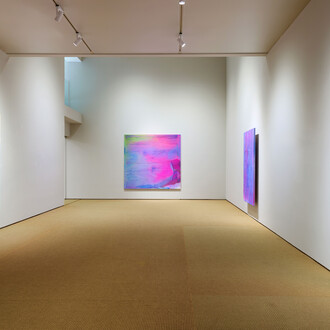
Bernard Frize has, since the late 1970s, pursued a distinct form of abstraction that reconciles order and chance. He establishes predetermined systems and executes them through repetitive gestures. Within the horizontal and vertical brushstrokes, accidental color interactions arise, dissolving the painter’s subjectivity and allowing the work to generate its own meaning. The process reveals the rhythmic essence of painting itself. Acting as an invisible mediator, Frize binds brushes of different sizes, or devises custom tools to produce his works. Over more than four decades, through continuous cycles of creation and dissolution, he has explored freedom through repetition and affirmed his belief in the sustainability of painting. Bernard Frize was born in Saint-Mandé, France, and lives and works in Paris and Berlin. Since his first solo exhibition at Galerie Lucien Durand, Paris, in 1979, he has held over seventy solo exhibitions worldwide. He gained international recognition after his 2003 solo exhibition at the Musée d’Art Moderne de Paris, and his works are included in major public collections such as the Centre Pompidou, Musée d’Art Moderne de Paris, Tate Modern, and the Museum of Contemporary Art, Los Angeles. Frize has held solo exhibitions at institutions such as the Musée d’Art Moderne de Paris, Gemeentemuseum Den Haag, Kunsthalle Basel, and Museum Morsbroich, and participated in the 2005 Venice Biennale. His career has been distinguished by numerous honors and residencies, including the Käthe Kollwitz Prize from the Akademie der Künste Berlin (2015), the Fred Thieler Prize for Painting from the Berlinische Galerie (2011), a DAAD residency in Berlin (1993), and a fellowship at the Villa Medici, the French Academy in Rome (1984–1986). He continues to exhibit internationally, with recent solo shows at Galerie Perrotin, Galerie nächst St. Stephan in Vienna, and the Marian Goodman Gallery in LA.
Lee Bae focuses on the expressive potential of charcoal as a medium. Over the course of three decades, Lee has dedicated himself to creating a diverse range of iterations of Korean painting through his use of charcoal and abstract forms that are self-sufficient and rich in spiritual and energetic qualities. By exploring immanent notions such as yielding, respiring, and circulation, which are embodied by charcoal as a material, Lee's work resonates with themes of life and death, absence and presence, light and shadow, form, and emptiness. Lee's oeuvre spans a wide range of mediums and forms, from drawings to canvas-based works, as well as installations, with each new work serving to expand upon his unique vision and approach. Lee’s works have been featured at museums and institutions worldwide including: Venice Biennale, Rockefeller Center, New York, Phi Foundation, Montreal, Canada; Indang Museum, Daegu, South Korea; Wilmotte Foundation, Venice, Italy; Fondation Maeght, Saint-Paul de Vence, France; Musée des Beaux-Arts, Vannes, France; and Musée Guimet, Paris, France. Among many others, Lee’s work is in the permanent collections of museums including the National Museum of Contemporary Art, Gwacheon, South Korea; Seoul Museum of Art, Seoul, South Korea; Leeum-Samsung Museum of Art, Seoul, South Korea; Fondation Maeght, Saint-Paul de Vence, France; Musée Guimet, Paris, France; Baruj Foundation, Barcelona, Spain, and Privada Allegro Foundation, Madrid, Spain.
Kim Taek Sang has been experimenting with the diffusion, sedimentation, and layering of color for over three decades through the medium of water. His process is iterative—mixing trace amounts of pigment into water, pouring the solution onto a canvas laid flat, then allowing it to dry. Repeated dozens of times, this practice is both ascetic and curative; he has come to describe it as the aesthetics of care. This delicate layering of sediment on canvas creates subtle interstices that scatter light and permeate the surface with depth and density, evoking nature's own palette of serene and understated hues. Kim describes his creations as dàamhwa (淡畵 - dàam painting), where dàam carries meanings of clear, delicate, faint, or thin in tint. Kim's earliest works in the early 1990s contained commentaries on socio-political issues, but he experienced an artistic turning point when he was captivated by the prismatic waters of the Yellowstone Caldera. Through this encounter, he began incorporating natural elements—water, air, light, and gravity—into his studio practice, developing a distinctive visual language that bridges materiality and the senses, concept and nature. Kim's works avoid overt contrasts, favoring elusive similarities, subtle oscillations, and minute pulses of light. While his work is discussed within the lineage of Dansaekhwa, his practice stands apart, reflecting a deeply personal exploration of the relationships between nature, humanity, medium, and perception. Kim holds a B.F.A. in Painting from Chungang University and an M.F.A. in Western Painting from Hongik University. His works are included in the collections of the National Museum of Modern and Contemporary Art (MMCA), Kumho Museum of Art; Leeum Museum of Art, Seoul, South Korea and Suwon I'Park Museum of Art, Suwon, South Korea.
Jung Kwang Ho, who aims to weave between painting and sculpture, desires to explore the essence and interpretation of sculpture in particular. A sculpture is a tangible representation of an image manifested by the sculptor using materials, techniques, and tools to create a specific object in a particular way. Jung oxymoronically refers to his works as "non-sculptural sculptures," as he works with non-sculptural properties to create essentially sculptural works. The paradoxical expression is part of how he explores the essence of sculpture. The artist made no distinction between inside and outside, instead exposing the surface and penetrating through to suggest that surfaces are merely the superficial layer of sculptural essence and the surface of reality. Jung presented solo exhibitions in various museums worldwide, including the Stedelijk Museum, Amsterdam, Netherlands, Art Sonje Museum, Gyeongju, South Korea, Kumho Art Museum, Seoul, South Korea, Gallery Thomas, Munich, Germany, Lumen Gallery, Paris, France, and Canvas International Art Gallery, Amsterdam, Netherlands. He also participated in significant group exhibitions at institutions such as the Seoul Museum of Art, Seoul, South Korea, Samsung Museum of Art Leeum, Seoul, South Korea, Singapore Art Museum, Singapore, and Gyeonggi Museum of Art, Ansan, South Korea. His works are held in various collections, including the National Museum of Modern and Contemporary Art, Seoul, South Korea, Daejeon Museum of Art, Daejeon, South Korea, Hanlim Museum of Art, Daejeon, South Korea, Sonje Museum of Contemporary Art, Gyeongju, South Korea, and Ho-Am Art Museum, Seoul, South Korea.
Bosco Sodi is an artist working globally, known for his densely textured paintings and objects with rich and vivid colors. His paintings are crystallized forms of arduous physical application; a constant cultivation of removing any hint of his own intent in the painting and populating the surface with the essence of material and fortuitous development. The artist works with the canvas laid down horizontally, applying a viscous mixture of soil, sawdust, glue and pigment to aggregate and then left to solidify over time. This process is a performance of sorts. That performance may last up to several months, with each accumulated strata of material testimony to the artist’s actions. Eventually, in that process, the layers cleft, and that is when the performance ends. From then on, all is left to time and nature’s forces. Cracks appear naturally on the surface and traces of material transforming from the material to the substrate to the whole of the artwork - a strikingly formal experiment in painting. Sodi’s works are included in various public and private collections, such as Ishikawa Prefectural Museum of Art, Kanazawa, Japan; Harvard Art Museums, MA, United States; Museum of Contemporary Art, Antwerp, Belgium; Museum Voorlinden, Wassenaar, Netherlands; and the National Gallery of Victoria, Melbourne, Australia.