English
 Español
 Français
 Deutsch
 Italiano
 Português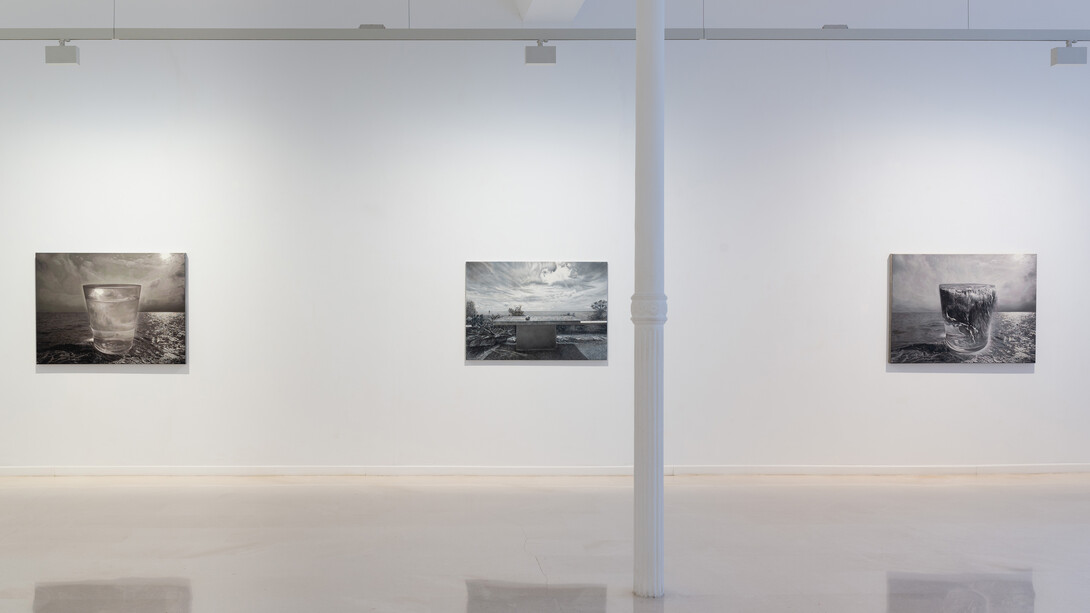
Steinmeyer's surrealism is deeply conceptual. The hyperrealistic, meticulously repainted copies of his own works question the very essence of the debate on originality in art. How can we value a painting knowing that it may be a reproduction?
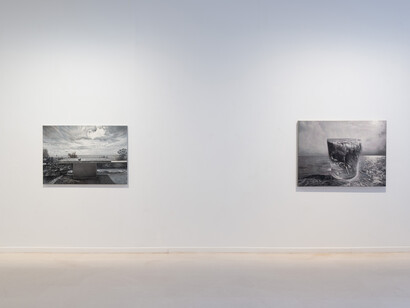
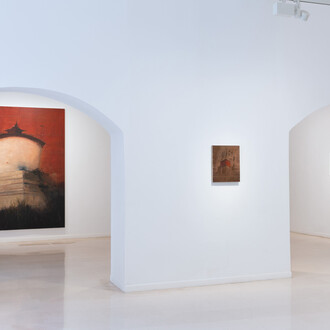
The introspective atmosphere of Steinmeyer's landscape canvases is shaped by ambiguous grisaille tones that contain a multiplicity of nuances, giving the paintings a dreamlike quality. We find similar chromatic compositions, in grayscale, in the works depicting the launch of a rocket in a desolate rural landscape. The empty wooden bench in the lower right corner, uncomfortably close to the edge of the canvas, intensifies the vibrant tension caused by the feeling of absence—like a silent nightmare unfolding in slow motion, electrifying the air with disturbing premonitions. The titles of the works, Challenge and Baltic sea, hint at what this strange fantastical sequence might be about. The cinematically composed scene alludes to the tragic 1986 accident in which the US space shuttle Challenger disintegrated just 73 seconds after take-off. By transferring the spacecraft to the Baltic Sea, Steinmeyer creates a fantastical narrative that directs our attention to the real climatic and humanitarian catastrophes currently unfolding in Europe.
Challenge and Baltic sea are identical replicas reproduced at different scales. When featured together, these duplicates mirror each other, trapping the viewer in a labyrinth of multiplied reflections. Another vivid example of this poetic transgression is the artist's series of four paintings on glass, each of which playfully recontextualises the exhibition title. The deeply personal process of transformation that the artist experienced during lockdown is captured through the tangled web of visual paradoxes.
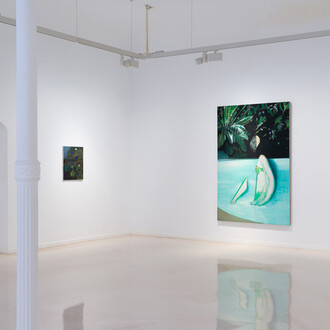
that inhabit these dreamlike seascapes, which Steinmeyer describes as his self- portraits. Depicted in photorealistic detail, the sea glistens under soft sunlight on one side of the painting, while on the other it appears devoid of light, as if the glass were preventing the sun's rays from spreading across the water. In contrast to the background, which remains almost unchanged in all four works, the sea within the glass is presented to us in a variety of states: the serene translucency depicted in the painting To have and to be is transformed into a dramatic storm that distorts the boundaries of the image in To be or to have, generating a nauseating sense of movement as it bursts through the glass. The physical installation of these paintings, hung in a linear row, gives the space between them a tactile physicality that is perceptible to the viewer. The absurd logic of Steinmeyer's surreal dreamscapes transgresses the boundaries of fiction, challenging the viewer with its amplified intensity. These introspective hybrids fuse the classic genres of landscape and still life painting into an existential chaos of magical hyperrealism, where neither having nor being are relevant. Luminous portals to the threshold of becoming, Steinmeyer's paintings project a high-resolution hyperobjectivity combined with a disturbing panorama of dreamlike distortions. Are we the ones who contain the sea? Or is it the sea that contains us?
Steinmeyer's paintings challenge both the viewer and the very act of looking, leading curator and critic Mark Gisbourne to place them in a category between archaic and contemporary notions of wonder. In his essay, appropriately titled From wondrous gaze to marvellous presence, Gisbourne highlights the ‘distant, if not sometimes somewhat disconcerting realities,’ a quality that gives them a surrealist tinge. But, as he suggests through his references to Aristotle, Descartes, Kant and Borges, the works engage in dialogue with philosophy, literature and music as well as with art history and the language of dreams.
Perhaps the most disturbing element of the exhibition is the eponymous work Situation suite (2018). According to Gisbourne, the piece provides ‘a key to other paintings in the exhibition,’ in that it opens up ‘a world that at first glance seems eloquently plausible, but upon closer examination reveals a progressive enigma of visual contradictions.’ Here Steinmeyer condenses his formal and conceptual games into a single image: a bedroom in muted colours. From outside the frame, it might look like the room is enclosed by mirrors; however, not even a simple mise en abîme escapes the artist's sabotage, as the reflections do not correspond to their context. And even if they faithfully reproduced the interior design, they would fail to explain the downward, fluid attraction that occurs in the foreground: a proverbial slippery slope that leads us into a mysterious world where causal relationships no longer obey common expectations. Instead, the uncanny prevails.