English
 Español
 Français
 Deutsch
 Italiano
 Português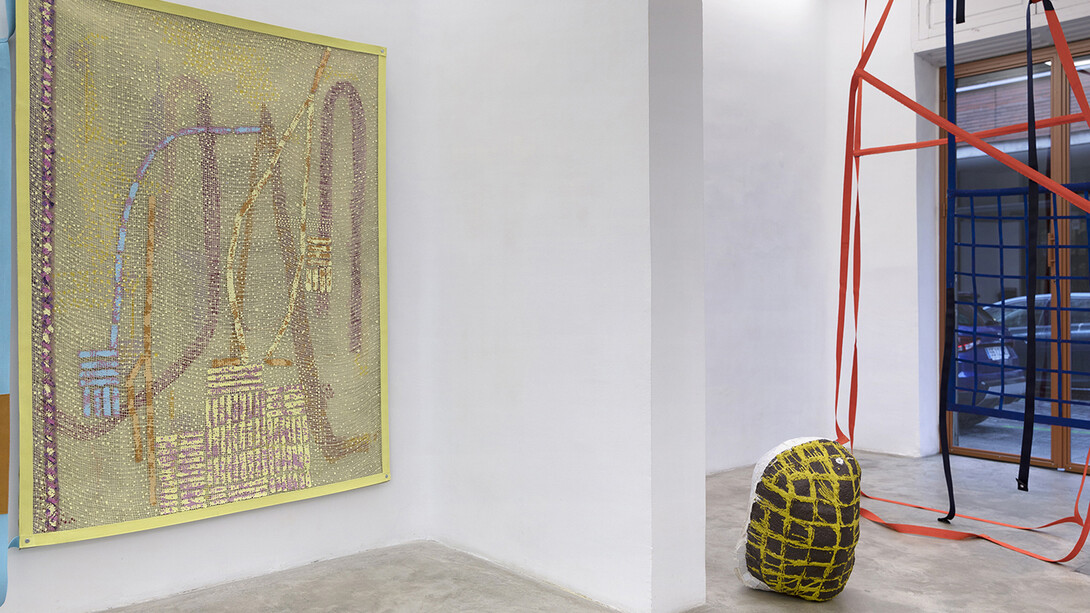
…names in this way a restless activity, a destructive/creative force/presence that does not fully coincide with any specific body… matter in variation that appears and disappears…
(Jane Bennett, Vibrant Matter: a political ecology of things)1
When a weave ceases to be a rigid, stable, defining or almost Cartesian structure, to become an unstable and uncertain field where, from gesture, new forms of fragmented elasticity may emerge, a place also arises at the same time—almost unconsciously—where speculation with matter agitates and shakes thought. The idea of stability and controlled behavior makes no sense in this new place that seeks to remain free from overly certain perspectives.
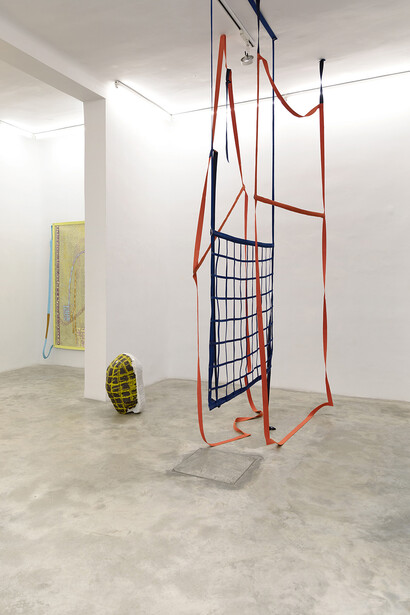
The borrowed gesture; weaves composed of interlaced filaments would operate here as devices of misalignment: systems that tighten and decompose in order to make way for a material logic that does not respond to a prior order, but rather to the friction between an idea of control and one of restlessness.
In the text Vibrant matter by Jane Bennett, written from an undefined field between philosophy and political theory, we are invited to radically rethink matter and its relations between, and within, different assemblages. That is, we are encouraged to stop understanding matter as something passive, inert, or merely available for human use, and to recognize it as something active, dynamic, and endowed with agency. With no intention of romanticizing objects, but rather of decentering the excessive protagonism of the human gesture, Bennett proposes to show that our lives are intertwined with material forces that we do not fully control, and she suggests opening here the possibility of thinking about the regeneration of these relations toward a more humble, careful, and attentive politics of interdependence among human, non-human, and/or more-than-human agents.
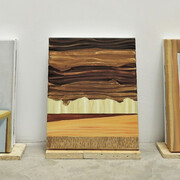
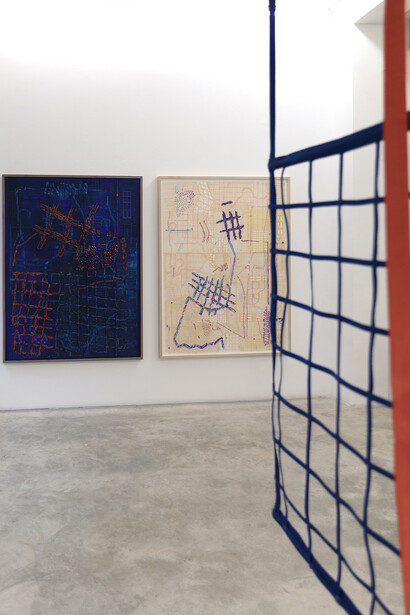
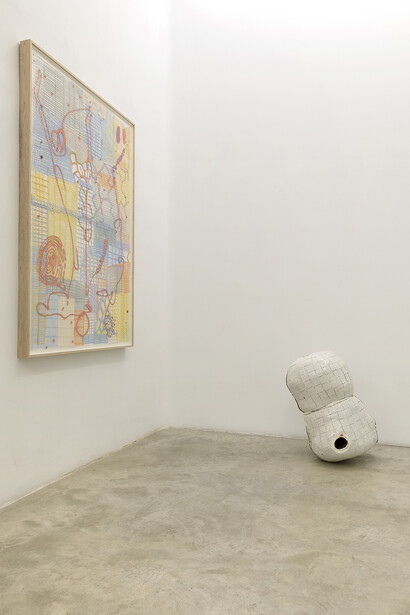
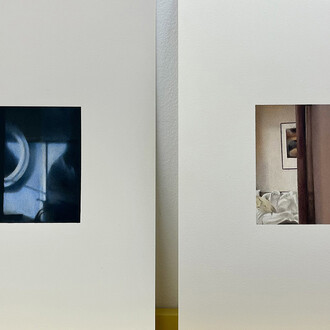
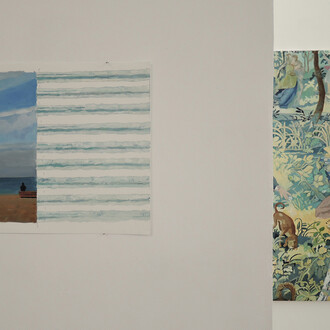
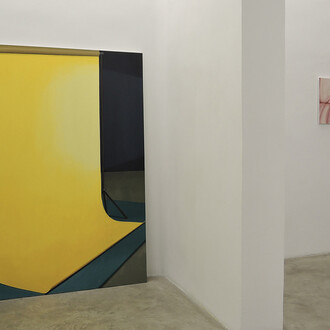
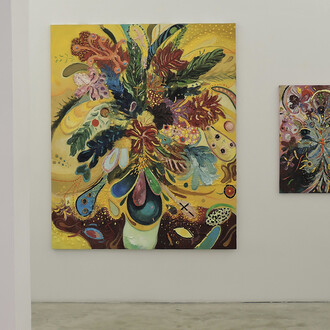
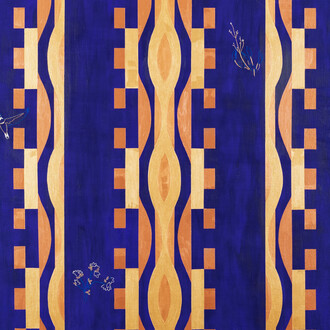
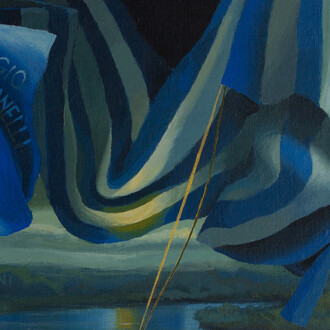
In the simple saturation of solvents, in the involuntary behavior of oil or other greasy substances in reaction to temperature, in the use of materials such as gesso or encaustic, Salvador Cidrás introduces a type of plastic propositions in which matter acts as an agent and not merely as a support, as it borrows that involuntary gesture in which weave and substance mutually host one another until they become indistinguishable: the background grid becomes confused with the accidental mesh produced by the physical and chemical processes of the materials with which he dialogues, and the work is then reorganized as a superimposition of layers of information, where experimentation with the medium asserts itself as a language in its own right.
This mode of proceeding, which also entails thinking about the deconstruction of the multiple grids that encode and limit the experimental exercise of expression in contrast to the sharp image and the stable sign of elements, produces a network of intermediate spaces, a fog of threads, a diffuse matter of low definition, low temperature, low resolution, and low technology, where the visible becomes uncertain and where the organic erupts as a somatic quality or as the desire to challenge geometry and its promises of domination.
It is in this spatio-temporal situation that a kind of play of energies takes place, in which our obsession with the domination of technique and the irreverence of matter becomes evident. A performative relationship that unfolds at different stages of the creative process and that, as suggested by the Australian artist Barbara Bolt in her book Art beyond representation. The performative power of the image2, does not dwell in representation, but remains an open and vulnerable relationship toward whatever may happen. And within this horizon, reality is not understood as an image or a represented object, but as a living and active presence.
Generating this web of relations among objects, materiality, and meaning, as lines of flight away from the structured, may be the beginning of a search without a defined answer. An exercise in “possibilism,” what art historian Mario Pedrosa called an “experimental exercise of freedom”3.
Salvador’s artistic production could be situated within this series of experimental exercises. I believe we could not understand his work unless we are willing to follow a research process in which small gestures can reconfigure our way of thinking and inhabiting the world. In a context saturated with high-definition images under very precisely stipulated coordinates, his practice proposes altering the traditional relationship with objects, exploring the polysemy of their manifestations and the instability of their meanings.
In an autobiographical manner, it incorporates a profound sense into the intricate relationships between the meaning of these actions and an artistic practice rooted in specific cultural influences, based on the personal experience of the very context he inhabits, and where, likewise, there is no possibility of establishing cartographic boundaries between the rural and the urban, between the natural and the artificial, or the tensions between object and spectator, understanding these binaries not as oppositions but as continuities.
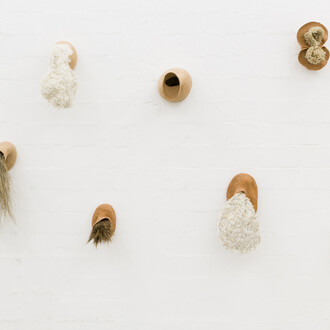
Salvador’s body of work traces an indirect line between ceramics and textiles from a sculptural and pictorial perspective and intensifies, even further, these concerns: volume, texture, weave, and their various densities are articulated as extensions of a single spatial and sensory investigation. Gestures that are situated between the universe of representation and that of lived experience, between the structured and the organic, between social identity and the matter that sustains it.
The borrowed gesture does not merely refer to an isolated act, but to a circulation: from the body to matter, from matter to thought, from thought to the gaze of the other. A gesture that is not possessed, but transmitted, fragmented, and transformed, leaving open the possibility that, in its indeterminacy, something new may begin. Or, as in a fragment from Letters to a Young Poet by Rilke: “…we must accept our existence as broadly as possible. Everything, even the unheard-of, must be possible. This is fundamental, the only value that is required of us: to be brave in the face of the strangest, most marvelous, and most inexplicable things that may happen to us.”4
(Text by Juan Luis Toboso)
Notes
1 Bennett, Jane (2010). Vibrant matter: a political ecology of things. Durham: Duke University Press.
2 Bolt, Barbara. (2004). Art beyond representation: The performative power of the image. London: I.B. Tauris.
3 O exercício experimental da Liberdade en “O bicho-da-seda na produção em massa” de Mário Pedrosa, 1967.
4 Rilke, R. M. (1903/2008). Cartas a un joven poeta – Carta 8-(A. Pascual i Piqué & C. Bernad Ribera, Trads.). Barcelona: Acantilado. Bennett, Jane (2010). Vibrant matter: a political ecology of things. Durham: Duke University Press.