English
 Español
 Français
 Deutsch
 Italiano
 Português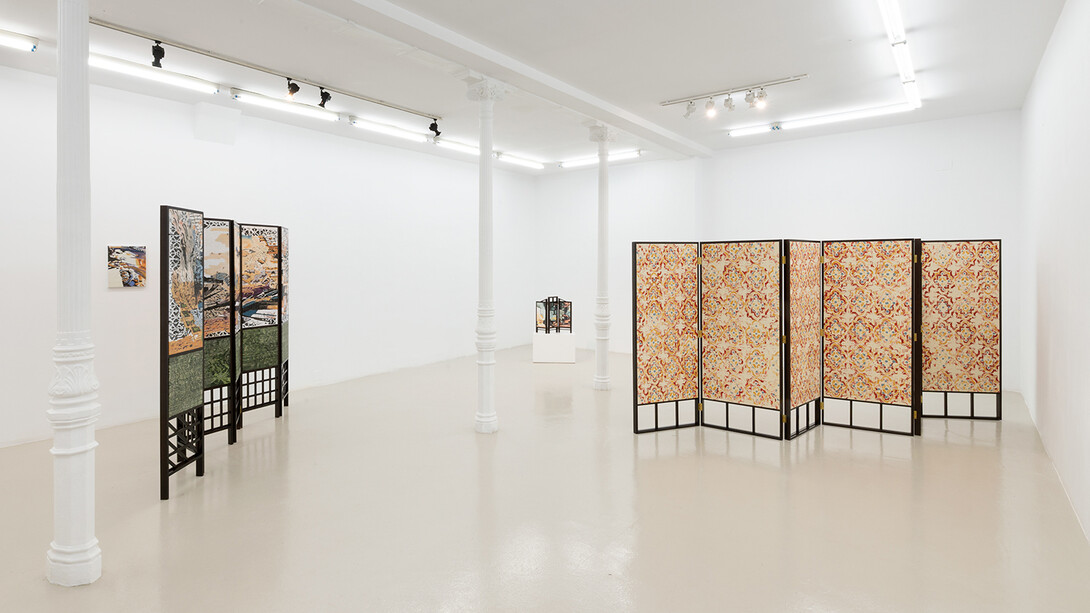
White, gray, and bottle blond, ugly, the highlights of Ocho the wildcat are tangled in a whirlwind of long, dirty, stiff hair. With every somersault, he spits out pine needles and grass, dried pine cone peels.
(Esther García Llovet)
Western culture contains a peculiar encounter that might be described as the “far-near,” a play of spatial and temporal distances through which different elements now familiar to us have filtered with varying intensity. In response to the dominance of materialist rationalism, it has cultivated forms of thought rooted in contemplation, reconfigured relationships between image and text, and embraced intuition as a mode of knowledge. In painting, strategies of fragmentation, compositional cropping, and the activation of negative space appear in the domestic interiors of Mary Cassatt or in the natural settings of Claude Monet and James McNeill Whistler, as signs of a Japonisme that operated as a temperature regulator within the picture. The aesthetic ran parallel to concepts of silence, imperfection, and transience known as ma, wabi-sabi, and mono no aware. Like the hum of a marketplace, these permeabilities resonate in Federico Miró’s search for a contemplative painting that nonetheless draws us into a tangled world. His compositions are built through extended processes that, while echoing certain technological logics, remain resolutely material, allowing sight to call upon touch.
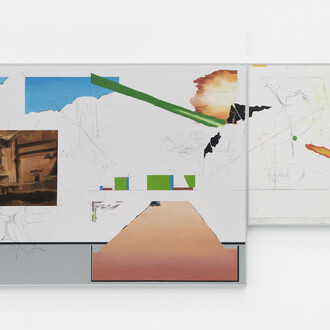
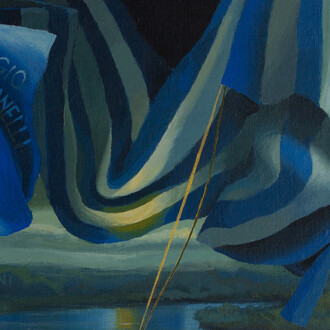
Federico Miró reconstructs landscapes from an affective archive first captured in photographs. Subjected to digital collage, these are translated into paint, absorbing the errors, repetitions, and discontinuities of software. In doing so, they embrace a contemporary environment whose distance and inhospitable character are softened through the manual act of tracing and coating lines with acrylic. Images generate other images even as they become real, holding an imprecise figuration in suspension, always on the edge of dissolution.
At two in the afternoon: a shifting, gleaming silver-green brocade.
At half past six: valleys of white foam fill with roses.
At quarter past seven: high, green water. A cobalt-blue sky heavy with storm clouds.
Gray sky. A sky of gold beyond.(JRJ)
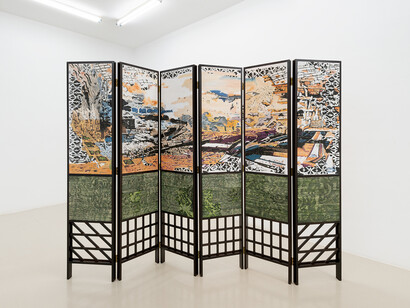
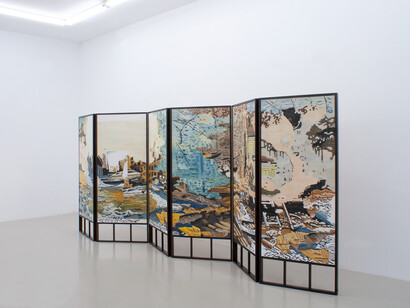
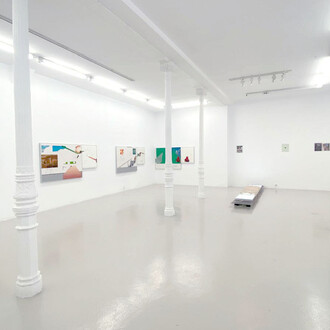
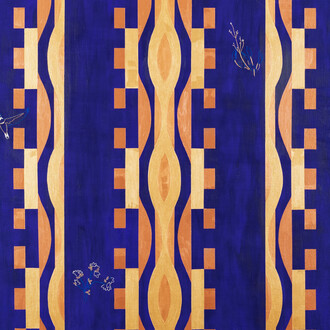
In this reflective attempt to produce a painting that exceeds the limits of the frame, Federico Miró introduces a new support: the folding screen. Drawing equally on Japanese (byōbu) and Mexican traditions, it becomes a spatial canvas where the unreality of landscape converges with the architectural and the decorative. Its composition requires careful calibration, continuity between panels, attention to negative space, asymmetry, and multiple vanishing points. Once resolved, the screen also generates a single image shaped by circumstance, one that condenses overlapping temporalities: the layering of near and distant references, and the accumulated hours devoted to giving the surface a textile appearance.
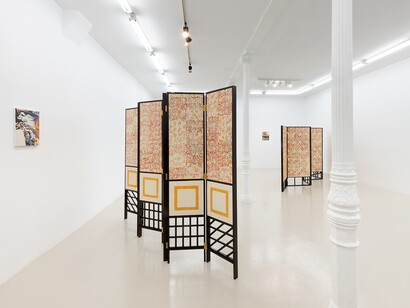
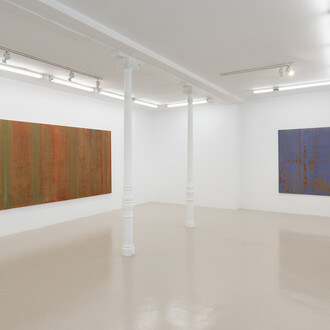
The screen functions as an instrument of air, a diaphragm articulated between inhalation and exhalation; a folded letter; a small, rhythmic architecture in which stability and flexibility coexist with the possibility of collapse. It establishes a dynamic between what is visible and what remains concealed (the “far-near”), partitioning space and creating passages. Seen from behind, what first appears as an opening onto the world (a lattice reminiscent of a painted sky) becomes a ground. This hidden side is constructed from singular patterns produced through block-printing techniques drawn from India. Carved into linoleum, these motifs form Miró’s own mural signature, informed by pre-Hispanic ornament and Baroque church decoration. Here, distance operates once more: between tradition and modernity, between Miró’s research in Latin America and the latent back-and-forth kinship linking pre-Columbian and Spanish imagery.
As another form of landscape staging (preceding the “theater of nature” that Alan Sonfist located outdoors), the screen not only traces paths through space but also allows Miró to work at a scale that conceals the body, engaging questions of intimacy, status, and the gendered organization of the domestic sphere.
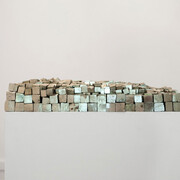
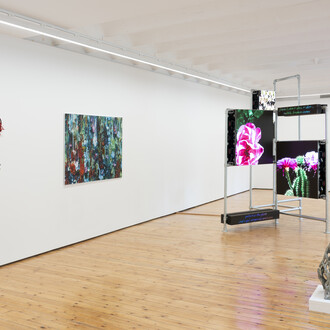
The low vibration present in the exhibition (at varying distances from what we conventionally call “painting”) condenses into a reduced model: a kind of reliquary or maquette of the screen that acts as a threshold to the smaller works on the walls, while unifying the ensemble. What once operated as a window and a ground, and as a dialogue between the stable and the flexible, now anchors itself to the wall in a series of indeterminate landscapes and deliberate pictorial incoherencies, attuned to the breathing rhythm of the screen.
Like brief narratives of what has been encountered in absence, Federico Miró inscribes in each line his own method for reconstructing the complexity of the world, a fragmented guide for moving through it.
If this world was mine, I’d take your dreams and make ‘em multiply.
(Kendrick Lamar)
(Text by Francisco Ramallo)