English
 Español
 Français
 Deutsch
 Italiano
 Português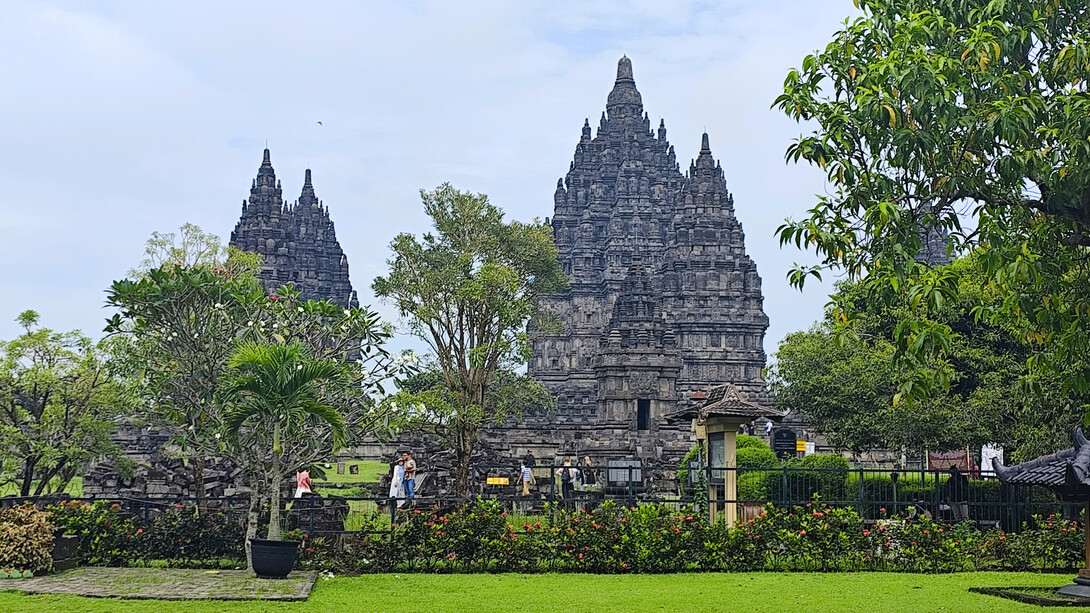
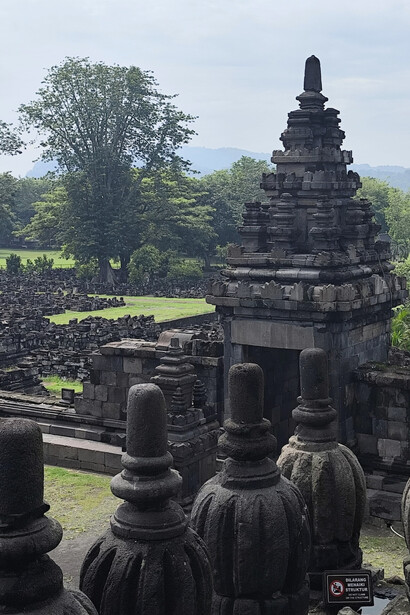
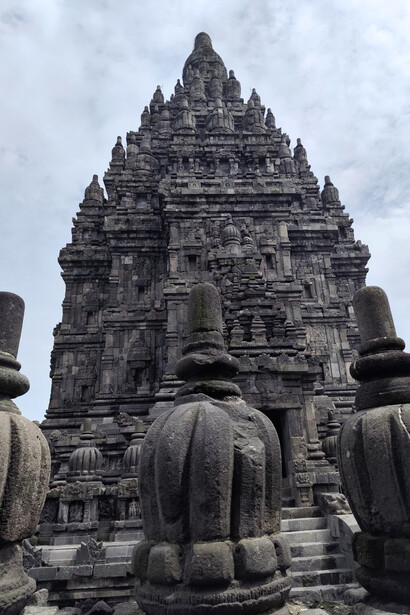
When I visited Prambanan temple, I was surprised to see a large group of men kneeling in front of the structure holding the centrally located statue of Shiva. Most visitors to Prambanan assume they are entering a sacred Hindu complex, but Prambanan can be better understood as a complex created to support a specific political regime using the authority of religion to legitimize their power, position their kingship within cosmic law and make their authority unquestionable through ritual, architecture and sacred geography.
A temple built for earthly power
Prambanan, constructed in the mid 9th century by the Sanjaya dynasty, was a political project from its start. In Central Java, a ruler’s authority depended on demonstrating control over religious institutions, labor and territory. Lineage alone was insufficient and a king had to prove he possessed the resources, alliances and ritual authority required to govern effectively.
A 9th century Javanese king did not “believe” in Shiva the way we now talk about belief. His world did not separate religion from politics or faith from his public role. What mattered for the king was his participation in a system where ritual, cosmic order and royal authority were inseparable and essential in validating and reinforcing his power.
By founding temples, sponsoring consecrations, performing royal rites and controlling the priesthood, the king ensured the order that gave his rule legitimacy. Belief, in this context, was not a private sentiment but a public performance allegedly in compliance with Shiva’s cosmic law. Prambanan physically and monumentally asserted that the universe was stable and the kingship legitimate.
A monumental temple complex served as proof of the king’s power. It demonstrated that the dynasty could mobilize thousands of workers, control the priesthood and establish a permanent ceremonial center that rival groups could not ignore. Prambanan established the Sanjaya dynasty as the dominant force in Central Java, formalized their partnership with religious elites and turned religious authority into a visible and potent political aid.
The king as Shiva’s representative
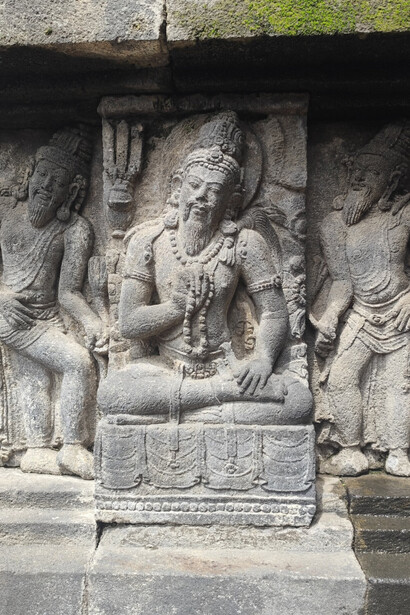
The king was at the heart of this system and he was understood as Shiva’s earthly representative. He was not literally Shiva or a reincarnation of the god, but the agent through whom Shiva’s cosmic order was enacted on earth. Shiva was the cosmic sovereign, whereas the king was the earthly sovereign authorized by him.
The temple complex stood as the physical proof of this relationship. This connection was maintained through ritual control. The king did not simply “believe in Shiva.” He controlled the priesthood, the ritual calendar, the temple economy and the sacred geography that defined Shiva’s presence in the world. By controlling the cult of Shiva, he could claim the cosmic mandate that justified his rule.
Ritual as statecraft
Religious ritual at Prambanan was not a public or private act of devotion. It was a form of statecraft created through a type of sacred choreography. Every action in the temple complex was designed to make Shiva seem present, to help stabilize the cosmos and, more than anything, publicly confirm the king’s right to rule.
The full ritual program of “puja” awakened the deity and set in motion the daily sequence of bathing, feeding, adorning and invoking Shiva that made his presence seem real within the sanctuary. In the Shiva temple, priests bathed a “linga” with water, milk, honey and butter, adorned it with flowers and incense, recited mantras, offered food and rang bells to draw the god’s attention.
These acts were not symbolic as, in this worldview, ritual literally activated Shiva’s presence. A temple without ritual was merely a building, while a temple with ritual became something perceived to be a dynamic influence in the world.
On major festival days, ritual expanded into public political theatre. Processions carried Shiva’s image around the temple grounds. The king presented offerings before crowds. Priests recited sacred texts linking royal authority to cosmic order. Temple specialists performed ritual dances and music. These events made the king visible as the mediator between the human and divine worlds.
Consecration rituals, especially prāṇa pratiṣṭhā — the “installation of breath” — transformed stone into a living presence. Only a legitimate king could sponsor such rites. Without them, the temple remained spiritually inactive. Other rituals addressed rainfall, fertility and protection from disease. Some rites required the king’s direct participation, functioning as official acts in a sacred political system.
A device for producing legitimacy
Prambanan was not a place for casual prayer. It was a ritual machine that made Shiva seem present, stabilized the cosmos, legitimized the king, displayed royal power, organized the economy, structured the calendar and placed the kingdom into a plan of divine order. Religious ritual was an operating system of the state.
Prambanan did not offer a pilgrim’s path to enlightenment like Borobudur, nor a royal autobiography like Angkor Wat. What it offered was something sharper and more revealing about how power worked in early Southeast Asia. If Borobudur teaches you how to transform yourself into a more humane being, and Angkor Wat teaches you how a king wanted to be remembered and immortalized, Prambanan teaches you how a king wanted to be obeyed.
Standing where only kings once stood
Today, simply wandering through Prambanan makes you an honored visitor, as climbing the steps into the sanctuary of Shiva places you in a space once reserved for only the king and the highest-ranking priests. It was the most restricted chamber in the entire complex, the point where cosmic authority and royal power met.
The statue of Shiva inside surprised me with its plainness. It is not a masterpiece of sculptural art but a simple, workmanlike image. That simplicity was intentional. The statue was not meant to impress; it was meant to be inhabited. It needed to be good enough for the spirit of Shiva to recognize it, anything else was superfluous. Once consecrated, it was believed to contain Shiva’s presence. Its power came from ritual activation, not artistic brilliance.
Standing there today, in a place once accessible only to the ruler of the kingdom, you face an object that once held the most powerful presence in Java. The fact that you can walk in casually is a reminder of how radically the world has changed, and how much of Prambanan’s original meaning has slipped out of everyday experience.
Prambanan only functioned as an active royal temple complex for roughly a century. Construction began in the mid 9th century, but by the mid 10th century, the site was effectively abandoned when the court relocated to East Java.
Central Java had become politically unstable because of rival factions, shifting loyalties and pressure from the maritime empire of Srivijaya. It became environmentally unreliable because of volcanic activity from Mount Merapi, which disrupted agriculture, damaged irrigation systems and made the region’s food supply unreliable.
The temple complex then entered a rapid decline. Its towers began collapsing from earthquakes and volcanic debris from Mount Merapi partially buried the site. By the time Europeans rediscovered the site in the 18th and 19th centuries, Prambanan was not a visible standing temple complex and its reconstruction required decades of archaeological excavation and the sorting out of millions of fallen blocks.
The folks engaged in prayer these days before the Shiva shrine have nothing to do with how Prambanan functioned long ago. These are modern Hindu worshippers (mostly Javanese and Balinese) using the shrine as a place for personal prayer, meditation and offering, even though the original royal court that used the temple vanished a thousand years ago.
Their presence shows that the site, once used as a complex to prop up a dynasty, has become a modern spiritual oasis where individuals seek connection and blessings on their own terms.