English
 Español
 Français
 Deutsch
 Italiano
 Português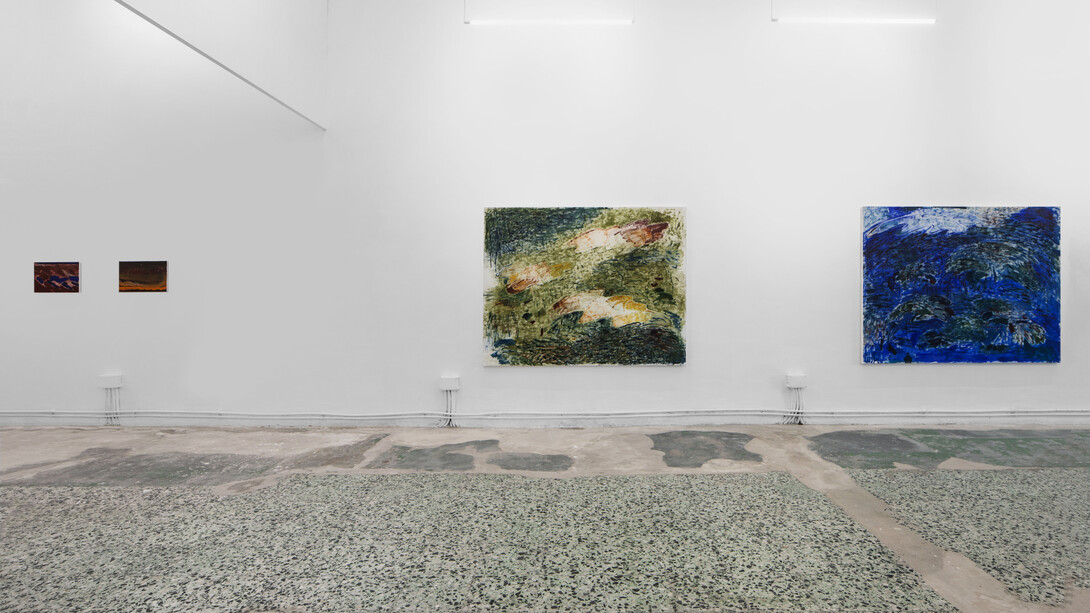
The spirit of a mineral, a plant, or an animal may begin to form here and reach its final development millions of ages later, on other planets, known or unknown, visible or invisible to astronomers. For who could refute the theory suggested above that the Earth itself, like the living beings it has given rise to, will eventually become—after going through its own stage of death and dissolution—an ethereal astral planet? “As above, so below”: harmony is the great law of nature."1
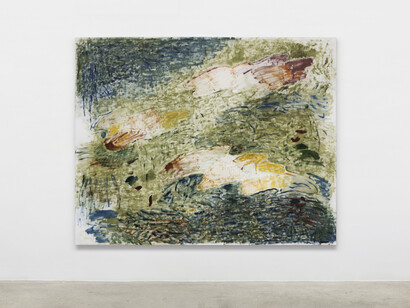
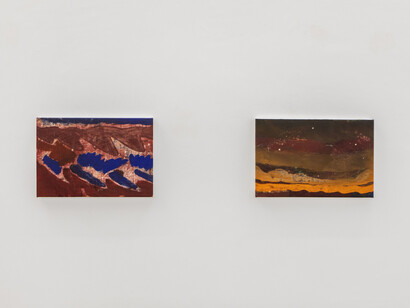
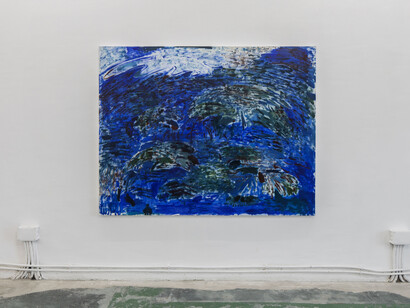
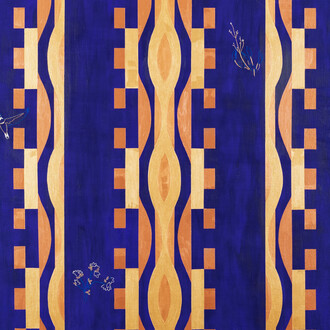
‘As above, so below’: what happens on a metaphysical plane has a direct correspondence in the material world. This logic runs through Miguel Marina's painting, which does not start from an image, but from a sensation that becomes an illusion and, finally, matter: a microsecond of visual consciousness. From there, there is no guide or closed form that indicates to the eye a beginning or an end to the canvas. There are no centres or hierarchies in the image. This condition is linked to the Japanese concept of ma (間), understood as an active interval, a space or time of suspension that is neither empty nor absent, but rather an opening charged with possibility. An ‘in-between’. More than a form, ma is that which allows forms to breathe and relate to each other. In painting, this interval appears when material is scraped or removed and the canvas opens up as an unresolved space, where what disappears activates new tensions on the surface. That same ma also manifests itself between one painting and the next as a latent continuity, a waiting time where the form of the work continues to vibrate.
The painting is constructed from a direct relationship between the body and the canvas, where the gesture is a physical extension and the painting is established as an analogue of the body. What is interesting is the similarity understood as that which allows us to discover something of the outside world from an embodied experience. The arm marks the reach of the stroke, the corners introduce resistance, and moving in front of the canvas, walking the painting, activates a mobile perception of the pictorial space.
In this exchange, painting does not offer thought an opportunity to recompose the constitutive relationships of things, but rather makes available to the gaze ‘the traces of the vision from within for it to possess’2: an imaginary texture of the real that is constructed through the body, muscle memory and a gesture that is transformed in its repetition.
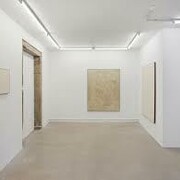
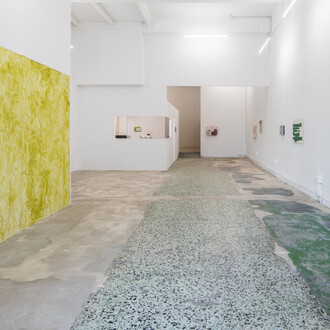
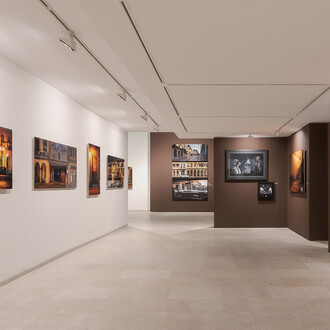
Thoreau, for whom moving through life, nature and meaning is the same art, subtly moves from one to the other in a single sentence. ‘Getting lost in the woods at any time is a surprising and memorable experience, and at the same time valuable,’ he wrote in Walden. Until we are completely lost or turn around—and all it takes is to turn around with our eyes closed to be lost in the world—we do not appreciate how vast and alien nature is to us. (...) It is not until we are lost, in other words, until we have lost the world, that we begin to find ourselves and realise where we are and the infinite network of correspondences."3 In Marina's body of work, getting lost is a necessary condition for painting to occur. There are no sketches or previous images to guide the journey. The canvases that make up the exhibition De lado at Galería Nordés begin from a deliberate not knowing, from impulses, flashes and vague associations that only find form in the act of doing. Working in this way implies accepting doubt, renouncing certainties and allowing the painting to transform itself as it happens. The body functions like a compass: muscle memory guides the gesture, but never guarantees it. The clumsiness, fatigue or agility of the moment are also inscribed on the surface.
As Sarah Ahmed points out, "in order to orient ourselves, we can assume that we must first experience disorientation. When we are oriented, we may not even realise that we are: we may not even think about “thinking” about this fact. (...) With this kind of disorientation, we can begin to ask ourselves: what does it mean to be oriented? How do we begin to know or feel where we are, or even where we are going, by aligning ourselves with the characteristics of the territories we inhabit, the sky that surrounds us, or the imaginary lines that cross maps?"4.
From this perspective, painting is understood as a vibrant material, with its own agency, capable of overflowing the will of the person who paints. Working from discomfort allows painting to remain something vital and changing, where in one painting the next is already intuited as an open resonance.
(Text by Cristina Ramos)
Notes
1 Helena P. Blavatsky, Isis unveiled: a master key to the mysteries of ancient and modern science and theology. Vol. 1. New York: J. W. Bouton, 1877. Translated by the author, 1877, pp. 330.
2 Maurice Merleau-Ponty, The eye and the mind, Barcelona: Ediciones Paidós, 1986, pp. 20.
3 Henry David Thoreau, Walden, Madrid: Alianza Editorial, 2021, pp. 252–253.
4 Sarah Ahmed, Queer phenomenology: orientations, objects, others, Barcelona: Ediciones Bellaterra, 2019, pp. 18-19.