English
 Español
 Français
 Deutsch
 Italiano
 Português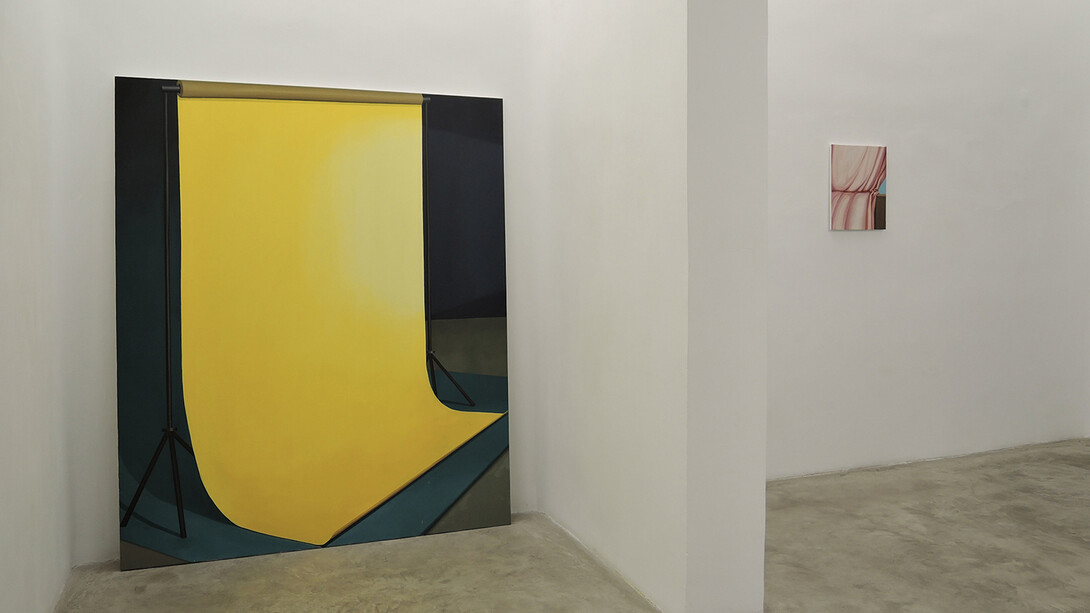
I
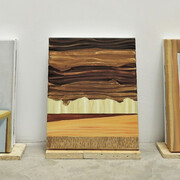
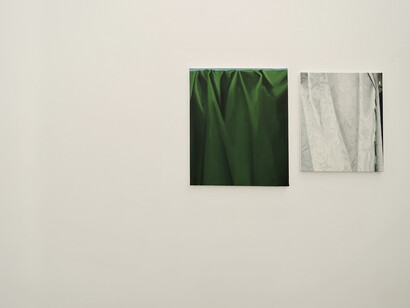
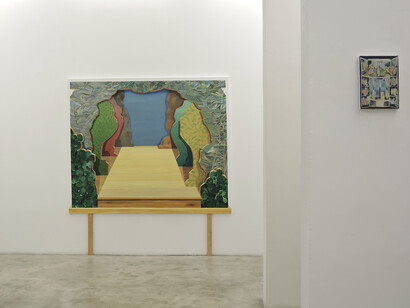
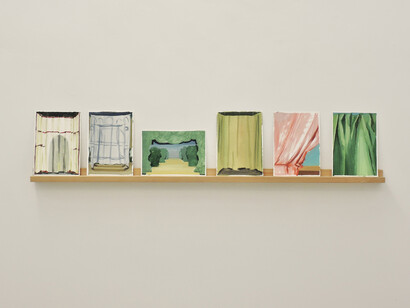
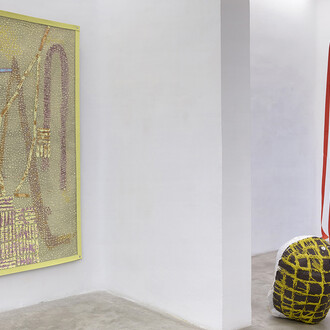
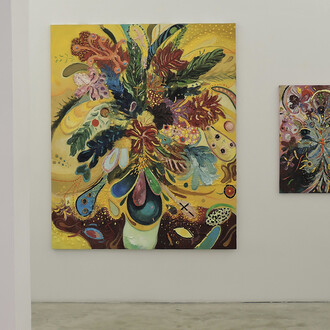
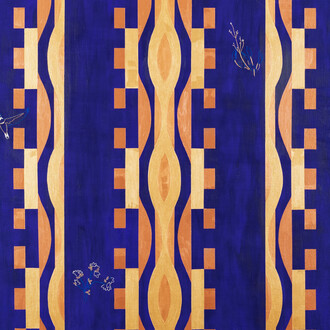
We found an endless supply of bright yellow. There are also thick fabrics designed as backgrounds for portraits, covered in endless folds that curve, twist and overlap each other; on some occasions, these fabrics are also accompanied by a group of intertwined threads that run from top to bottom and are finished with tassels of orderly filaments. We also see a chain of arched structures that enclose a space with perfect perspective, ready to activate a scene. Finally, there are two twill fabrics, one decorated with geometric figures and the other with a series of religious motifs, but both designed to temporarily cover parts of sacred architecture.
These are some of the representations contained in Gloria Martín's paintings for this exhibition. These are seemingly disparate themes, but they can be brought together under a common denominator: establishing different spatialities so that fiction, if anything, can happen.
II
At least three of Gloria Martín's interests are intertwined in this project and come into play through the practice of painting. Firstly, the representation of elements that have not been fully addressed in art history (twill fabrics, portrait backgrounds, ceramics as a technique normally subordinate to architecture, etc.); secondly, a penchant for capturing the spaces that these elements generate; and finally, as a result of the combination of the first two, a genuine interest in representing empty and open spaces, ready to be filled by bodies. All of this gives the project a dimension that is open to what is to come. It thus opens up the possibility of letting in the unknown.
Furthermore, Retablo, the noun chosen as the title for this exhibition, encapsulates the ideas presented in the show. Derived from the Latin expression retaulus, which comes from retro (“behind”) and tabula (“table”), a retablo (altarpiece) is an architectural structure that can contain other objects, such as paintings and sculptures. It serves as a support for figures that tell us a story.
III
Retablo is a continuation of the artist's previous work. Gloria Martín has always paid attention to motifs, practices and elements that art history tends to overlook. Gloria Martín could be described as a ragpicker woman—an allegorical figure described by Walter Benjamin—whose work consists of paying attention to details, to forgotten and seemingly insignificant objects, amid the immeasurability of the world, in order to reconstruct meaning from them and challenge univocal historical-artistic knowledge with these fragments. To this end, G. Martín uses painting, a discipline widely recognised in art history and one that the artist never ceases to reflect on.
(Retabl, by Blanca del Río)