English
 Español
 Français
 Deutsch
 Italiano
 Português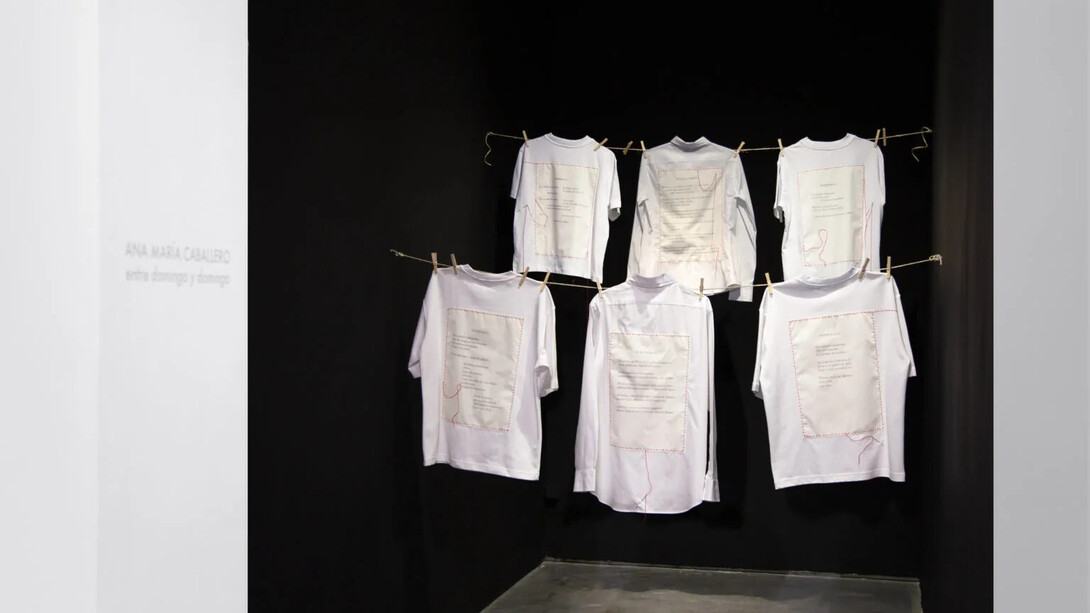
To launch the collaboration between Max Estrella and Ana María Caballero, the artist presents her installation Entre domingo y domingo (From sunday to sunday) in the gallery’s Project Room. The project opened on Saturday, January 17, starting at 11:00 a.m.
Entre domingo y domingo is the title of Caballero’s first book, with which she became the first woman to receive Colombia’s José Manuel Arango Poetry Prize. Every other poem in her manuscript is a “Sunday” poem, juxtaposing the iconography of the weekend with that of the workday.
Caballero’s installation visualizes her book’s creative proposal, transforming everyday garments into spaces that invite close reading: every stitch becoming a moment of potential collective interpretation.
To write down the marrow of our days is to acknowledge their density, infusing them with meaning that reaches beyond the onslaught of time.
From sunday to sunday is an installation by Ana María Caballero that shares its title with her first poetry collection, published a decade ago after receiving Colombia’s José Manuel Arango National Poetry Prize and reprinted by Valparaíso Ediciones in 2023.
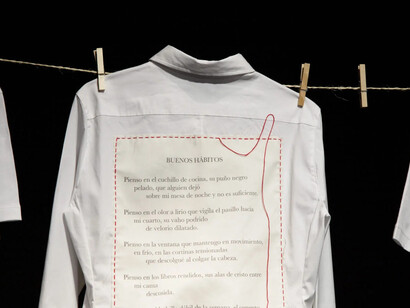
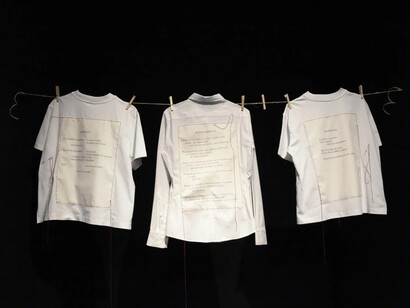
The installation employs a minimal material vocabulary: everyday clothing, red thread, poems printed on fabric, and a great deal of silence. In the book, every alternating poem is a Sunday. In the gallery’s Project Room, that alternation becomes visible and legible in space. The Sunday-poems are printed on T-shirts; the non-Sunday poems appear on collared shirts. The contrast—sweat versus starch—signals the two rhythms that shape our weeks: the exceptional that pulses and the ordinary that sustains.
The work is presented as two triptychs, six pieces in total, each with a different poem. Both triptychs maintain the order T-shirt, collared shirt, T-shirt, with the sleeves barely brushing one another to underscore the unity of the whole. The garments hang from clotheslines with wooden clothespins, arranged at two heights, generating perspective and a layered reading.
The clothesline is a recurring motif in Caballero’s work, symbolizing the act of accessing the transcendent through the mundane. This motif appears in other installations by the artist, such as Fifty Ways of Looking at a Poem, where the search for the transcendental is woven from the mundane.
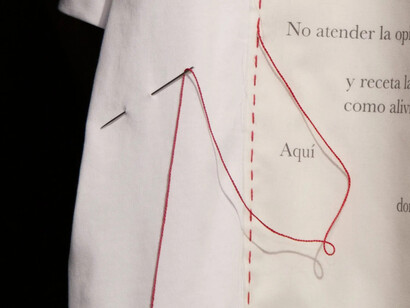
The poems are printed on fabrics, then attached to the backs of each garment with red thread. This stitching introduces the breath of the dash—a consistent symbol in the author’s work—as a bridge between verse and life. It does not illustrate; it sutures and underscores.
Placing the texts on the back recalls how the unsaid is carried, while the red also alludes to intertextuality, the act of writing over existing texts. At the end of the path, the needles hang, bearing witness to the manual labor and the effort of producing meaning in the face of the onslaught of time.
The architecture of the space—a narrow rectangle painted black—concentrates the gaze on the garments, accentuating the emptiness, or the unsaid, between its walls.
An audio track with the poet’s voice reading the same six poems printed on the garments accompanies the room. This overlap of visual and auditory reading creates an intimate, immersive experience, inviting each visitor to encounter poetry across multiple mediums and at their own pace.
From Sunday to Sunday transforms the common wardrobe into a poetic device: garments become invitations to read closer with each seam providing margins of meaning.