English
 Español
 Français
 Deutsch
 Italiano
 Português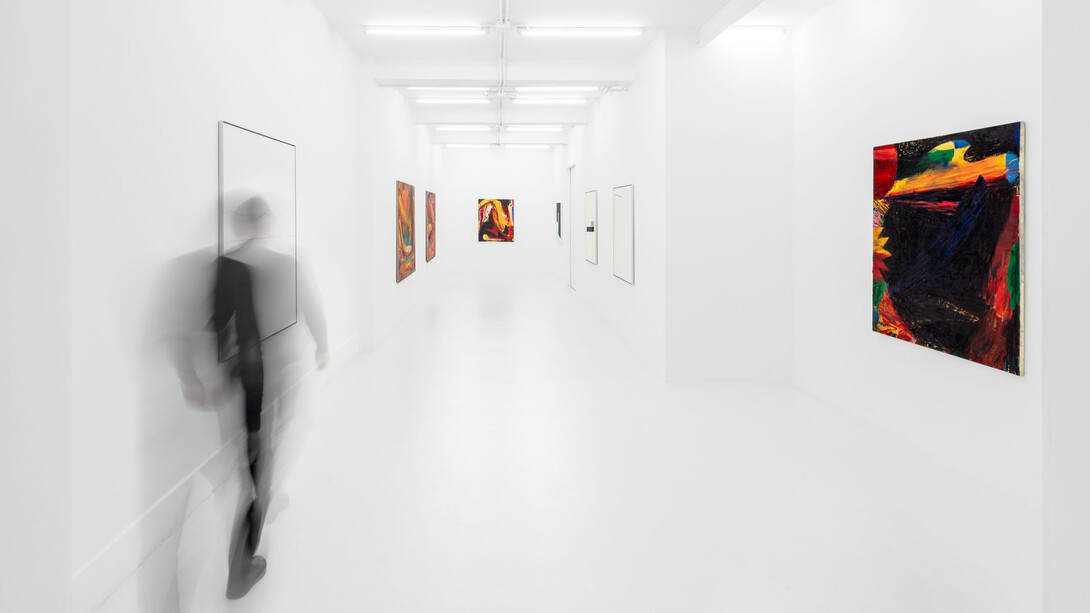
Casado Santapau is pleased to present Interstice, the first dual exhibition at the gallery by artists Diet Sayler (Romania, 1939) and Nelo Vinuesa (Valencia, 1980).
According to the dictionary, the term interstice refers to a small space that lies between two bodies or between two parts of the same thing. It can also be understood as an interval or a pause between two moments. It is a place of transition, an “in-between” that is not always visible, yet is essential for something to transform or move from one state to another.
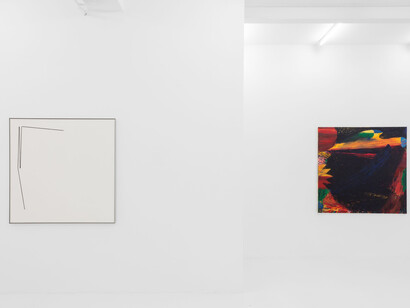
This idea of an intermediate space, of an active pause between two realities, gives the exhibition its title and meaning. Interstice proposes a dialogue between two very different yet complementary artistic languages, the structured geometric abstraction of Diet Sayler and the gestural, expressionist painting of Nelo Vinuesa. Between them, a shared territory emerges where stability and change, control and energy, coexist and remain in tension.
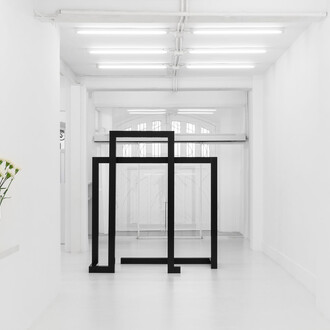
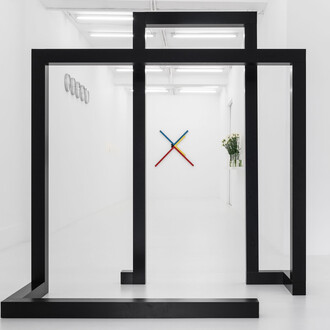
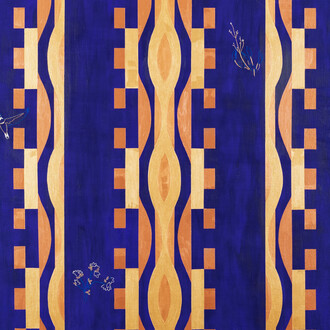
Diet Sayler’s work is articulated through a constructive logic that embraces instability as a constitutive part of form. In contrast to the tradition of Concrete Art, which aspired to an objective, depersonalized geometry, Sayler develops the concept of the Basic Element, a formal unit that emerges from the fragile balance between rationality and intuition, structure and emotion. In his works, color acquires body and spatial presence, shifting from the frontal plane toward a three-dimensional experience that alters perception. Chance operates in his practice as a structural force. It does not introduce chaos, but tension. Geometry remains, yet it ceases to be closed; the system stays operative, but opens up. The work becomes a field of forces where stability and instability coexist without resolution. The interstice appears here as a point of activation, a space where form is never fully fixed.
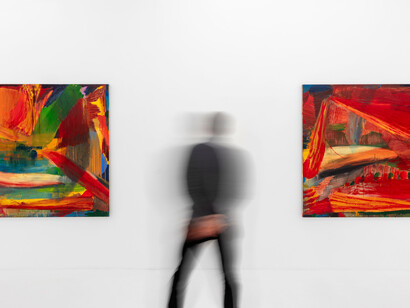
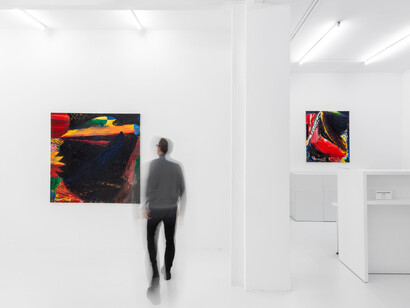
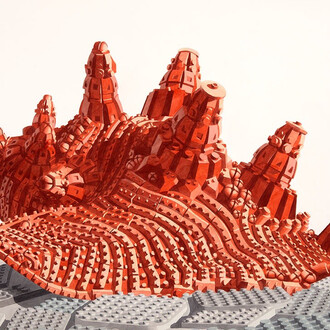
Nelo Vinuesa’s work occupies the opposite end of the system, that of gesture, body, and action. His abstraction is at once visceral and reflective. In his recent work, color acts as a living matter, expanding in successive layers where transparencies and superimpositions generate depth, vibration, and visual resonance. Gesture unfolds freely, marking an internal rhythm that runs through the pictorial surface, yet is always sustained by a tension between impulse and restraint. Painting is constructed as a space of sedimentation, where each stratum preserves the memory of the process and transforms action into visible form. Landscape is the backbone of his practice, understood not as geographical representation but as a metaphysical space. Pictorial matter appears in constant transformation, evoking telluric forces, geological processes, and states of eruption as metaphors for the human condition. The canvas becomes a record of passage, where the primitive and the technological coexist, and where the image presents itself as the visible result of energy in motion.
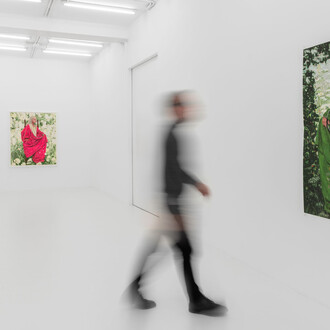
The exhibition space thus becomes a shared territory of productive instability. The works do not neutralize one another; rather, they activate each other. Geometry becomes charged with vulnerability, gesture encounters resistance. The viewer moves among bodies of color, vibrating surfaces, and formal silences, experiencing the exhibition as an open perceptual field without hierarchies or singular paths, where the interstice is constantly at work.