English
 Español
 Français
 Deutsch
 Italiano
 Português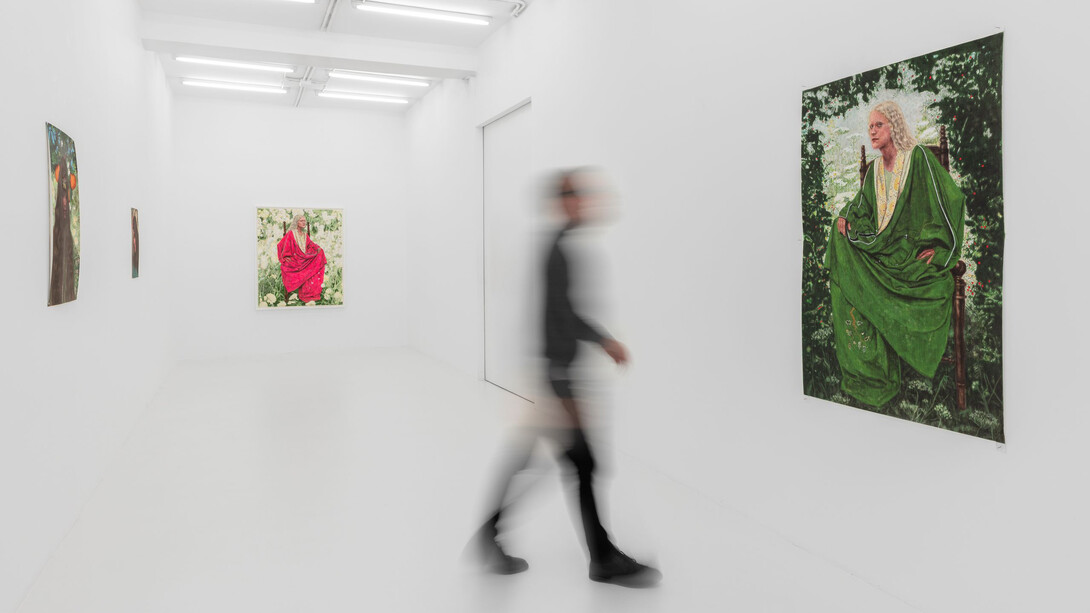
Casado Santapau is pleased to present To be at home in the world, the first solo exhibition at the gallery by Dutch artist Iris van Dongen (Tilburg, 1975).
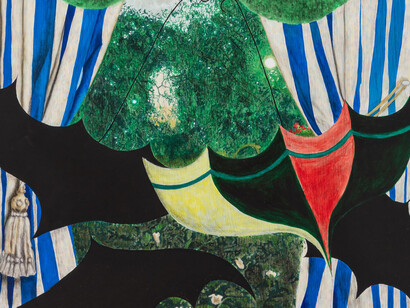
Through a practice that combines dry pastel, pressed charcoal, gouache and acrylic paint on paper, Iris van Dongen presents a series of new portraits in which she recomposes elements from different styles and cultures, from Asian art to Art Nouveau, shaping a new feminine iconography that revisits Pre-Raphaelite sensitivity through a contemporary melancholy. Her work offers a current perspective that dialogues with the legacy of Dante Gabriel Rossetti’s melancholic romanticism and Gustav Klimt’s golden theatricality, where introspection, beauty, and emotional tension intertwine with restrained delicacy. The ambiguous spirituality of Frida Kahlo and the dreamlike sensitivity of Odilon Redon also resonate in her imagery, amplifying the introspective character of her figures.
Among the works in this exhibition, the representations of Judith, the biblical heroine who decapitates Holofernes stand out. Far from a violent interpretation, van Dongen presents her as a symbol of determination, resilience, and autonomy. Van Dongen’s Judiths are neither victims nor avengers; they are witnesses of their time, women who gaze directly, defiantly, from the apparent fragility of graphite and pastel.
“I’m interested in what lies beneath the surface,” says van Dongen. “I work with paper as an intimate territory, vulnerable yet resilient. It’s there that the contradictions of the feminine are drawn: beauty and rage, serenity and strength.” This tension between the visible and the veiled, between technical delicacy and emotional density, becomes the guiding thread of her work.
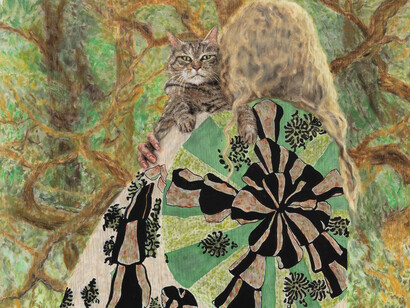
Van Dongen has developed a distinctive language in pastel portraiture, where the meticulous representation of reality intertwines with the transient; with restrained expression, vitality, and nostalgia. On the surface of her works, line and color blend to produce a texture that almost recalls the digital. Up close, one perceives a grainy, subtly pixelated quality reminiscent of the chromatic distortions of early-2000s digital cameras. This material paradox—between the manual nature of the stroke and the aesthetics of resolution—grants her figures a liminal presence, as if emerging from a vanished photographic archive or a forgotten SD memory card.
The past occupies a fundamental place in Iris van Dongen’s imagination. Far from approaching it as quotation or nostalgic exercise, the artist integrates it as another living presence in her work. Her portraits display extraordinary decorative richness and give central importance to representations of fauna and flora, evoking memories that connect the ornamentation and melancholy of Art Nouveau with the textiles of Indonesian Wayang shadow puppets. Her practice is woven into a network of cultural resonances—from the Asian imaginary to the ornamental sophistication of European Modernism, to echoes of Lana Del Rey’s pop nostalgia or the dark romanticism of Siouxsie and the Banshees. This intersection of languages shapes her singular voice, a web that serves as a vehicle for introspection. In her paintings, the arrested gesture and distant gaze transform the image into a kind of contemporary vanitas, where time—rather than recalling death—appears suspended in a balance between appearance and disappearance, celebrating the persistence of the ephemeral.
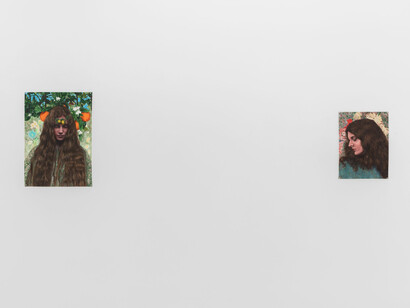
Ultimately, the female figure in Iris van Dongen’s work transcends the category of portrait. They are not representations of real people but projections of presences emerging from her own imagination. Each embodies an emotional state rather than a concrete identity, inhabiting a space between reality and memory. In this sense, these meta-portraits function as mental constructions, where the visible and the intimate overlap, revealing through a gaze their deepest intentions. Her figures seem to hold a silent conversation with the viewer—a gaze that, as in the most enigmatic portraits in art history, keeps alive the tension between mystery and revelation.