English
 Español
 Français
 Deutsch
 Italiano
 Português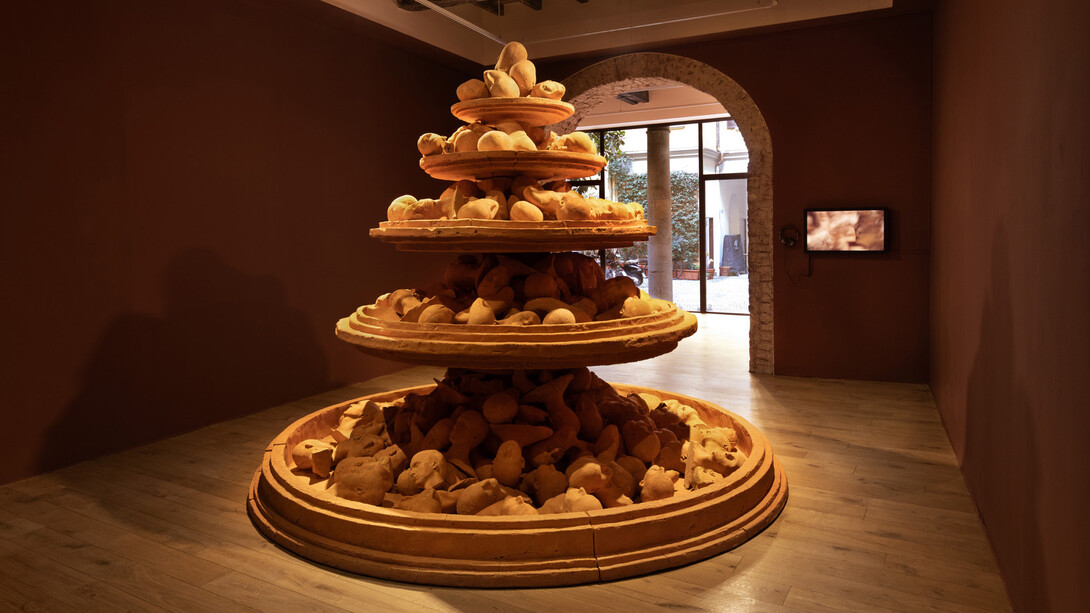
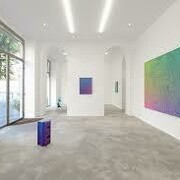
In these new relief works, the structure of memory resurfaces, now in a more eroded and tactile form. As a continuation of In the depths of memory, Van Veluw transforms memory into symbols that bear clear traces of wear and decay.
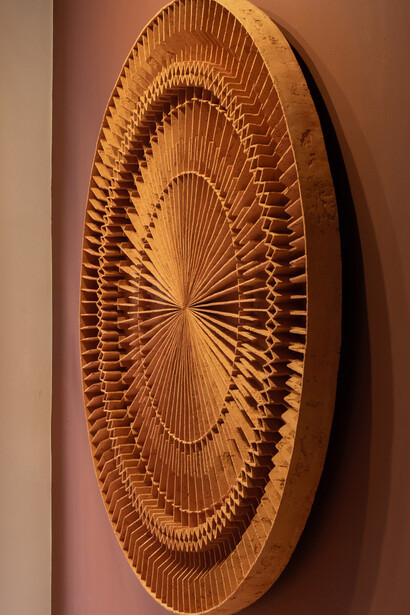
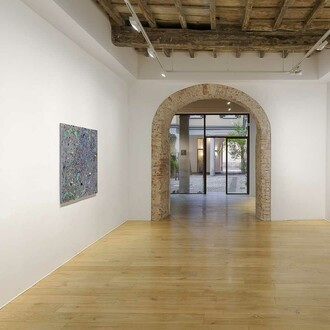
The circular reliefs clearly reference religious visual language, particularly rose windows that traditionally symbolize stability and cosmic order. Here, however, they are formed from dried clay, undermining their symmetry. Their dryness and crumbling texture suggest a future in which even spiritual symbols are subject to erosion. The works evoke a world in which drought transforms not only landscapes, but also the images through which we create meaning.
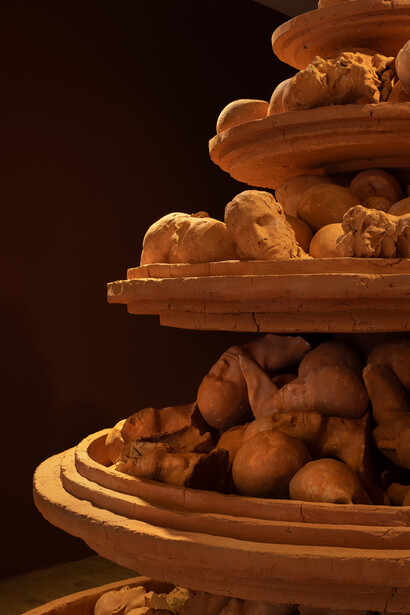
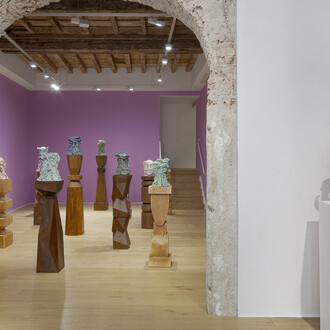
In a freestanding installation, we encounter the form of a fountain. Traditionally, the fountain symbolizes a source of life, with flowing water representing energy, renewal, and continuous movement. It also emphasizes the fleeting nature of the moment and the transience of life. Here, however, the clay is broken and cracked, clearly marked by the passage of time. Instead of water, the fountain’s basins are filled with the likeness of the artist himself. Two hundred and fifty sculpted heads form an apocalyptic image. Van Veluw merges associations of memory and identity, creating a disturbing and disorienting vision. Are we witnessing a future in which the fountain has taken on a new role within a spiritual ritual? Or are we looking at something that has been lost?
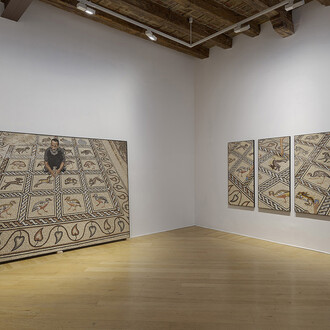
In the film, we see the artist caught in a neurotic creative frenzy, repeatedly modelling his own head in clay. As in a feverish dream, he desperately attempts to fill all the shelves in the cupboards behind him. Each time he believes he has completed the final shelf, another block of clay is already waiting, and the process begins anew. The scene recalls the myth of Sisyphus, condemned to endlessly push a boulder up a hill, only for it to roll back down again. Like Sisyphus, Van Veluw is literally trapped in the obsessive repetition of his creative drive. The creation of his own effigy becomes a quest for eternal youth or an impossible pursuit of immortality—an ambition that underlies the work of every artist.
In a relatively small work, we see a grid structure that appears to be collapsing on one side. Within this framework, small spherical forms are carefully arranged. As the structure disintegrates, order itself begins to disappear. The grid represents human control, while the rounded forms symbolize the containment of the natural. When the structure fails, this balance collapses.
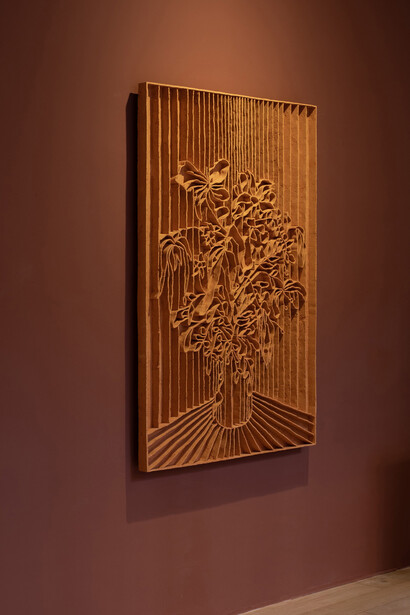
In the Remnant of bloom works, the motif of a floral arrangement is transformed into a sedimentary, fossil-like relief. Flowers—normally associated with vitality and ephemeral beauty—are presented here as residual forms: voids and edges in a surface that has lost its moisture. The use of dried clay emphasizes both the transience of nature and the fragility of memory, envisioning a world in which growth gives way to brittle remnants.