English
 Español
 Français
 Deutsch
 Italiano
 Português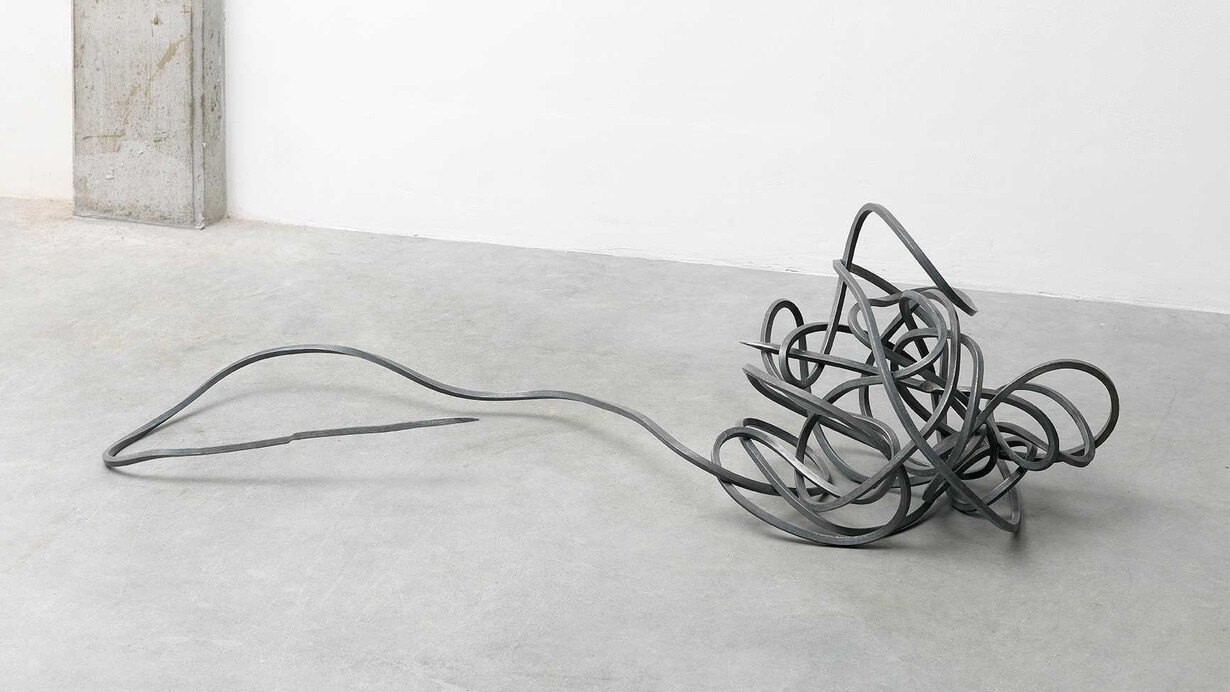
On December 19th, I was witness to a memorable event. Connected remotely from their respective cities – Paris, Pesaro and Brescia being the corners of a triangle – Sheila Hicks, Paolo Icaro and Massimo Minini discussed the show that this brief text aims to accompany. At the start of the online meeting, the only details known to all were the title, Live wires, and the invitation image, a steel blade draped in a bundle of coloured threads. This is how Massimo Minini had imagined the meeting between the two artists’ works: led by a visual and rational intuition, the gallerist had brought together Luogo della linea, the sculpture created by Icaro in 1969, and a colourful tangle of threads, an unmistakable reference to Hick’s practice.
I cannot tell how long the meeting was – maybe a couple of hours? –, but I clearly remember the exhilaration of those moments: Sheila, Paolo and Massimo’s faces framed by the squares of the videocall, the gestures, the visions and the shared questions formulated in English as a lingua franca, the wordplay, the attempts at mediation to channel the flow of thoughts arising from the meeting between artists and gallerist. I was connected from Spoleto; as an enraptured and amused voyeur, I listened to Hicks, Icaro and Minini – in order of birth: 1934, 1936 and 1944 –, three lighthearted youths toying with ideas, no fear whatsoever but, on the contrary, quite excited as they imagined the works to exhibit and the possible installations. It is thanks to this spontaneous and unique happening that I had the privilege of witnessing the birth of an exhibition.
Live wires has taken shape through something very similar to a game. It is no coincidence if the onset of this project brought to mind a ping-pong game, where the artists’ suggestions bounce back and forth from one end of the table to another. Likewise, I find another sports metaphor equally appropriate, i.e. two players from different disciplines – say, a tennis player and a volleyball player – who meet up in the park to hit the ball around, each with their own “tools of the trade”. In fact, Hicks and Icaro seem to play sports with few affinities, with the former favouring soft materials, vibrant colours and a somewhat visceral representation of form, while the latter creates works which are definitely more sculptural, whose chromatic vibrations are controlled and where the elements used seem to have a more solid appearance. Still, reducing the comparison to a mere contrast between two different approaches to art – one “feminine” and one “masculine” – would be a rather oversimplified interpretation.
The differences are clearly evident when we look at the works on display, as are the affinities, which in some cases are manifestly obvious. Many are the “rules”– and this is my last association with sport – that Hicks and Icaro have in common. The first is undoubtedly the “ductility” of the artwork: both artists tend not to crystallise their works, but rather consider them as organisms that can mutate over time and even hybridise, as can be inferred from the freedom granted to Massimo Minini to create the image for the invitation to the exhibition. In addition, both Hicks and Icaro are formally attracted to masses that tangle or intertwine following a sort of spontaneous accumulation. It is true that the materials they use to create these forms are almost polar opposites in terms of “compactness”, and yet both of them mostly adopt elements, e.g. plaster, lead, textiles and discarded garments, etc. that do not boast a noble origin or affected preciousness. I also find that, in both artists practice, the exhibition space should be construed as part of the work itself. Regardless of the environment where the works are exhibited, be it a museum, a gallery or an abandoned place, Hicks and Icaro tend to react to the conditions dictated by the context, not to meet these conditions neutrally, but to highlight their characteristics, verticality and breadth, making sure that the work constructs the space instead of being constrained by it.
Ultimately, if I had to choose a distinctive feature for both of them, I would not hesitate: Hicks and Icaro are artists with an unshakeable faith in the process, in the relationships between the works, the places and the energy of the people who move around them, according to the principle of “doing, redoing, undoing” (not necessarily in this order) leading to results that are hardly ever final. From this perspective, I believe that both artists wholly embody that attitude – fostered in the seventies and still fully in vogue today – which sustains that a work can slough off its old skin and, leaving the studio, get a new lease of life with every exhibition.
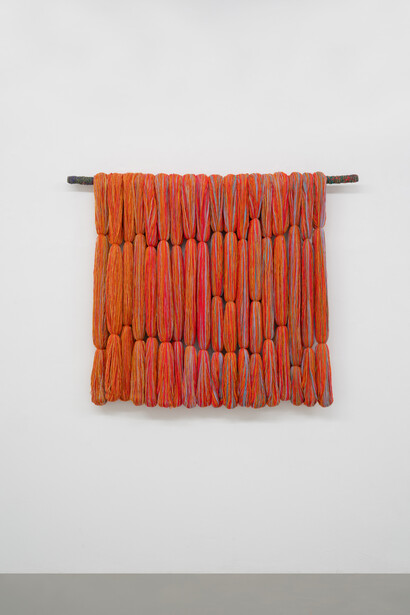
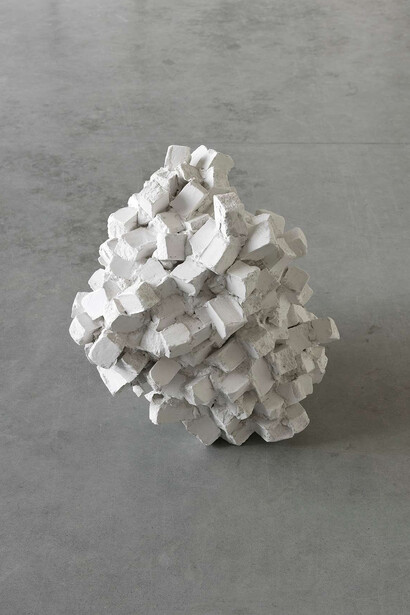
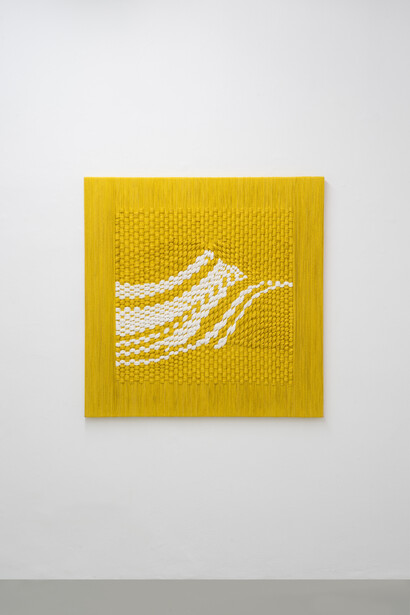
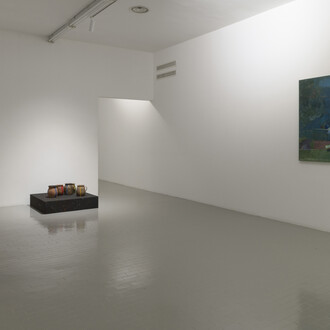
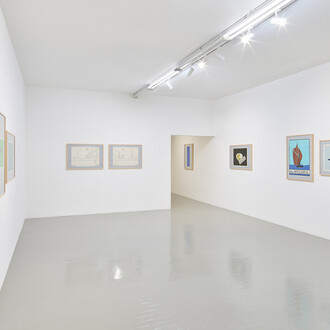
This is the reason Hicks and Icaro have welcomed Minini’s invitation, since it is to his vision – or, I should say, visual intelligence – that we owe this unprecedented double solo exhibition. The installation makes tangible some of the similarities between the artists. Firstly, the works that welcome the visitor, a piece of paper and a piece of fabric, as well as sharing a relatively small format, both contain brownish chromatic notes; the rest of the works on display within the same room are all characterised by an idea of suspension and levitation, almost as if they were all taking a leap at once. The second room shows a face-to-face dialogue between two types of nets, featured in Hicks’ The captured comrades, 2026, and Icaro’s Cumulo Rete, 1968, whose physical composition and arrangement are, however, significantly different. In the third gallery room, Attempt en escape (2025) and Torciglione (1963) induce a similar physical tension based on torsion; My echo surrounds you (2025) and Cubical molecular (1978), although the first is wall-mounted and the second placed on the floor, share a sort of accumulation based on white, almost as if Icaro’s aggregation of particles, had sprung from the floor onto Hick’s “canvas”; that same white-yellow wave seems to flow onto the brass of Linea tesa (2018), then thrust, again with an upward movement, towards Radiating speech (2025); both works are crossed by a concentration of forces. In the last room, the visitor is faced with a confrontation – a debate, more than a dialogue – between Impertinence en vacances (2025) and Percorso neuronale (2011), works that resemble entangled organisms, rather reminiscent of illegible drip calligraphies traced in space, but made from different materials. It is remarkable how, in some cases, Hicks and Icaro’s works manage to talk to and resemble each other, just as the faces of two individuals who might not look alike at all but who, having some features in common or a similar expression, end up being superimposed. It is true that the most sublime and surprising analogies are found when we try to find similarities between things that at first glance seem distant.
The text you are reading does not want to be a slavish guide to the exhibition. As I write, the choice of works and installation are still in progress and we cannot rule out – if fact, you can bet on it – a last-minute change of mind, a dernière touche by the artists, probably just before the opening… As a matter of fact, it would be very much in line with the genesis of Live wires, true to the nature of the title: an exhibition made of intertwined threads and live wires (stressing the “dangerous” side of the relationship), of vital connections and resonance, of playful things. In this regard, I wish to emphasize the childlike nature of Hicks and Icaro. “We spent our time looking out the window” – Sheila tells us about her travels across the United States with her parents and brother during the Great Depression – “playing, picking up things wherever we stopped […]. It was a form of improvisation and bricolage, from one city to another.” A feeling that tastes of wonder and awe, also expressed by Icaro in La favola della favola (1974), a very short, ingenious text – almost a stream of consciousness – which reveals the birth of the artist:
One day, a sun and a moon, a weariness, an address without a ribbon, a pot of geraniums, a staircase with marble steps, an accountant’s office, a nearby street, a dangerous house, best wishes: here comes the push, the light. The struggle of the shadeless climb, breathing, again, here comes the cough, the slap, the loud cry, the stiches in the navel healing quickly, coiling and vibrating while waiting, sounds, my father plays the piano, my mother cooks, inside I heal the stitches of a thousand petals, so I do. Everything is a fairy tale. I am under the impression that Live wires keeps those childhood memories intact; moreover, I believe that it arises directly from those memories. Like children, Hicks and Icaro’s works have met in the space of the gallery and, after playing with each other, are temporarily resting, waiting to get going once more. Who knows if they will meet again, in times to come. As far as I am concerned, all I know is that I would like to take part in a thousand more videocalls like the one where I saw two emerging artists and a young gallerist create an exhibition in front of my astonished eyes.
(Saverio Verini)