English
 Español
 Français
 Deutsch
 Italiano
 Português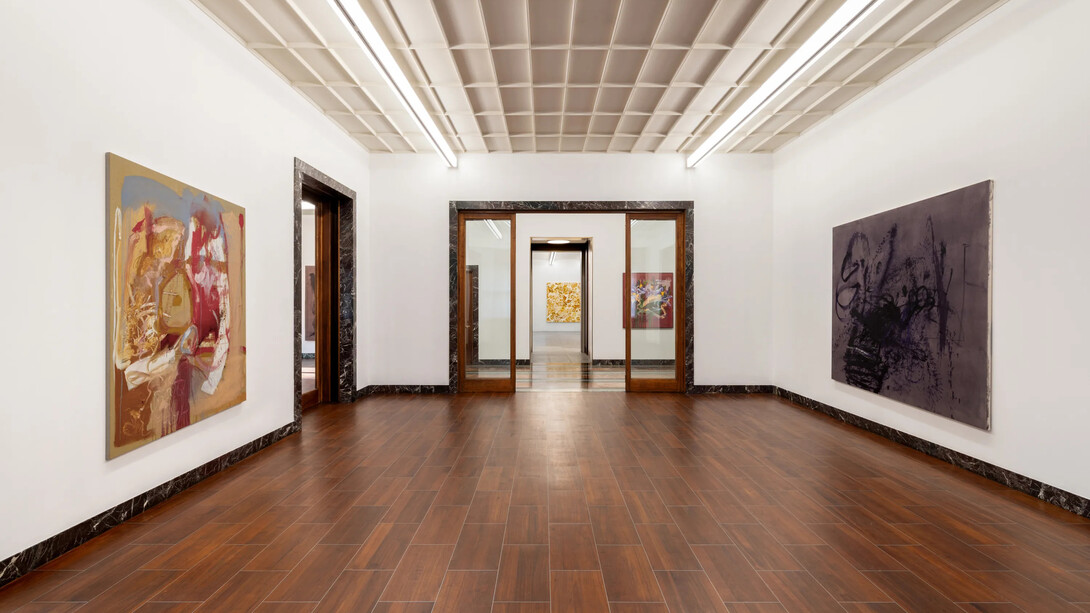
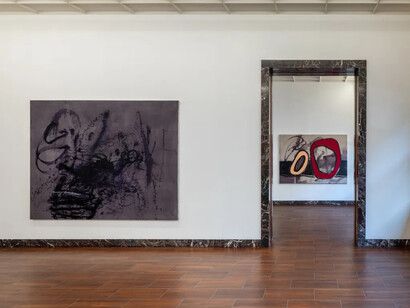
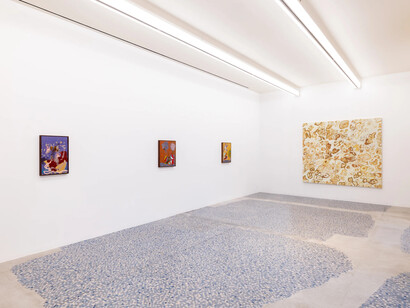
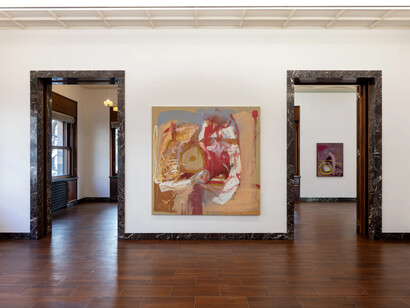
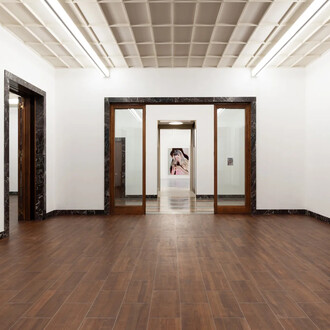
Massimo De Carlo is pleased to present Something borrowed, something plum, Austyn Weiner’s first solo exhibition in Milan.
The title plays on the Victorian wedding tradition, but the expected blue is replaced by plum, a purple so dense it feels more like a mood rather than a color.
Weiner describes the arrival of plum as involuntary. Returning to the studio after loss and celebration collided, the color took over the work, emerging organically and with little mediation, as if it had been waiting its turn. The palette narrowed accordingly: plum for the weightier parts of memory, flashes of yellow for joy and, in her words, “a kind of self-portrait.” Over time, that purple became the color of her recent life - a period shaped at once by loss and love, nostalgia and repair. In many Eastern traditions, the plum stands for perseverance through hardship; here it sharpens into a visual terrain of its own, a surface shaped by emotional impact.
The exhibition brings together two cycles of paintings made roughly a year apart. At their centre sit two anchor works: one devoted to grief, the other to her wedding. “I needed an outlet to process both things,” she says. What emerged were fiercely direct, formally divergent paintings: one executed without brushes, almost carved into being by pressure and gesture; the other layered and atmospheric, its lace-like passages recalling her earlier floral vocabulary. Two events, two modes of working, two incompatible temporalities forced to coexist.
Between these poles unfolds a broader cosmology of memory, in which the past becomes something narrated rather than simply endured. “When you’re processing memory in the rear view,” she explains, “you then become a narrator… The show almost lives in the past and then in the future - I completely omit the present.”
As the exhibition progresses, the later paintings loosen their grip on autobiography and edge toward landscape - though a landscape unsettled by impact. Weiner describes them as an attempt to imagine “what happens to our landscape upon impact” and what kinds of apocalyptic forms might emerge. Some canvases tilt toward embryonic shapes, tentative and future-facing, others appear like horizons briefly held in place. If the earlier works speak from within the event, the later paintings map its aftermath.
One painting – Rewind - carries a set of oversized Walkman buttons along its lower edge: rewind, pause, play. They sit like the tombstones of a former way of listening. Weiner notes that processing loss in hindsight means not only revisiting a person but revisiting “a whole life” - its textures and soundtracks.
Her writing threads through the exhibition as a parallel form of mark-making. The first grief painting began with a poem, and many notes from this period hover between observation and confession.
This porousness between forms is central to Something borrowed, something plum. The paintings channel the immediacy of gesture; the poems capture the thoughts that run underneath it; the symbols and fractured landscapes map the distance between experience and interpretation. Together, they reveal an artist testing how far a feeling can extend - across color, across time, across the surface of a canvas.
The show lingers in the space before and after an event, when emotion starts to harden into structure. The paintings don’t resolve the dualities that formed them - grief and wedding lace, plum and yellow, rupture and repair. They just let these forces share a surface, long enough to show their edges. For Weiner, holding them there is also a release: a way of setting the past down so something new can begin.