English
 Español
 Français
 Deutsch
 Italiano
 Português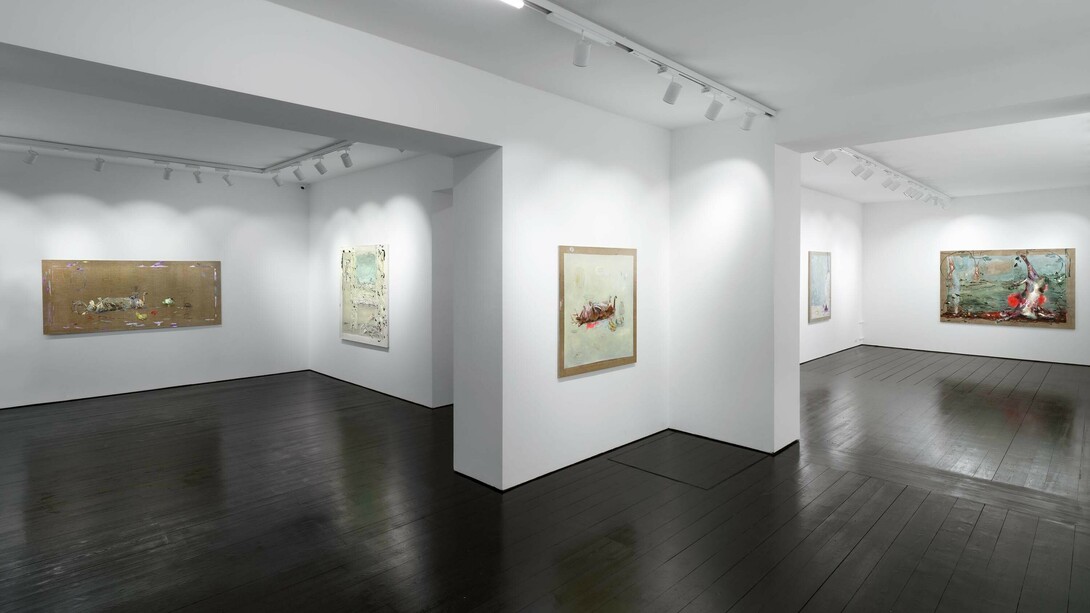
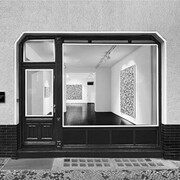
Contemporary Fine Arts is pleased to present Paradise news by Finnish artist Anna Tuori – her first exhibition with the gallery.
The painting practice of Helsinki-based artist Anna Tuori (b. 1976) unfolds within a field of tension between visibility and concealment. Her works revolve around the question of how reality is experienced – and whether it often reveals itself only indirectly: through imagination, projection, and illusion. In Tuori’s work, reality does not appear as a stable or clearly legible condition, but rather as something fragile, contradictory, and subtly unsettling. Accordingly, she approaches it not through rational explanation, but through a deliberate embrace of ambiguity, multiplicity, and paradox.
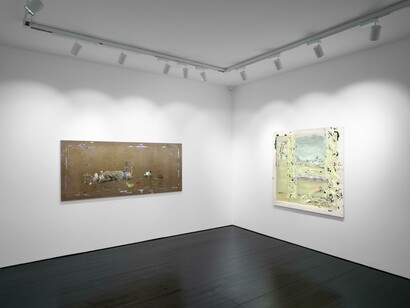
This attitude translates into a painterly language in which clear boundaries dissolve: between interior and exterior, surface and depth, pictorial space and canvas. Multiple layers seem to slide into one another without settling into a fixed hierarchy. In works such as Getting the wind back, this play with perception becomes especially apparent. Are we looking from an interior outwards – or does the gaze instead turn inward? The curtain through which we look remains permeable, undermining any notion of a clearly defined threshold. Perception hovers; orientation becomes unstable.
Formally, Tuori’s paintings bring together distinct painterly vocabularies. Transparent, almost immaterial layers of acrylic coexist with dense, corporeal passages of oil paint. Painting emerges as an open, process-based field in which formal, emotional, and expressive registers operate simultaneously. Tuori often develops her images from abstraction – as compositions of color, rhythm, touch, and light that remain receptive to the unforeseen as they evolve. Central to this process is the brushstroke, visible as a trace of hesitation and resolve alike, functioning as an index between reality and illusion, control and loss of control.
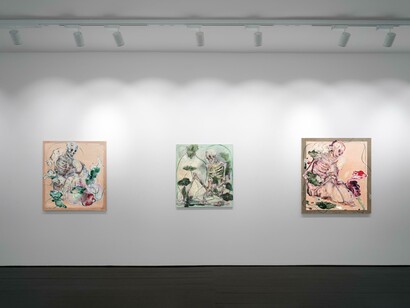
Conceptually, Tuori’s works engage in a loose yet deliberate dialogue with the tradition of still life, and in particular with the memento mori. This art-historical genre, which since the 17th century has addressed transience, temporality, and the fragility of human existence, is not quoted directly but reimagined in a contemporary register. In Smell of Green, a skeleton sits slumped in exhaustion in the lower right corner of the painting, entwined by lush ivy leaves. The skeleton functions as a classic emblem of mortality, while the evergreen ivy traditionally symbolizes endurance and renewal. In the confrontation of these opposites, a new form of still life emerges: the interior – the lifeless – turns outward and merges with ideas of continuity, growth, and cyclical time.
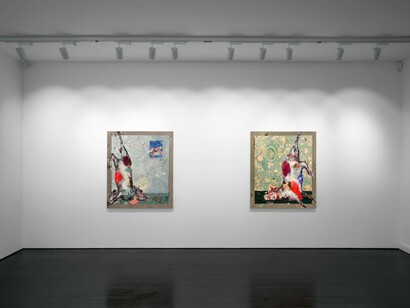
In The milk train doesn’t stop here anymore, the body of a cow comes into focus as a bearer of existential meaning. The animal motif is not deployed for overt shock value, but rather as an ambivalent reference to vulnerability and finitude. In this emphasis on a depersonalized body – at once massive and fragile – parallels can be drawn to Francis Bacon’s depictions of carcasses and flesh, in which organic matter oscillates between presence and dissolution. By choosing an animal instead of a human figure, Tuori deliberately shifts the expression of this existential condition toward the universal. The absurdity of the present is not personalized, but abstracted. At the same time, this distance opens up a different, less immediate form of empathy – one grounded not in individual identification, but in a shared vulnerability.
![Various artists, [ materialistin ], exhibition view. Courtesy of Hamburger Bahnhof](/attachments/fd8f4fd76b73be0a02d398535c29d017e1309b65/store/fill/330/330/3f54331fd7869a13166dfe67a9e91306c6e180b2e29b9fd308d958b87ad2/Various-artists-materialistin-exhibition-view-Courtesy-of-Hamburger-Bahnhof.jpg)