English
 Español
 Français
 Deutsch
 Italiano
 Português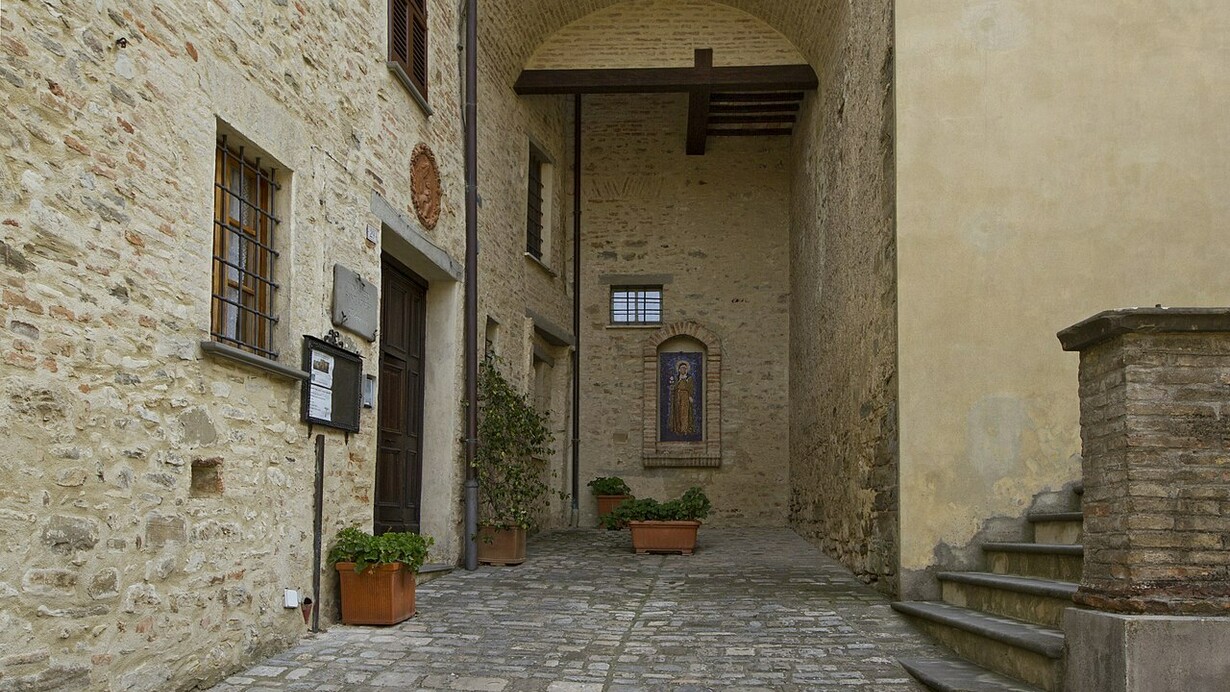
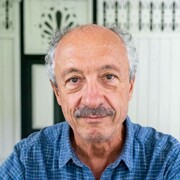
This is the second part of the interview with Mirco Rinaldi, mayor of Montone, after which I'll offer some insights. Those who haven't read the previous articles on the same topic can find them here.
From what I've seen, I'd say that here, despite the beauty of the place and the various cultural initiatives, you haven't yet been affected by the negative aspects of mass tourism.
Rinaldi: It's true, and this is because we try to offer quality events, we are very careful about this, because quality brings quality tourism that does not spoil the environment and does not cause crowding.
I'd like to reiterate how culturally active the residents of Montone are: there are many associations, a band, a music school, a theatre with a winter season, the municipal museum, the San Francesco museum, a library with an archive, a choir, and the Proloco (local tourist board) that works year-round with the Palio dei Rioni, a historic pageant that requires extensive research. This too is an important aspect of social interaction. Cultural interaction is important for living in a united community; the synergy between associations, citizens, and the administration enhances the sense of belonging to one's community, one's territory, one's country.
So one way to bring villages and small communities to life is through culture.
Culture, of course. We recently renovated the former slaughterhouse, where we'll create another cultural space. It's a two-story building. The ground floor will house children's play areas, a meeting place for young and old, and a space for various associations to hold their activities. On the first floor, we'll open a small 50-seat cinema, because it seemed absurd not to have one, especially considering we've been organizing an international film festival for 30 years. We also inaugurated an indoor tennis court and built covered stands for the stadium, along with an LED system to save energy when playing at night. And, again, some young people are forming an association to manage the facility.
And where do you get the resources from?
We find them through contributions from regional, national, and European calls for proposals.
There are several that you can access, but you need to constantly monitor the sites where these calls are promoted, and all of us in the administration try to be very careful about them.
Services are essential to ensure that people remain in small towns and do not seek alternative solutions in cities.
We also have a private nursery school. It's private because we tried with the National Plan for the Development of the Italian Regions (PNRR), which would have funded a 06 school, which was our goal. However, the funds provided by the PNRR are for schools built on flat land, while we live on a hill, and this means excavating the land and strengthening the slope. So we were short 700,000-800,000 euros. In fact, this PNRR 06 call for proposals always went unsold, but in Rome they didn't understand there was a reason.
I think your strength is certainly the beauty of the place, which attracts both foreigners and informed tourism, but also the fact that you organize valuable cultural activities and that you have understood the need for an office, or at least several of you, who keep abreast of the various calls for proposals that come out.
For a small municipality, this is essential; otherwise, it becomes difficult, if not impossible, to survive on our own resources.
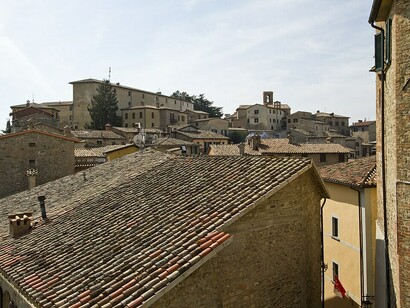
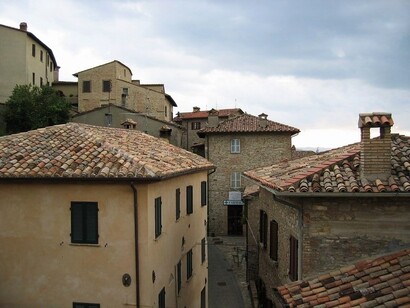
This was the meeting with the incumbent mayor of Montone, a wonderful village in the province of Perugia.
As you've read, this municipality, despite the challenges facing small communities, has so far managed to retain most of its residents, avoiding the dispersion that typically occurs in rural Italian villages, where young people, especially, seek the comforts of city life. And it's doing so by fostering a social and cultural awareness that, among its many indisputable benefits, also maintains a certain cohesion among its residents. They become aware of the value of their town and not only renew past traditions through the various events they organize, but also develop a strong civic and social sense among young people.
But we must also be objective: this village has indisputable advantages that other Italian towns lack. Aside from the beauty of its town and landscape, it is also fortunate to have a highway that passes just a few dozen meters from its industrial area, which, in turn, is located far from the historic center. Fortunately, this is not within the reach of many other similar towns.
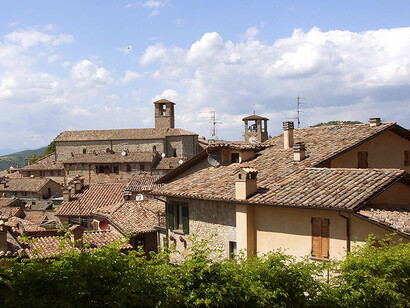
Nearby, for example, on a prominent hill, lies the village of Santa Maria Tiberina, another of Italy's wonders we owe to those who came before us. This village rivals Montone in architectural beauty, but it's not as close to the SS3bis. Therefore, its industrial area hasn't been able to develop, and indeed, the few industries that once existed have closed over the years.
But even there, as in Montone and many other small towns on the peninsula, foreigners have arrived and are buying the most beautiful homes in the historic centre. And young people are leaving for the reasons listed by the mayor of Montone.
Most of our territory is hilly or mountainous, and many of our small medieval towns are located on high ground, strategic points given the conflicts our municipalities faced at the time. As Mirco Rinaldi has said, national political decisions should consider the diversity of our regions. Diversity in both soil type and morphology and in the size of the towns.
But our institutions should address not only this but also the phenomenon of rising house prices in historic city centres, due to the growing number of foreigners who see our smaller towns as an opportunity both for investment, when they open tourism businesses—very often for the exclusive use of their own compatriots, as we have seen—and for owning a beautiful home in an Italian village for vacation or retirement. This consequently forces young families to move to the outskirts of major cities, unable to afford a home in their relatives' towns due to excessive prices.
I realize this might be a difficult problem to solve, but I'll draw inspiration from some realities I know personally.
In Egypt, a foreigner can't buy a house, but they can rent it for 50 years, after which they must vacate it. Nor can they bequeath it to anyone else.
In India, a non-Indian can buy a house, but only by establishing a partnership with an Indian citizen who will own 51%. If countries do this where, frankly, the homes are of very little value and architectural interest, why not consider similar solutions in Italy, where the beauty of our historic homes is unquestionable?
As I wrote in my first article, I only examined the sale of ordinary residential houses, and, deliberately, I left out the stately homes, castles, and convents, which are also following the same fate.
I don't want to sound chauvinistic; I wanted to highlight a situation that has been quietly developing for several years and is spreading throughout Italy.
I wonder if it isn't time for our politicians to reflect on what is happening and understand the long-term implications of this phenomenon, especially for our young people.